Diagnostic performance of non-contrast quiescent-interval slice-selective (QISS) magnetic resonance angiography for evaluation of the renal arterial vasculature compared to computed tomography angiography (CTA) as reference standard
Patrick Ghibes, Florian Hagen, Petros Martirosian, Stephan Ursprung, Konstantin Nikolaou, Daniel Raskin, Abraham Levitin, Levester Kirksey, Sasan Partovi

TL;DR
This study compares non-contrast QISS MRA with CTA for evaluating renal arteries and finds that QISS MRA has similar diagnostic quality and detects most anatomical variants.
Contribution
The study evaluates QISS MRA's diagnostic performance for renal arteries against CTA, focusing on anatomical variant detection.
Findings
QISS MRA showed excellent diagnostic accuracy in detecting 19 out of 20 anatomical variants in renal artery branching patterns.
CTA had significantly higher signal-to-noise ratio than QISS MRA, but QISS MRA had higher contrast-to-noise ratio.
Both QISS MRA and CTA provided similar vessel diameters and high diagnostic confidence.
Abstract
To evaluate the diagnostic quality and detection of anatomical variants in branching patterns of the renal arteries for non-contrast quiescent-interval slice-selective (QISS) MR Angiography (MRA) compared to CT Angiography (CTA). Patients who underwent a QISS MRA of the renal arteries as well as CTA as reference standard were included in this retrospective study. Signal-to-noise ratio (SNR), contrast-to-noise ratio (SNR), and vessel diameter were determined in the left and right renal arterial systems. Image quality and diagnostic confidence were assessed with a standardized five-point Likert scale. Sensitivity, specificity and accuracy for the detection of anatomical variants in branching patterns (accessory renal artery, aberrant renal artery and early branching) of the renal arterial system were determined compared to CTA as reference standard. 30 patients (59 renal arteries) were…
Genes, proteins, chemicals, diseases, species, mutations and cell lines named across the full text — each resolved to its canonical identifier and authoritative record.
Click any figure to enlarge with its caption.
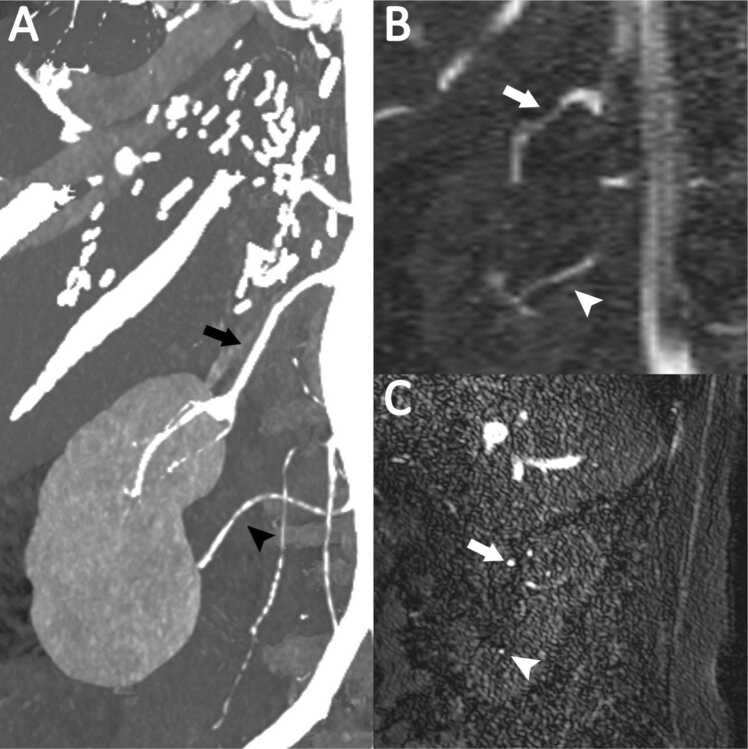 Figure 1
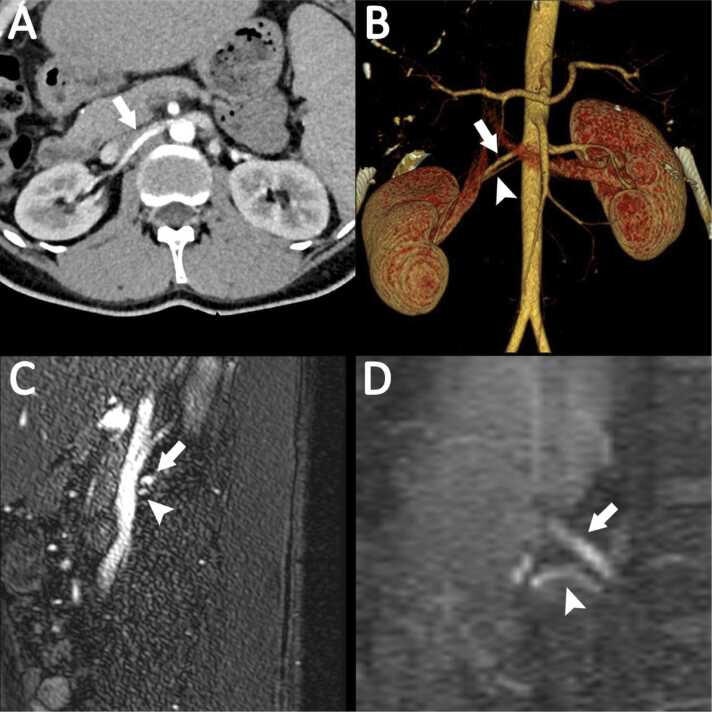 Figure 2
Peer Reviews
No public reviews on file for this paper yet. If you reviewed it on a platform where reviews are public (OpenReview, ICLR, NeurIPS, ICML), you can paste yours below so the community can read it here.
Videos
No videos yet. Explain this paper in a talk, walkthrough, or lecture? Add one.
Taxonomy
TopicsRenal and Vascular Pathologies · Pediatric Urology and Nephrology Studies · Renal Diseases and Glomerulopathies