Reversible and Massive Structural Transformation in Meltable Cyanido‐bridged Coordination Polymer Crystals
Yuudai Iwai, Saaya Kimura, Manabu Nakaya, Takanori Nakane, Akihiro Kawamoto, Genji Kurisu, Yuta Tsuji, Kenji Hirai, Koji Kimoto, Ovidiu Cretu, Fumitaka Takeiri, Kunihisa Sugimoto, Benjamin Le Ouay, Masaaki Ohba, Ryo Ohtani

TL;DR
Scientists created a new type of coordination polymer crystal that melts at a surprisingly low temperature and can transform back to its original form when exposed to water vapor.
Contribution
A novel 3D coordination polymer with an unusually low melting point was synthesized and shown to reversibly transform upon hydration.
Findings
A melting composite of KCd[Cu(CN)2]3 and K2Cu3(CN)5 was synthesized via dehydration.
The composite melts at 559 K due to surface effects and low-coordinate Cu centers.
The material reversibly transforms between dehydrated and hydrated forms via water vapor exposure.
Abstract
Cyanido (CN−)‐bridged coordination polymers (CP) have been extensively studied as molecular‐based functional materials. However, synthesizing 3D compounds composed only of metal ions and CN−—without bulky organic groups—and that melt before decomposing remains a considerable challenge. This difficulty arises because CN− strongly interconnect metal ions, forming rigid, dense frameworks with high melting points. In this study, we successfully synthesized a melting composite consisting of 3D KCd[Cu(CN)2]3 and 2D K2Cu3(CN)5 by dehydrating K2Cd(H2O)Cu4(CN)8·1.5H2O. Remarkably, nanodomains of these two compounds coexisted within single particles, allowing their crystal structures to be independently determined by 3D electron diffraction (MicroED) of the resulting powders. Each compound melted at its respective melting point, around 559 K. Notably, the melting point of KCd[Cu(CN)2]3 is…
Genes, proteins, chemicals, diseases, species, mutations and cell lines named across the full text — each resolved to its canonical identifier and authoritative record.
Click any figure to enlarge with its caption.
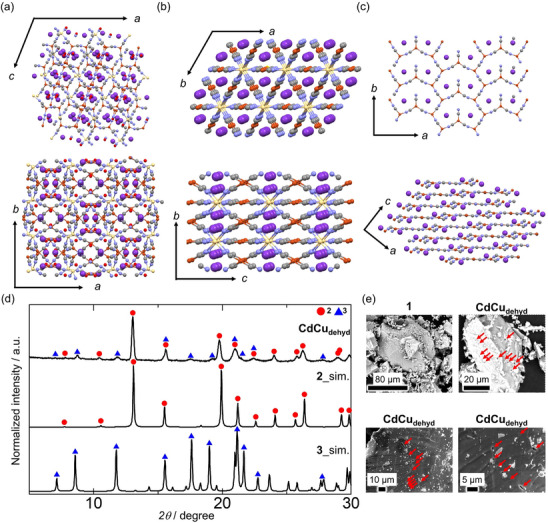 Figure 1
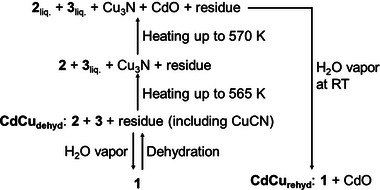 Figure 2
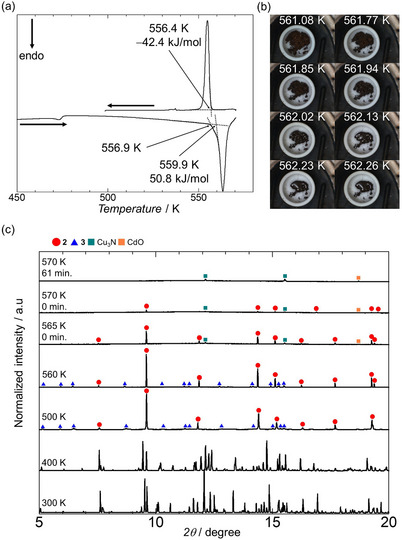 Figure 3
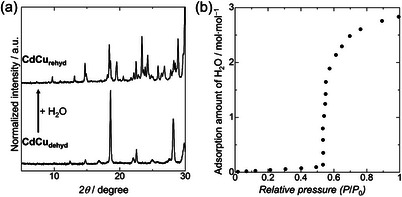 Figure 4
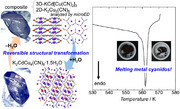 Figure 5
Peer Reviews
No public reviews on file for this paper yet. If you reviewed it on a platform where reviews are public (OpenReview, ICLR, NeurIPS, ICML), you can paste yours below so the community can read it here.
Videos
No videos yet. Explain this paper in a talk, walkthrough, or lecture? Add one.
Taxonomy
TopicsMetal-Organic Frameworks: Synthesis and Applications · Magnetism in coordination complexes · Thermal Expansion and Ionic Conductivity