Enantioselective Route to Terminal 2,3‐Epoxy Tosylates Enabled by Cooperative Organocatalytic Desymmetrization of 2‐Substituted Glycerol Derivatives
Armando Astone, Sara Meninno, Alessandra Lattanzi

TL;DR
Scientists developed a new method to create complex epoxy compounds with high precision using common catalysts, enabling the production of valuable chemical structures.
Contribution
A novel enantioselective synthesis of 2,2-disubstituted 2,3-epoxy tosylates via cooperative organocatalytic desymmetrization.
Findings
The method produces (R)- and (S)-epoxides with up to 87% yield and 76% ee.
The p-toluensulfonate anion acts as both leaving group and nucleophile, affecting conversion but not enantioselectivity.
The epoxides are versatile intermediates for making functionalized products and N-heterocycles.
Abstract
A first enantioselective synthesis of challenging 2,2‐disubstituted 2,3‐epoxy tosylates has been developed via an organocatalytic desymmetrization reaction of bis tosylated 2‐substituted glycerols. The intramolecular nucleophilic substitution has been cooperatively catalyzed by commercially available mixtures of L‐diphenyl prolinol and (R,R)‐α,α,α’,α’‐tetraphenyl‐2,2 disubstituted 1,3‐dioxolane‐4,5‐dimethanol (TADDOL) or the enantiomeric couple, leading to (R)‐ and (S)‐epoxides in up to 87% yield and 76% ee. Reaction monitoring highlighted the double role of leaving group and nucleophile played by the p‐toluensulfonate anion, which was found to be responsible of epoxide ring‐opening back to the reagent. The latter process affects the conversion to the epoxide, but marginally the enantioselectivity. These uncommon epoxides, bearing a quaternary stereocenter, demonstrated to be versatile…
Genes, proteins, chemicals, diseases, species, mutations and cell lines named across the full text — each resolved to its canonical identifier and authoritative record.
Click any figure to enlarge with its caption.
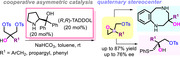 Figure 1
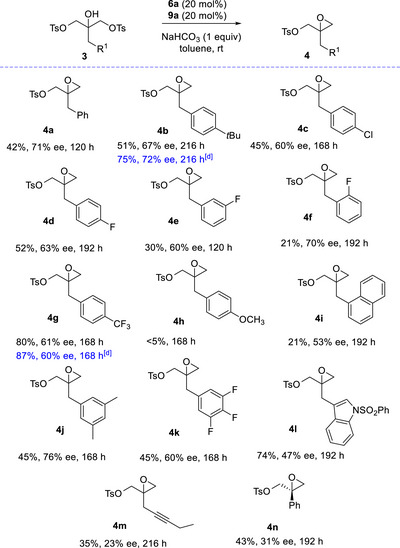 Figure 2
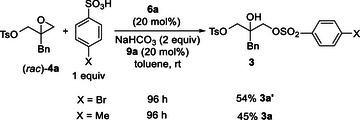 Figure 3
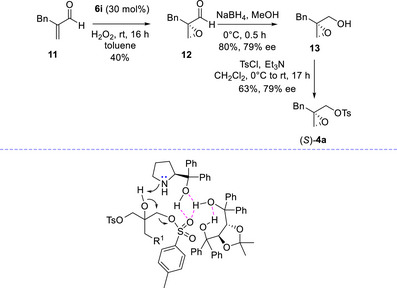 Figure 4
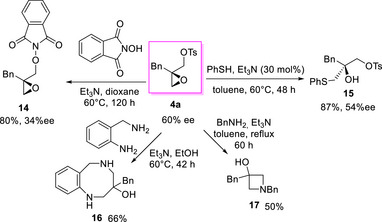 Figure 5
 Figure 6
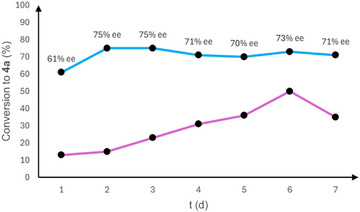 Figure 7
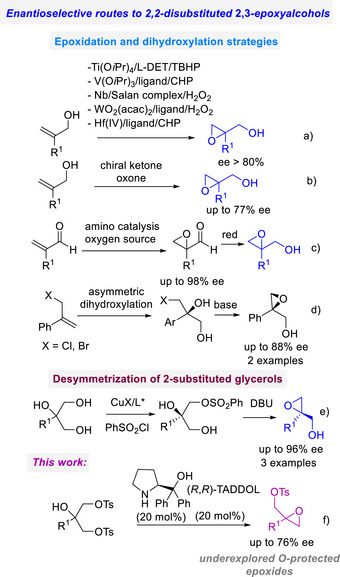 Figure 8
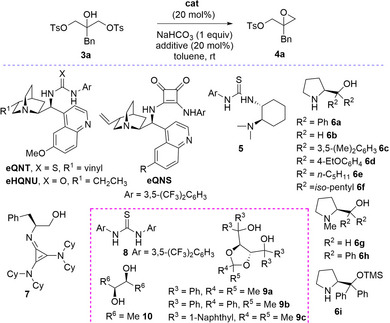 Figure 9
Peer Reviews
No public reviews on file for this paper yet. If you reviewed it on a platform where reviews are public (OpenReview, ICLR, NeurIPS, ICML), you can paste yours below so the community can read it here.
Videos
No videos yet. Explain this paper in a talk, walkthrough, or lecture? Add one.
Taxonomy
TopicsSynthetic Organic Chemistry Methods · Asymmetric Synthesis and Catalysis · Asymmetric Hydrogenation and Catalysis