Effects of Isomorphous Substitution on Photophysical and Magnetic Properties of Complexes [Ln1‐ x Dy x (MeDPQ)2Cl3] (Ln = Y3+, Ho3+, and Er3+)
Maksim A. Zhernakov, Yuriy G. Denisenko, Ruslan G. Batulin, Ildar.I. Mirzayanov, Elza D. Sultanova, Maxim S. Molokeev, Vladimir A. Burilov, Valery G. Shtyrlin, Klaus Müller‐Buschbaum

TL;DR
This study explores how substituting Dy3+ ions in coordination compounds affects their magnetic and optical properties, revealing multifunctional materials with light absorption and emission across multiple ranges.
Contribution
The paper introduces new insights into the effects of isomorphous substitution on the photophysical and magnetic behavior of lanthanide-based complexes.
Findings
Dilution of Dy3+ with Y3+ ions altered magnetic and photophysical properties, showing paramagnetic behavior in substituted complexes.
Ho3+ and Er3+ complexes exhibited f–f emission in visible and NIR ranges, with additional ligand-based emission bands observed.
The substituted complex [Er0.5Dy0.5(MeDPQ)2Cl3] showed thermal stability similar to individual complexes, starting to oxidize at 410°C.
Abstract
This work encompasses the study of magnetic, optical, and structural properties of the coordination compounds [Ln(MeDPQ)2Cl3] (Ln ─ Ho3+, Er3+, Dy3+, and Y3+; MeDPQ − 2‐methyldipyrido‐[3,2‐f:2′,3′‐h]‐quinoxaline) and substituted complexes [Ln1‐ x Dy x (MeDPQ)2Cl3] (Ln = Ho3+, Er3+, and Y3+) based on them. Magnetic measurements within the range 5–300 K revealed single ion anisotropy in [Dy(MeDPQ)2Cl3], with the Curie‐Weiss temperature θ being −3.69 ± 0.03 K. Complexes of Ho3+ and Er3+ exhibited f–f emission in the visible range, while the latter was also emissive in the NIR. Dilution of the Dy3+ complex with diamagnetic Y3+ ions resulted in alterations of magnetic and photophysical properties. The substituted complexes Y0.5Dy0.5 and Y0.9Dy0.1 demonstrated paramagnetic behavior, with θ being 3.06 ± 0.12 K and 9.64 ± 0.23 K, respectively. In both cases, the emission decay times of Dy3+…
Genes, proteins, chemicals, diseases, species, mutations and cell lines named across the full text — each resolved to its canonical identifier and authoritative record.
Click any figure to enlarge with its caption.
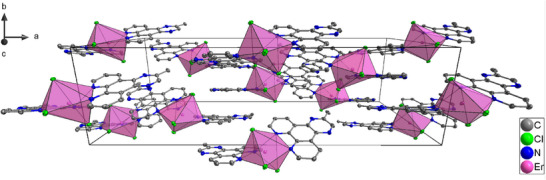 Figure 1
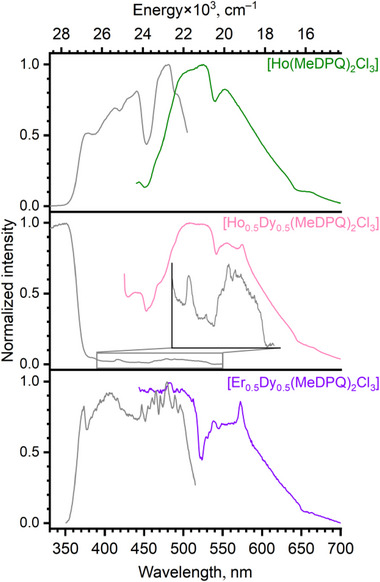 Figure 2
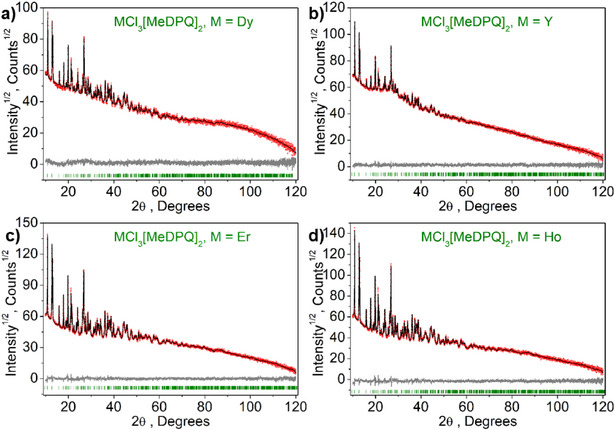 Figure 3
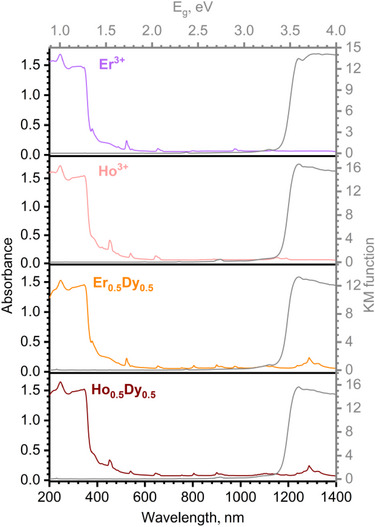 Figure 4
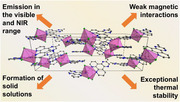 Figure 5
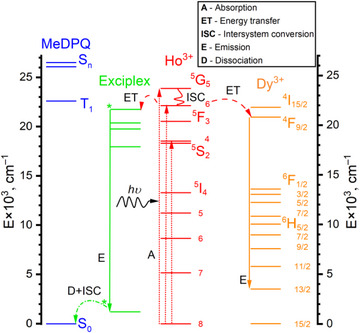 Figure 6
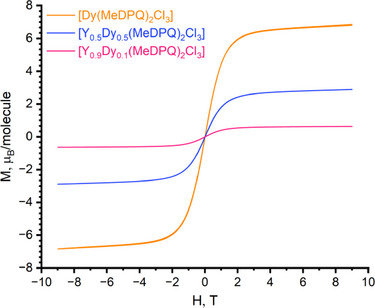 Figure 7
 Figure 8
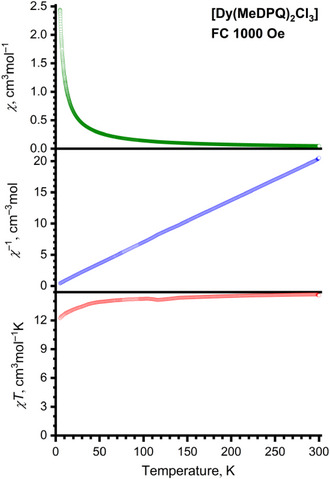 Figure 9
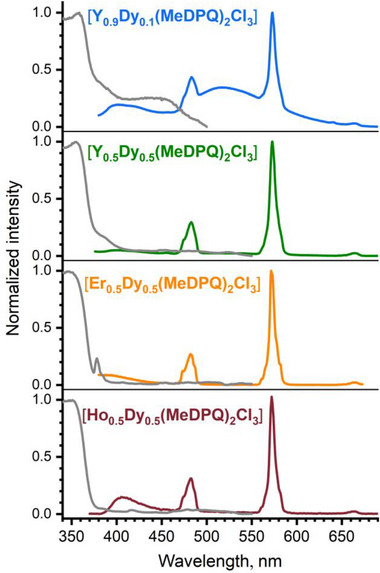 Figure 10
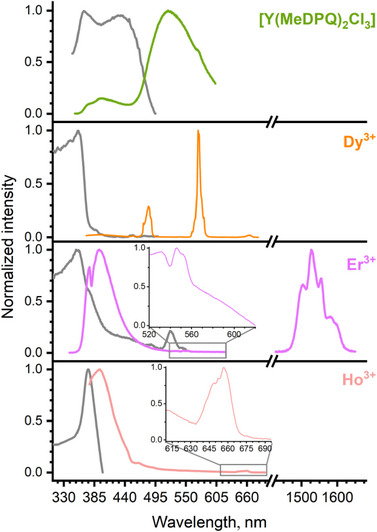 Figure 11
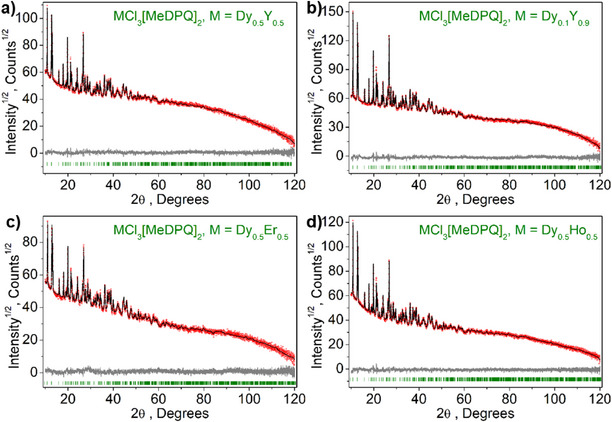 Figure 12
Peer Reviews
No public reviews on file for this paper yet. If you reviewed it on a platform where reviews are public (OpenReview, ICLR, NeurIPS, ICML), you can paste yours below so the community can read it here.
Videos
No videos yet. Explain this paper in a talk, walkthrough, or lecture? Add one.
Taxonomy
TopicsMagnetism in coordination complexes · Lanthanide and Transition Metal Complexes · Metal complexes synthesis and properties