FUSE-PhyloTree: linking functions and sequence conservation modules of a protein family through phylogenomic analysis
Olivier Dennler, Elisa Chenel, François Coste, Samuel Blanquart, Catherine Belleannée, Nathalie Théret

TL;DR
FUSE-PhyloTree is a new software that links protein functions with sequence conservation patterns using phylogenetic analysis.
Contribution
The novelty lies in combining partial local multiple sequence alignment with phylogenetic reconciliation to associate protein functions with sequence modules.
Findings
FUSE-PhyloTree identifies local sequence conservation modules in multi-functional protein families.
The software annotates gene trees with predicted sequence modules and ancestral gene functions.
It enables the association of functions with specific sequence regions based on their co-emergence in evolution.
Abstract
FUSE-PhyloTree is a phylogenomic analysis software for identifying local sequence conservation associated with the different functions of a multi-functional (e.g. paralogous or multi-domain) protein family. FUSE-PhyloTree introduces an original approach that combines advanced sequence analysis with phylogenetic methods. First, local sequence conservation modules within the family are identified using partial local multiple sequence alignment. Next, the evolution of the detected modules and known protein functions is inferred within the family’s phylogenetic tree using three-level phylogenetic reconciliation and ancestral state reconstruction. As a result, FUSE-PhyloTree provides a gene tree annotated with both predicted sequence modules and ancestral gene functions, enabling the association of functions with specific sequence regions based on their co-emergence. FUSE-PhyloTree is…
Genes, proteins, chemicals, diseases, species, mutations and cell lines named across the full text — each resolved to its canonical identifier and authoritative record.
Click any figure to enlarge with its caption.
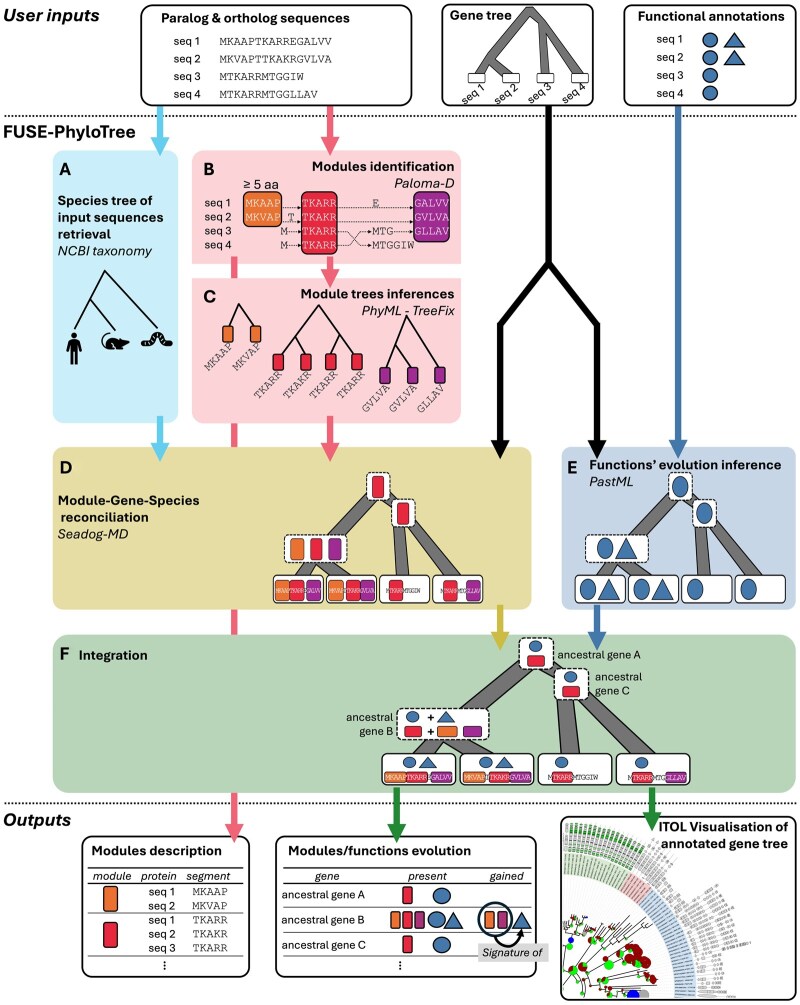 Figure 1
Peer Reviews
No public reviews on file for this paper yet. If you reviewed it on a platform where reviews are public (OpenReview, ICLR, NeurIPS, ICML), you can paste yours below so the community can read it here.
Videos
No videos yet. Explain this paper in a talk, walkthrough, or lecture? Add one.
Taxonomy
TopicsGenetics, Bioinformatics, and Biomedical Research