Opposite aging effects among cell subsets revealed in the human transcriptome and epigenome
Daigo Okada

TL;DR
This study shows that aging affects different human cell subsets in opposite ways, both in gene activity and DNA accessibility.
Contribution
The novel finding is that opposite aging effects observed in mice also occur in human cell subsets at both transcriptomic and epigenomic levels.
Findings
Opposite aging effects are observed in human cell subsets at the transcriptomic level.
Epigenomic changes also show opposite aging effects across different human cell subsets.
These findings mirror previously observed patterns in mouse cell subsets.
Abstract
In our previous work, we reported a global landscape of opposite aging effects among mouse cell subsets, where each cell subset is defined as a combination of tissue and cell type, and aging leads to increased gene expression in one subset but reduced expression in another. In this study, we investigated whether opposite aging effects are also observed in human cell subsets using the database of differentially expressed genes (DEGs) and differentially accessible regions (DARs) in various human cell subsets. The results suggest that the opposite aging effects occur among human cell subsets at both the transcriptomic and epigenomic levels.
Genes, proteins, chemicals, diseases, species, mutations and cell lines named across the full text — each resolved to its canonical identifier and authoritative record.
Click any figure to enlarge with its caption.
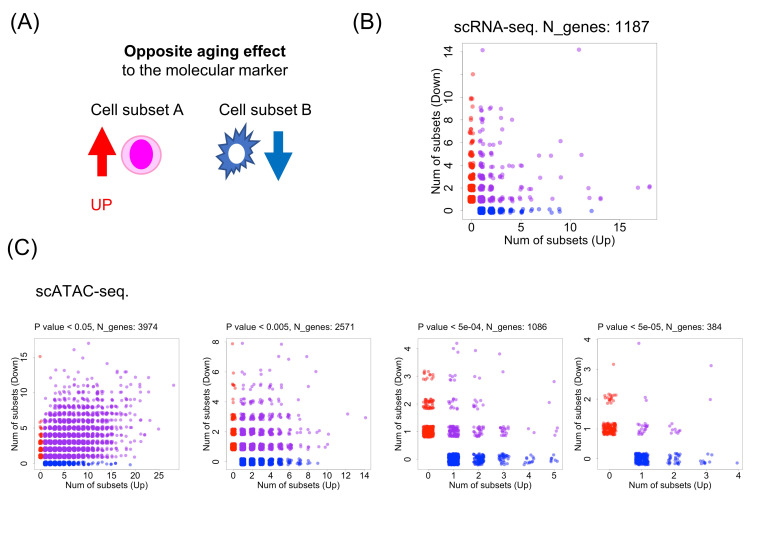 Figure 1
Peer Reviews
No public reviews on file for this paper yet. If you reviewed it on a platform where reviews are public (OpenReview, ICLR, NeurIPS, ICML), you can paste yours below so the community can read it here.
Videos
No videos yet. Explain this paper in a talk, walkthrough, or lecture? Add one.
Taxonomy
TopicsSingle-cell and spatial transcriptomics · Cancer Cells and Metastasis · Pluripotent Stem Cells Research