Chromosome-level genome assembly of the hamour (orange-spotted grouper), Epinephelus coioides
Razan Khalifa, Tim Bean, Dana Albatesh, Ronny van Aerle, Zenaba Kahtir, Zainab Hizam, Marta Gut, Francisco Câmara, Fernando Cruz, Jèssica Gómez-Garrido, Tyler Alioto, Eduarda Santos, Alexandra Leitão, Diana Minardi, Karim Gharbi, Merly Escalona, Jayan Duminda M Senevirathna

TL;DR
This paper provides a detailed genome assembly of the hamour fish, which is important for understanding its biology and responses to environmental stressors.
Contribution
The study presents the first chromosome-level genome assembly of the orange-spotted grouper, Epinephelus coioides.
Findings
The genome assembly is 1.07 Gb, organized into 24 large scaffolds covering 99.9% of the genome.
Annotation identified 28,384 protein-coding genes with high BUSCO completeness (98.9%).
Abstract
We present a chromosome-level genome assembly and annotation of the hamour, or orange-spotted grouper ( Epinephelus coioides), a high-value and significant teleost fish species across West Indo-Pacific regions of the Middle East, South Africa, and Australia. This species is a popular target for both commercial and recreational fishing and it is widely cultured around the world, particularly in the Asia-Pacific region. The hamour genome was sequenced from one individual male originating from a wild population in the Arabian Gulf and assembled into a 1.07 Gb assembly, the largest 24 superscaffolds making up 99.9% of the assembly. Annotation of the genome identified 28,384 protein-coding genes, with 98.9% single-copy BUSCO gene completeness (Actinopterygii database). These data will support further studies on functional ecological and evolutionary genomics of this species, enhancing the…
Genes, proteins, chemicals, diseases, species, mutations and cell lines named across the full text — each resolved to its canonical identifier and authoritative record.
Click any figure to enlarge with its caption.
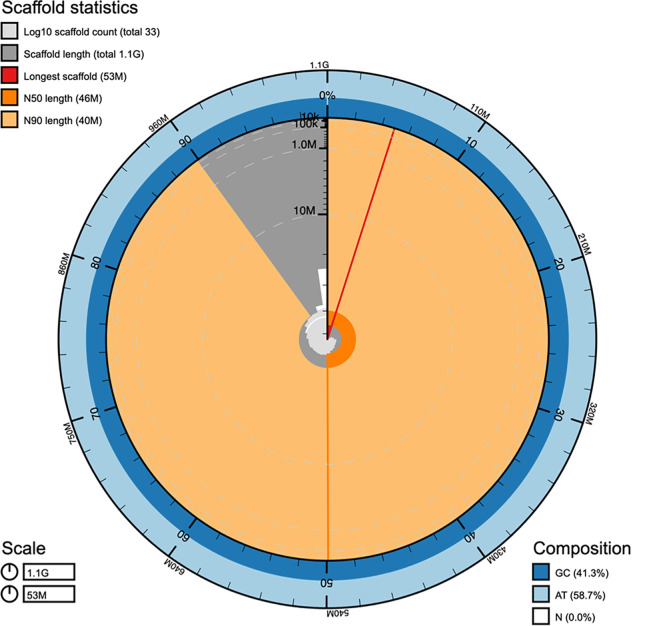 Figure 1
Peer Reviews
No public reviews on file for this paper yet. If you reviewed it on a platform where reviews are public (OpenReview, ICLR, NeurIPS, ICML), you can paste yours below so the community can read it here.
Videos
No videos yet. Explain this paper in a talk, walkthrough, or lecture? Add one.
Taxonomy
TopicsGenomics and Phylogenetic Studies · Aquaculture disease management and microbiota · Genetic diversity and population structure