Ecological similarities and dissimilarities between donor and recipient regions shape global plant naturalizations
Shu-ya Fan, Trevor S. Fristoe, Shao-peng Li, Patrick Weigelt, Holger Kreft, Wayne Dawson, Marten Winter, Petr Pyšek, Jan Pergl, Franz Essl, Amy J. S. Davis, Mark van Kleunen

TL;DR
Alien plants are more likely to naturalize in regions with similar climates and floras to their native regions, or in regions with lower diversity and more human impact.
Contribution
The study identifies climate similarity and native flora diversity as the strongest predictors of plant naturalization success.
Findings
Alien plants naturalize more in regions with similar climates and phylogenetically similar native floras.
Naturalization is also more likely in regions with lower native flora diversity and higher human modification.
Climate similarity and diversity differences are the strongest predictors of naturalization success.
Abstract
A central question in ecology is why alien species naturalize successfully in some regions but not in others. While some hypotheses suggest aliens are more likely to naturalize in environments similar to donor regions, others suggest they thrive in regions where certain characteristics are different. Using the native (i.e., donor) and recipient distributions of 11,604 naturalized alien plant species across 650 regions globally, we assess whether plants are more likely to naturalize in regions that are ecologically similar or dissimilar to their donor regions. Our results show that species are more likely to naturalize in recipient regions where climates are similar and native floras are phylogenetically similar to those of their donor regions, indicating that pre-adaptation to familiar biotic and abiotic conditions facilitates naturalization. However, naturalization is also more likely…
Genes, proteins, chemicals, diseases, species, mutations and cell lines named across the full text — each resolved to its canonical identifier and authoritative record.
Click any figure to enlarge with its caption.
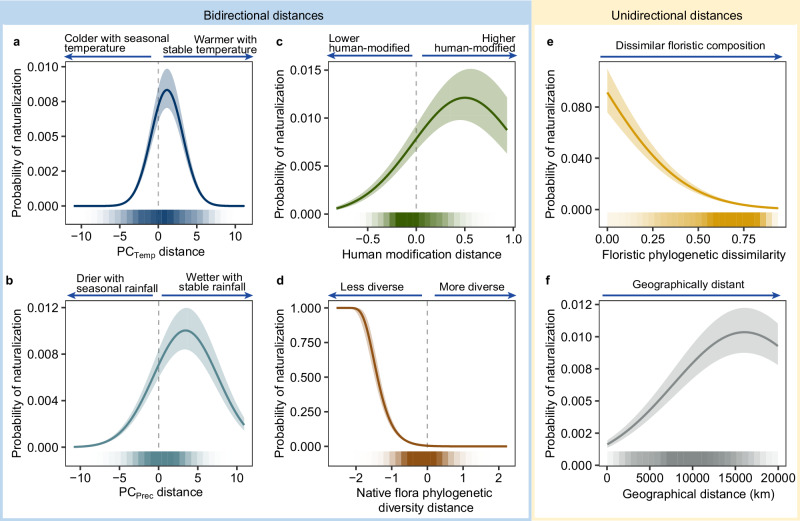 Figure 1
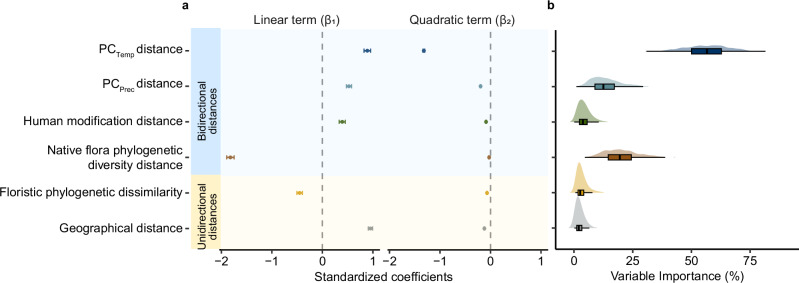 Figure 2
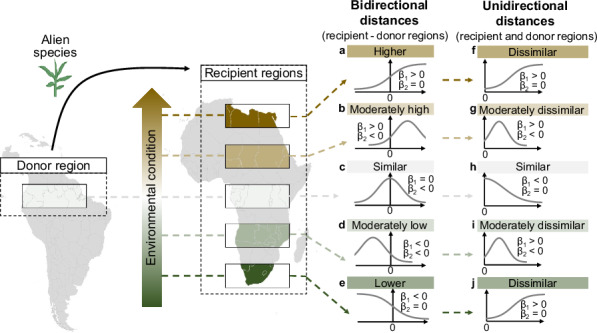 Figure 3
Peer Reviews
No public reviews on file for this paper yet. If you reviewed it on a platform where reviews are public (OpenReview, ICLR, NeurIPS, ICML), you can paste yours below so the community can read it here.
Videos
No videos yet. Explain this paper in a talk, walkthrough, or lecture? Add one.
Taxonomy
TopicsSpecies Distribution and Climate Change · Ecology and Vegetation Dynamics Studies · Plant and animal studies