Validity and reliability of the Hebrew version of the Brief Questionnaire of Olfactory Disorders (Brief-QOD) and the Self-Reported Mini Olfactory Questionnaire (Self-MOQ)
Tal Hefetz, Firas Kassem, Ameen Biadsee, Thomas Hummel, Ilan Blau, Dafna Gershnabel-Milk

TL;DR
This study validates Hebrew versions of two questionnaires for assessing smell disorders, showing they are reliable and accurate for Hebrew-speaking patients.
Contribution
The Hebrew versions of Self-MOQ and Brief-QOD are newly validated for use in Hebrew-speaking populations.
Findings
The Hebrew versions showed high internal consistency (Cronbach’s α of 0.79–0.94).
The Self-MOQ was the strongest predictor of group membership (patients vs. controls).
A cutoff score of ≥2 on Self-MOQ accurately distinguished patients from controls (AUC = 0.97).
Abstract
To translate and validate Hebrew versions of two patient-reported outcome measure questionnaires: the Self-Reported Mini Olfactory Questionnaire (Self-MOQ) and the Brief Questionnaire of Olfactory Disorders (Brief-QOD). A forward-backward translation process was conducted for both questionnaires. All participants rated their sense of smell using a general Visual Analog Scale (VAS) ranging from 0 (no dysfunction) to 10 (severe dysfunction). The patient group completed the questionnaires and the SNOT-22 questionnaire once. A control group of healthy participants completed the questionnaires twice to evaluate test-retest reliability. Subsets of both groups took the Sniffin’ Sticks test. The translation process resulted in Hebrew versions deemed clear and culturally appropriate. A total of 91 individuals were enrolled in the control group and 62 in the patient group. The Hebrew versions…
Genes, proteins, chemicals, diseases, species, mutations and cell lines named across the full text — each resolved to its canonical identifier and authoritative record.
Click any figure to enlarge with its caption.
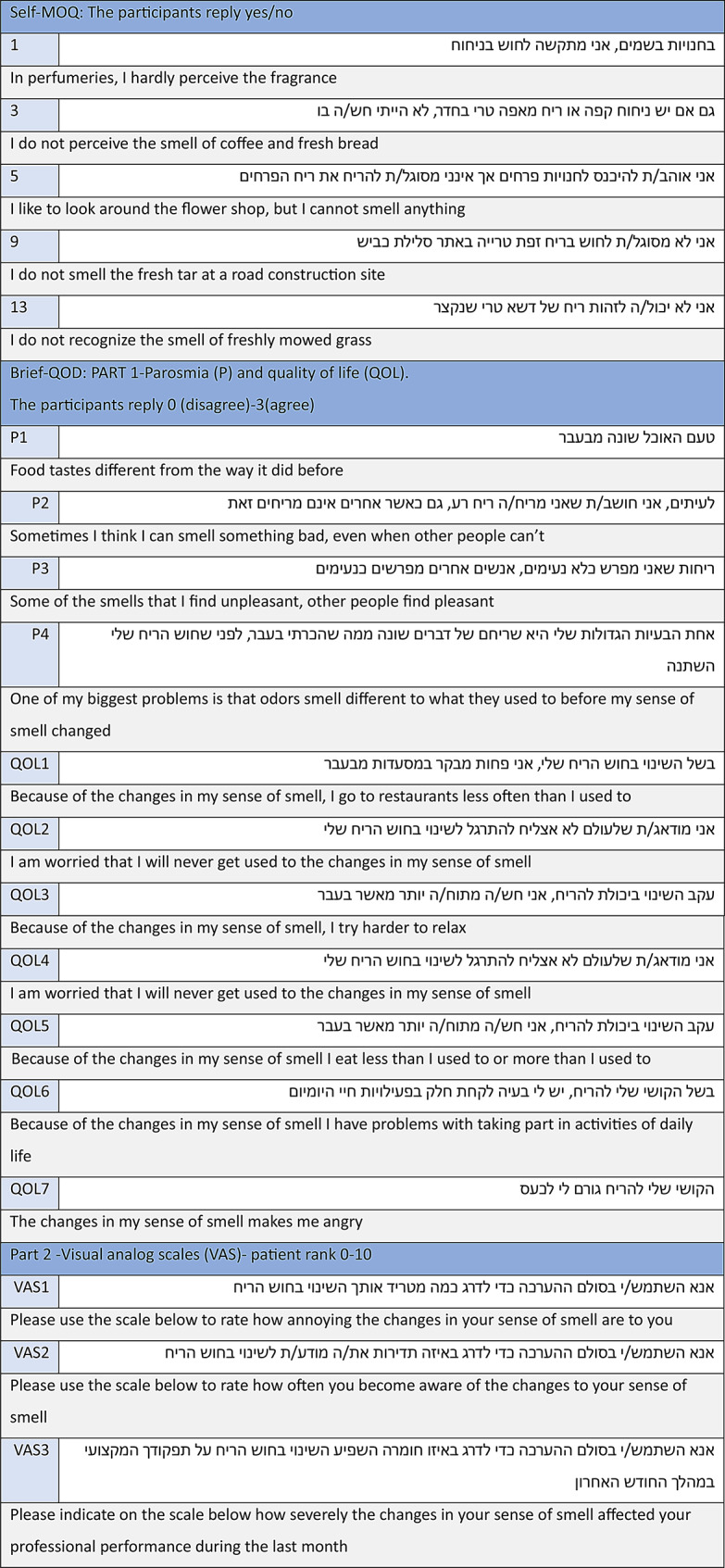 Figure 1
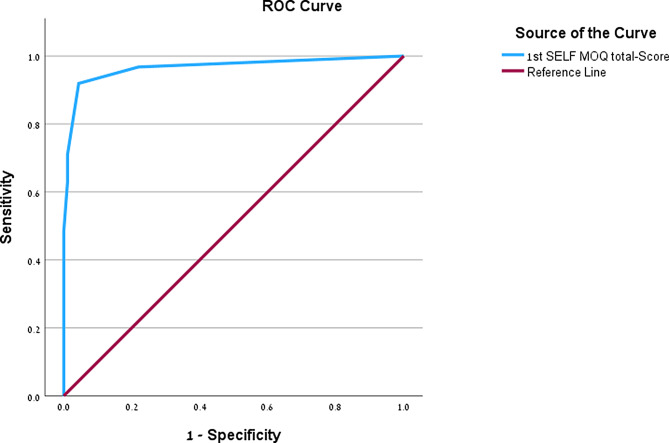 Figure 2
Peer Reviews
No public reviews on file for this paper yet. If you reviewed it on a platform where reviews are public (OpenReview, ICLR, NeurIPS, ICML), you can paste yours below so the community can read it here.
Videos
No videos yet. Explain this paper in a talk, walkthrough, or lecture? Add one.
Taxonomy
TopicsOlfactory and Sensory Function Studies · Fibromyalgia and Chronic Fatigue Syndrome Research · Body Image and Dysmorphia Studies