Poly(A) tail regulation in stem cells and early development
Xiaosu Miao, Guang Hu

TL;DR
This paper explores how poly(A) tails regulate gene expression in stem cells and early development, and how new sequencing methods help study these processes.
Contribution
The paper reviews recent advances in poly(A) tail sequencing and their impact on understanding stem cell and embryonic development.
Findings
Poly(A) tails influence mRNA stability and translation in stem cells and embryos.
New sequencing methods allow accurate measurement of poly(A) tail lengths.
Regulators of poly(A) tails affect stem cell fate and early development.
Abstract
Eukaryotic mRNAs are polyadenylated at their 3’-ends, and the poly(A) tails play critical roles in post-transcriptional gene regulation by influencing mRNA stability and translation. Here, we describe the biological processes and major protein factors that control poly(A) tail synthesis and shortening. We also discuss recent breakthroughs in poly(A) tail sequencing methods that enable high throughput and accurate measurement of poly(A) tail lengths. Finally, we review how poly(A)-tail regulators and poly(A)-tail-mediated post-transcriptional mechanisms affect stem cell fate and early embryonic development.
Genes, proteins, chemicals, diseases, species, mutations and cell lines named across the full text — each resolved to its canonical identifier and authoritative record.
Click any figure to enlarge with its caption.
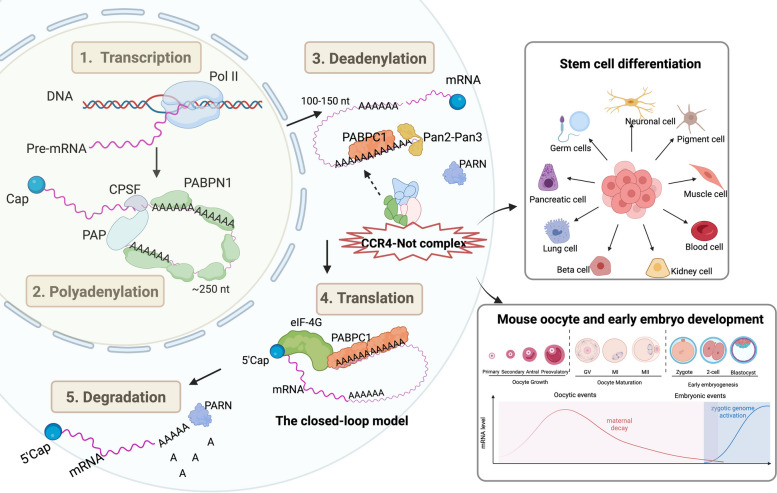 Figure 1
Peer Reviews
No public reviews on file for this paper yet. If you reviewed it on a platform where reviews are public (OpenReview, ICLR, NeurIPS, ICML), you can paste yours below so the community can read it here.
Videos
No videos yet. Explain this paper in a talk, walkthrough, or lecture? Add one.
Taxonomy
TopicsRNA Research and Splicing · Neurogenesis and neuroplasticity mechanisms · Wnt/β-catenin signaling in development and cancer