On the origin of the Nc1 scaling in the confined but chirally symmetric phase at high T
L. Ya. Glozman

TL;DR
The paper explains why a specific scaling pattern in high-temperature QCD matter arises, linking it to the behavior of quark-antiquark systems.
Contribution
The paper clarifies the origin of the Nc^1 scaling in the confined, chirally symmetric phase of QCD.
Findings
The Nc^1 scaling in the stringy fluid is due to fluctuations of color-singlet quark-antiquark systems.
Chiral restoration at Tch is caused by Pauli blocking from thermal quark-antiquark excitation.
The Bethe–Salpeter equation for quark-antiquark systems is Nc-independent in the confining regime.
Abstract
There is lattice evidence that the QCD matter above the chiral restoration temperature \documentclass[12pt]{minimal} \usepackage{amsmath} \usepackage{wasysym} \usepackage{amsfonts} \usepackage{amssymb} \usepackage{amsbsy} \usepackage{mathrsfs} \usepackage{upgreek} \setlength{\oddsidemargin}{-69pt} \begin{document}\end{document}Tch and below the deconfinement temperature \documentclass[12pt]{minimal} \usepackage{amsmath} \usepackage{wasysym} \usepackage{amsfonts} \usepackage{amssymb} \usepackage{amsbsy} \usepackage{mathrsfs} \usepackage{upgreek} \setlength{\oddsidemargin}{-69pt} \begin{document}\end{document}Td, called stringy fluid, is characterized by approximate chiral spin symmetry, which is a symmetry of confinement in QCD with light quarks. The energy density, pressure and entropy density…
Genes, proteins, chemicals, diseases, species, mutations and cell lines named across the full text — each resolved to its canonical identifier and authoritative record.
Click any figure to enlarge with its caption.
 Figure 1
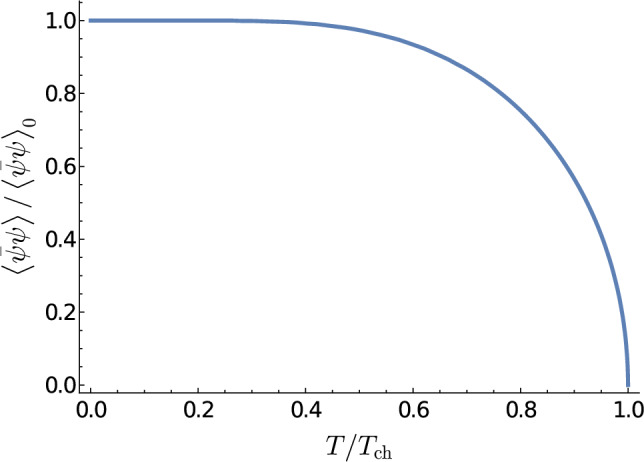 Figure 2
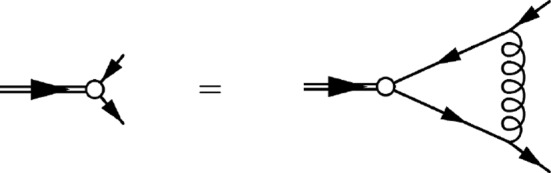 Figure 3
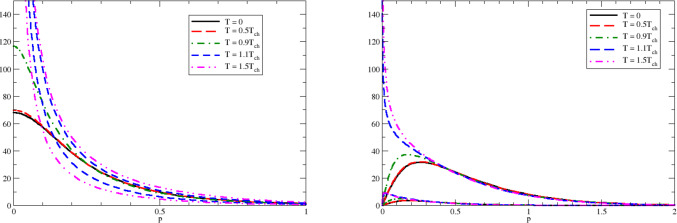 Figure 4
Peer Reviews
No public reviews on file for this paper yet. If you reviewed it on a platform where reviews are public (OpenReview, ICLR, NeurIPS, ICML), you can paste yours below so the community can read it here.
Videos
No videos yet. Explain this paper in a talk, walkthrough, or lecture? Add one.
Taxonomy
TopicsHigh-Energy Particle Collisions Research · Quantum Chromodynamics and Particle Interactions · Statistical Mechanics and Entropy