Common characteristics of variants linked to autism spectrum disorder in the WAVE regulatory complex
Song Xie, Ke Zuo, Silvia De Rubeis, Giorgio Bonollo, Giorgio Colombo, Paolo Ruggerone, Paolo Carloni

TL;DR
This study explores how specific genetic variants linked to autism affect a protein complex called WAVE regulatory complex, potentially leading to abnormal cell activity.
Contribution
The study extends molecular dynamics simulations to new WAVE regulatory complex variants, revealing common structural and functional disruptions in ASD-linked mutations.
Findings
All mutations weaken interactions and disrupt communication within the WAVE regulatory complex.
Most mutations destabilize the ACR V-helix and increase its movement, potentially leading to dysfunction.
The findings suggest that small-molecule ligands could help restore normal function in ASD-related variants.
Abstract
Six variants associated with autism spectrum disorder (ASD) abnormally activate the WASP-family Verprolin-homologous protein (WAVE) regulatory complex (WRC), a critical regulator of actin dynamics. This abnormal activation may contribute to the pathogenesis of this disorder. Using molecular dynamics (MD) simulations, we recently investigated the structural dynamics of wild-type (WT) WRC and R87C, A455P, and Q725R WRC disease-linked variants. Here, by extending MD simulations to I664M, E665K, and D724H WRC, we suggest that all of the mutations weaken the interactions and affect intra-complex allosteric communication between the WAVE1 active C-terminal region (ACR) and the rest of the complex. This might contribute to an abnormal complex activation, a hallmark of WRC-linked ASD. In addition, all mutants but I664M destabilize the ACR V-helix and increase the participation of ACR in…
Genes, proteins, chemicals, diseases, species, mutations and cell lines named across the full text — each resolved to its canonical identifier and authoritative record.
Click any figure to enlarge with its caption.
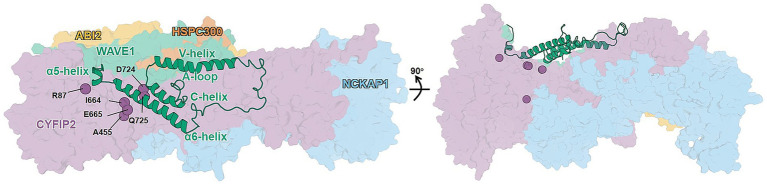 Figure 1
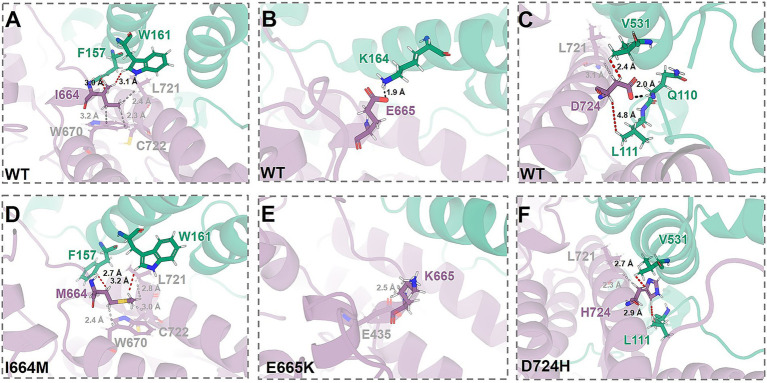 Figure 2
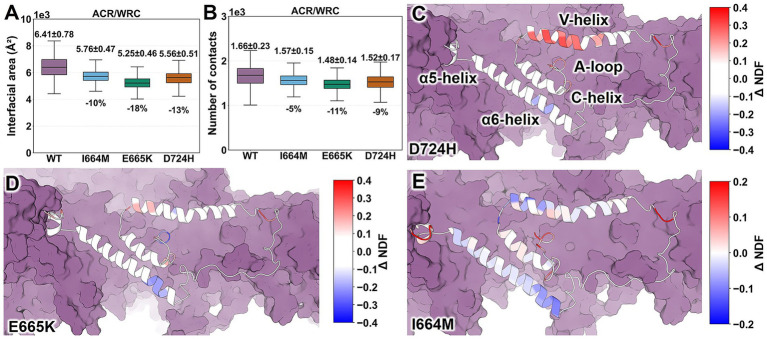 Figure 3
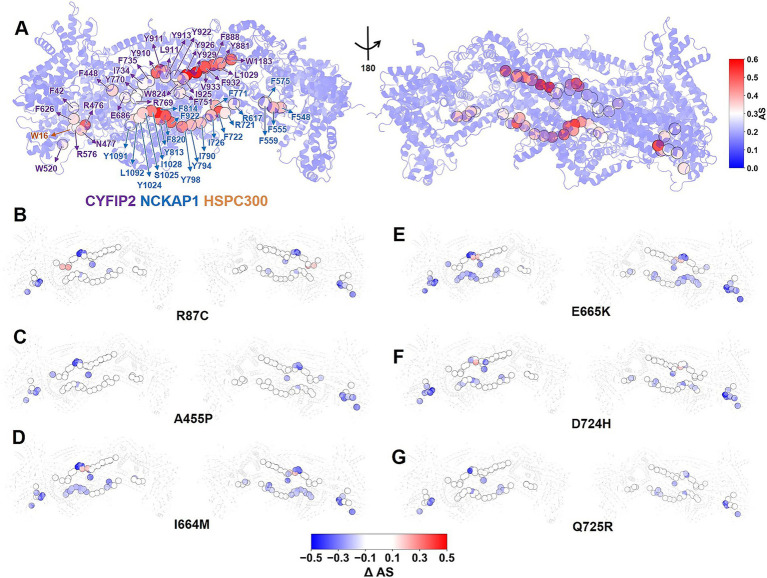 Figure 4
Peer Reviews
No public reviews on file for this paper yet. If you reviewed it on a platform where reviews are public (OpenReview, ICLR, NeurIPS, ICML), you can paste yours below so the community can read it here.
Videos
No videos yet. Explain this paper in a talk, walkthrough, or lecture? Add one.
Taxonomy
TopicsAutism Spectrum Disorder Research · Cellular Mechanics and Interactions · Genomics and Rare Diseases