Development of a psychosocial-clinical nomogram to predict delayed medical help-seeking in women with stress urinary incontinence: a retrospective cohort study
Xuemei Luo, Yating Zhong, Dongmei Ai, Guiqiang Yin, Lu Mo

TL;DR
This study creates a tool to predict why women with urinary incontinence delay seeking medical help, combining clinical and psychological factors.
Contribution
A validated nomogram integrating psychosocial and clinical factors to predict delayed help-seeking in women with stress urinary incontinence.
Findings
58% of women with stress urinary incontinence delayed medical consultation for over six months.
The nomogram achieved strong discrimination (AUC = 0.855) and good calibration for predicting delayed help-seeking.
Psychological factors like anxiety and shame were significant predictors of delayed care.
Abstract
Delayed medical help-seeking is a common yet understudied behavior among women with stress urinary incontinence (SUI), potentially worsening symptom burden and diminishing quality of life. While clinical factors have been investigated, the contribution of psychosocial determinants remains poorly defined. This study aimed to identify key predictors and develop a validated nomogram for individualized risk estimation of delayed consultation. In this retrospective cohort study, we analyzed electronic health records of 1,400 adult women diagnosed with SUI at a tertiary medical center in Southwest China (2019–2023). Delayed help-seeking was defined as > 6 months between symptom onset and first medical consultation. Multivariable logistic regression, guided by backward stepwise selection and Akaike Information Criterion, was used to identify independent predictors. A nomogram was constructed…
Genes, proteins, chemicals, diseases, species, mutations and cell lines named across the full text — each resolved to its canonical identifier and authoritative record.
Click any figure to enlarge with its caption.
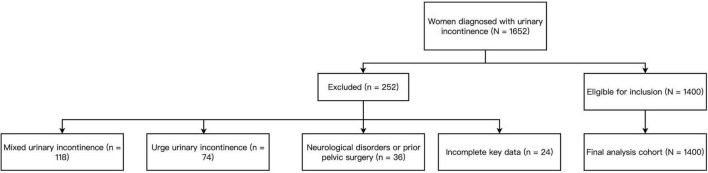 Figure 1
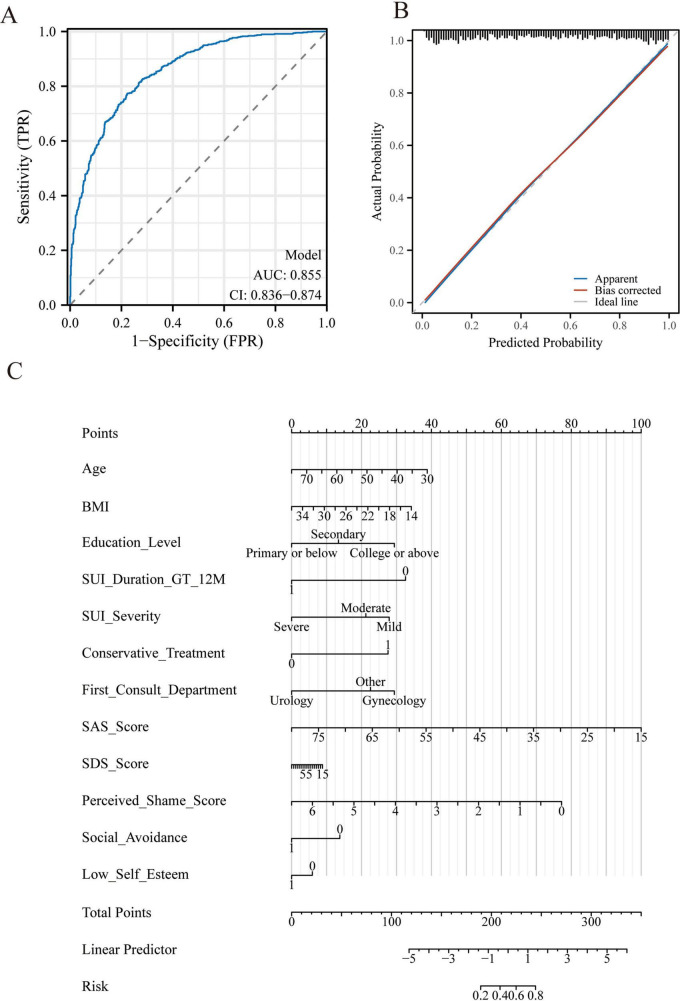 Figure 2
Peer Reviews
No public reviews on file for this paper yet. If you reviewed it on a platform where reviews are public (OpenReview, ICLR, NeurIPS, ICML), you can paste yours below so the community can read it here.
Videos
No videos yet. Explain this paper in a talk, walkthrough, or lecture? Add one.
Taxonomy
TopicsPelvic floor disorders treatments · Maternal and Perinatal Health Interventions · Pressure Ulcer Prevention and Management