The role of spectator modes in the quantum-logic spectroscopy of single trapped molecular ions
Mikolaj Roguski, Aleksandr Shlykov, Ziv Meir, Stefan Willitsch

TL;DR
This paper explores how motion of trapped ions affects the detection of molecular ion states using quantum-logic spectroscopy.
Contribution
The study identifies a Debye-Waller-type effect and shows how cooling spectator modes improves detection fidelity and experimental efficiency.
Findings
Cooling spectator modes enables detection of the rovibrational ground state of N2+ with over 99.99% fidelity.
The method reduces experimental time by half and improves sensitivity for identifying multiple rotational states.
Spectator modes not directly involved in the protocol significantly influence the measurement response.
Abstract
Quantum-logic spectroscopy has become an increasingly important tool for the state detection and readout of trapped atomic and molecular ions which do not possess easily accessible closed-cycling optical transitions. In this approach, the internal state of the target ion is mapped onto a co-trapped auxiliary ion. This mapping is typically mediated by normal modes of motion of the two-ion Coulomb crystal in the trap. The present study investigates the role of spectator modes not directly involved in a measurement protocol relying on a state-dependent optical-dipole force. We identify a Debye-Waller-type effect that modifies the response of the two-ion string to the force. We show that cooling the spectator modes of the string allows for the detection of the rovibrational ground state of an \documentclass[12pt]{minimal} \usepackage{amsmath} \usepackage{wasysym}…
Genes, proteins, chemicals, diseases, species, mutations and cell lines named across the full text — each resolved to its canonical identifier and authoritative record.
Click any figure to enlarge with its caption.
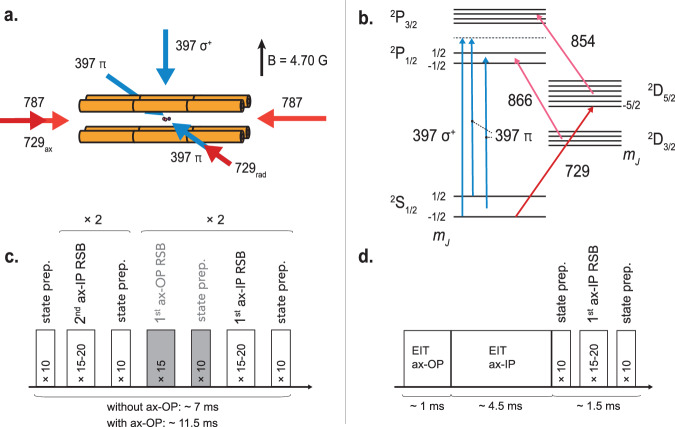 Figure 1
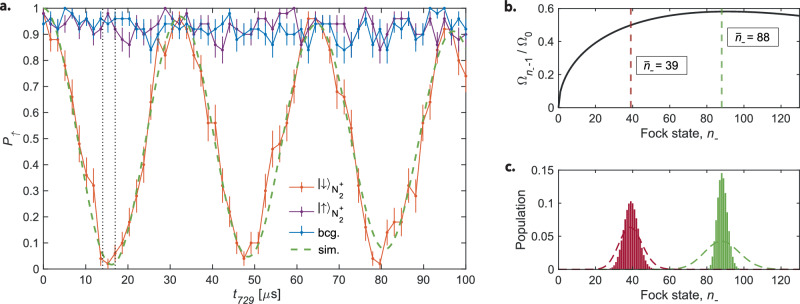 Figure 2
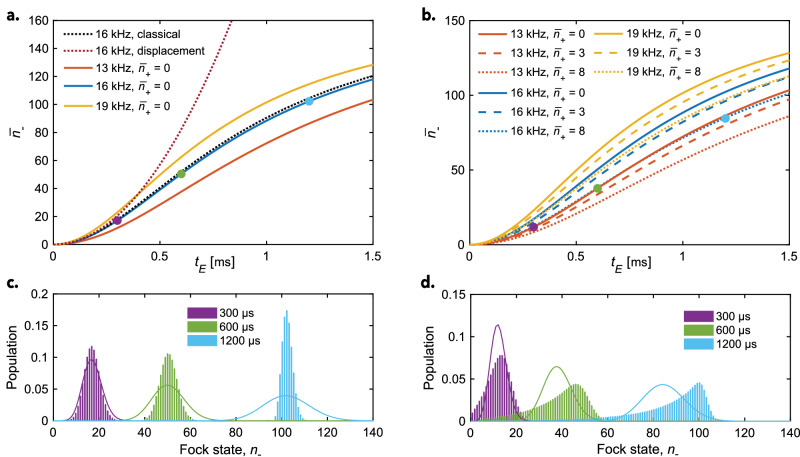 Figure 3
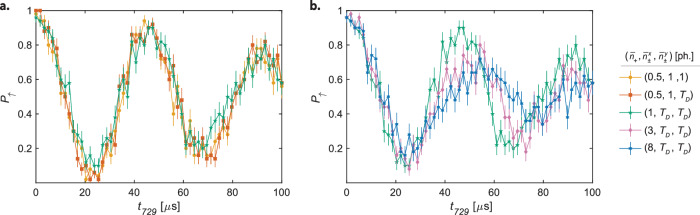 Figure 4
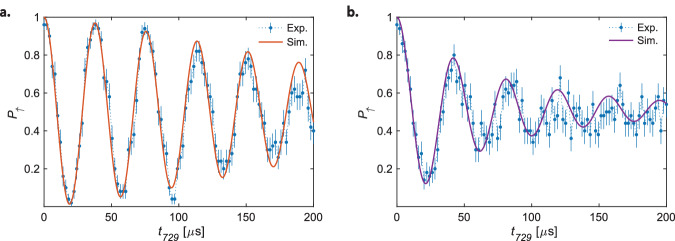 Figure 5
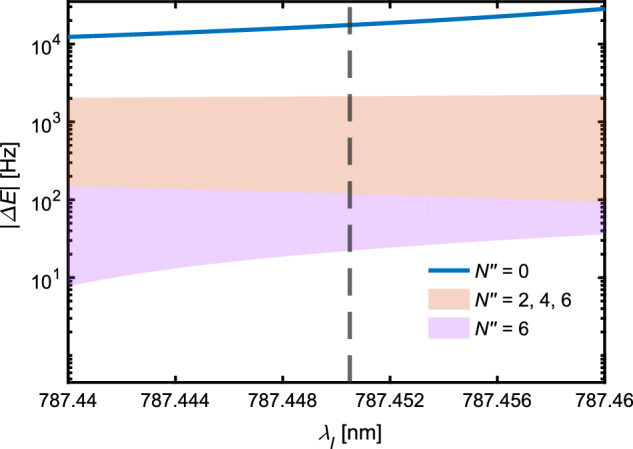 Figure 6
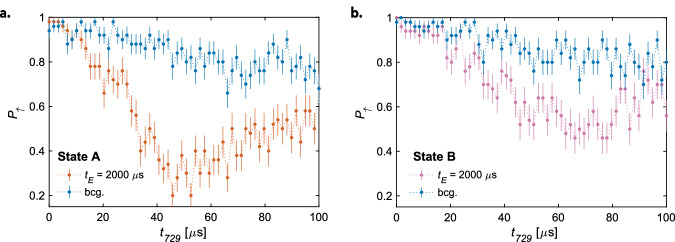 Figure 7
Peer Reviews
No public reviews on file for this paper yet. If you reviewed it on a platform where reviews are public (OpenReview, ICLR, NeurIPS, ICML), you can paste yours below so the community can read it here.
Videos
No videos yet. Explain this paper in a talk, walkthrough, or lecture? Add one.
Taxonomy
TopicsCold Atom Physics and Bose-Einstein Condensates · Mechanical and Optical Resonators · Quantum Information and Cryptography