Motivated to care: latent classes of caregiver motivation as moderators among stress, resources, and well-being
Deborah L. Nichols, Amy Laine

TL;DR
This study identifies different motivation types in informal caregivers and shows how these affect their stress and well-being in response to caregiving demands and resources.
Contribution
The paper introduces distinct motivational profiles of caregivers and demonstrates their moderating role in stress and resource relationships.
Findings
Duty-Motivated caregivers experience reduced burnout with more hours but increased strain under intensive care tasks.
Affectively-Motivated caregivers benefit from resilience but are vulnerable to distress from time and task demands.
Resilience is broadly protective, while social support shows uneven and sometimes paradoxical effects on well-being.
Abstract
Informal caregiving motivations are central to how informal caregivers interpret stressors, access resources, and maintain wellbeing. However, motivation is rarely integrated into models of caregiver stress. This study applies the Informal Caregiving Integrative Model to identify distinct motivation profiles and test their role in moderating the impact of caregiving responsibilities and resources on caregiver distress and burnout. Using data from 1,026 U.S. informal caregivers, latent class analysis identified five motivational profiles: Duty-, Affectively-, Obligation-, Culturally-, and Situationally-Motivated. Path models tested how these classes moderated the associations among caregiving tasks, duration, psychological resources (resilience, social support), and wellbeing outcomes (acute emotional distress, chronic burnout). Models were run in Stata using standardized observed…
Genes, proteins, chemicals, diseases, species, mutations and cell lines named across the full text — each resolved to its canonical identifier and authoritative record.
Click any figure to enlarge with its caption.
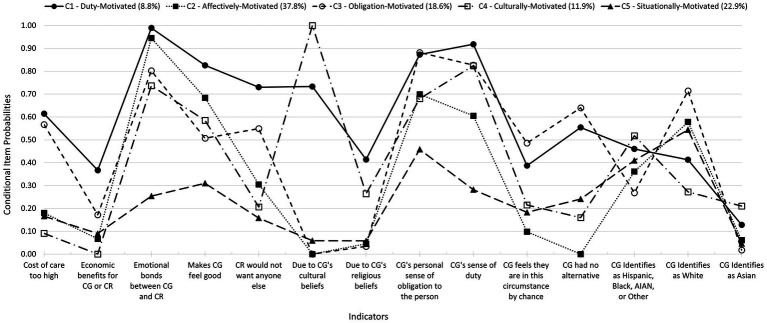 Figure 1
Peer Reviews
No public reviews on file for this paper yet. If you reviewed it on a platform where reviews are public (OpenReview, ICLR, NeurIPS, ICML), you can paste yours below so the community can read it here.
Videos
No videos yet. Explain this paper in a talk, walkthrough, or lecture? Add one.
Taxonomy
TopicsFamily Caregiving in Mental Illness · Intergenerational Family Dynamics and Caregiving · Dementia and Cognitive Impairment Research