Instructional design complexity and pop-up notification interference: effects on attention allocation and information retention in virtual classrooms
Yushan Wang

TL;DR
This study explores how instructional design and pop-up notifications affect learning in virtual classrooms, finding that both factors reduce attention and retention.
Contribution
The study introduces a dual-factor manipulation of instructional design complexity and pop-up notifications in virtual learning environments.
Findings
Both instructional design complexity and pop-up notifications significantly reduced attention and retention.
Learners with more digital experience were less affected by pop-up notifications.
Attention allocation partially mediates the effects of instructional design and notifications on retention.
Abstract
The growing prevalence of virtual multimedia learning environments raises questions about how instructional complexity and environmental interference jointly shape learning. This study examines the independent and interactive effects of instructional design complexity (IDC) and pop-up notification interference (PNI) on attention allocation and information retention. IDC was manipulated through instructional design, using streamlined layouts with concise text (low complexity) versus fragmented layouts with redundant on-screen text and background audio (high complexity). PNI (external-to-material) was manipulated through the presence or absence of periodic, task-irrelevant pop-up notifications. Drawing on Cognitive Load Theory (CLT), the Limited Capacity Model of Mediated Message Processing (LC4MP), and Media Multitasking Theory (MMT), a 2 × 2 between-subjects experiment was conducted…
Genes, proteins, chemicals, diseases, species, mutations and cell lines named across the full text — each resolved to its canonical identifier and authoritative record.
Click any figure to enlarge with its caption.
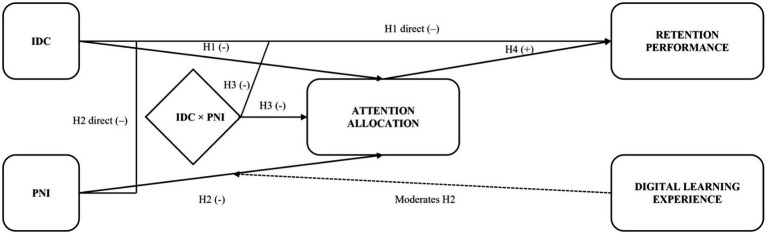 Figure 1
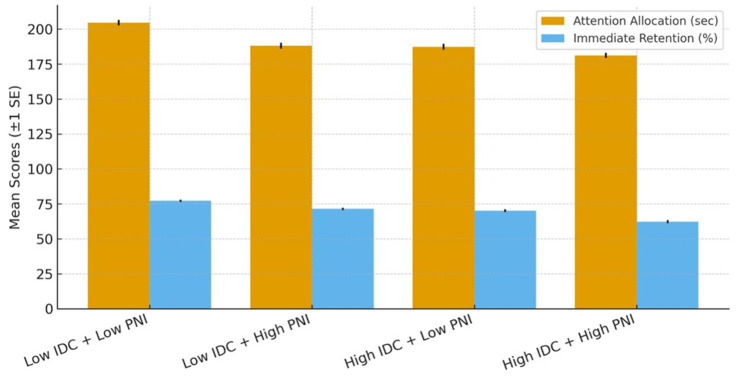 Figure 2
Peer Reviews
No public reviews on file for this paper yet. If you reviewed it on a platform where reviews are public (OpenReview, ICLR, NeurIPS, ICML), you can paste yours below so the community can read it here.
Videos
No videos yet. Explain this paper in a talk, walkthrough, or lecture? Add one.
Taxonomy
TopicsVisual and Cognitive Learning Processes · Mind wandering and attention · Personal Information Management and User Behavior