Evaluation of Muscle Mass and Quality With an AI‐Based Muscle Ultrasound Imaging System in Patients at Risk of Malnutrition
Juan José López‐Gómez, Lucía Estévez Asensio, Jaime González Gutiérrez, Ángela Cebriá, Olatz Izaola Jauregui, Paloma Pérez López, Emilia Gómez‐Hoyos, David Primo Martín, Rebeca Jiménez Sahagún, Eduardo Jorge Godoy, Daniel A. De Luis Román

TL;DR
An AI-based ultrasound system was tested to assess muscle mass and quality in malnourished patients, showing that it can detect sarcopenia-related changes effectively.
Contribution
The study introduces an AI-assisted ultrasound system for evaluating sarcopenia in malnourished patients, demonstrating its effectiveness in measuring muscle mass and quality.
Findings
Patients with sarcopenia had significantly lower muscle thickness and area compared to those without sarcopenia.
AI-assisted ultrasound parameters like muscle thickness and low echogenicity were significantly lower in sarcopenic patients.
Higher muscle thickness was protective against sarcopenia, while higher low echogenicity was protective against low handgrip strength.
Abstract
Sarcopenia is characterized by the loss of muscle mass, quality and function. Ultrasonography provides a non‐invasive method for assessing sarcopenia. Its generalizability remains limited due to certain methodological and population‐specific challenges. This study evaluated the association between AI‐assisted muscle ultrasonography and sarcopenia in patients at risk of malnutrition. This observational, cross‐sectional study included 647 patients at risk of malnutrition. Nutritional status was assessed via anthropometry, bioimpedanciometry, quadriceps rectus femoris (QRF) ultrasonography and handgrip strength. An AI‐based imaging system segmented the region of interest (ROI) in transverse QRF images to measure muscle thickness (RFMT), area (RFMA) and pennation angle (RFPA). The Multi‐Otsu algorithm extracted ROI biomarkers: low echogenicity (MiT) and medium echogenicity (FatiT), assumed…
Genes, proteins, chemicals, diseases, species, mutations and cell lines named across the full text — each resolved to its canonical identifier and authoritative record.
Click any figure to enlarge with its caption.
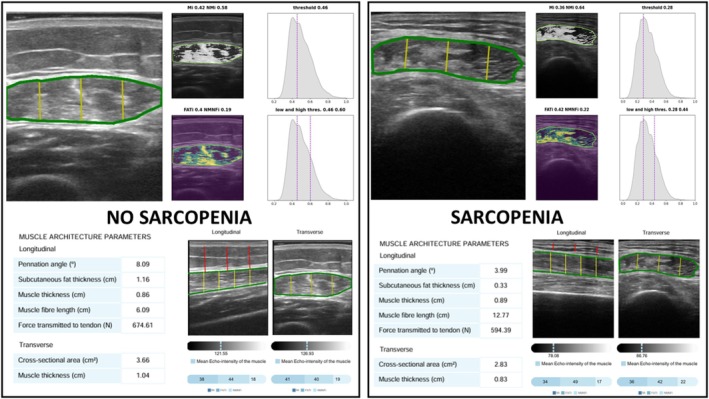 Figure 1
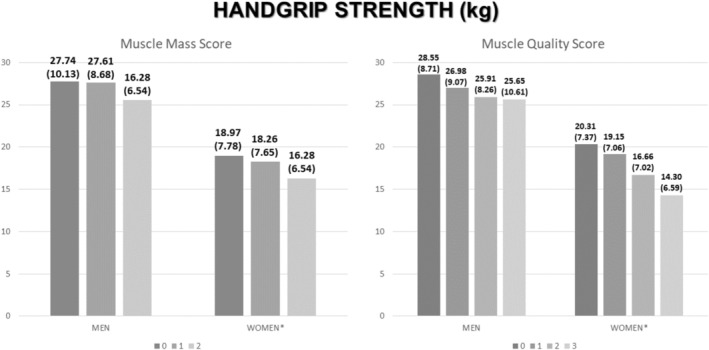 Figure 2
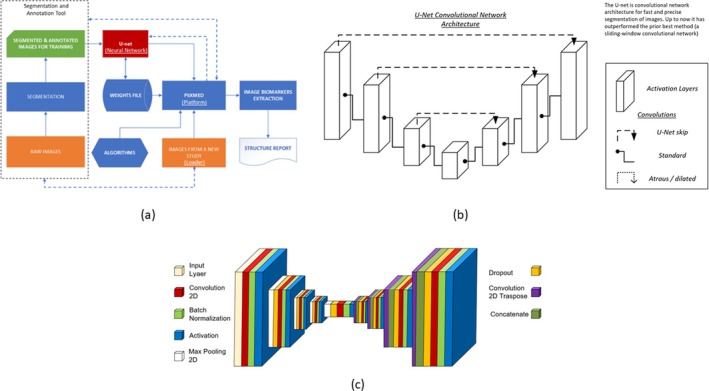 Figure 3
 Figure 4
Peer Reviews
No public reviews on file for this paper yet. If you reviewed it on a platform where reviews are public (OpenReview, ICLR, NeurIPS, ICML), you can paste yours below so the community can read it here.
Videos
No videos yet. Explain this paper in a talk, walkthrough, or lecture? Add one.
Taxonomy
TopicsNutrition and Health in Aging · Body Composition Measurement Techniques · Cerebral Palsy and Movement Disorders