Global evidence of non-pyramidal and uniform ratios of animal diversity across terrestrial trophic levels
Luis F. Camacho, Miguel B. Araujo

TL;DR
This study finds that animal diversity is evenly distributed across trophic levels, challenging the expected pyramidal pattern of energy distribution.
Contribution
The study reveals a non-pyramidal and uniform ratio of species richness across terrestrial trophic levels.
Findings
46% of terrestrial animal species are primary consumers, 43% are higher-level consumers, and 11% are mixed consumers.
Species richness ratios across trophic levels are consistent globally, regardless of location or total richness.
Ecological differentiation at higher trophic levels may offset extinction risks and lead to uniform diversity patterns.
Abstract
Thermodynamics imposes a well-established pyramidal distribution of energy availability across trophic levels, but whether species richness follows the same pattern remains unclear. In this study, we examined species richness across trophic groups for all known terrestrial tetrapod and arthropod species, representing over 90% of Earth’s terrestrial animal diversity. By categorizing species into fundamental trophic levels, we found that 46% are primary consumers (feeding on plants), 43% are higher-level consumers (feeding on primary consumers) and 11% are mixed consumers (generalists). Further analysis of global community trophic structures in mammals and birds uncovered a consistent ratio of species richness across trophic levels, independent of geographical location or total species richness. We propose that this non-pyramidal distribution of diversity arises from higher ecological…
Genes, proteins, chemicals, diseases, species, mutations and cell lines named across the full text — each resolved to its canonical identifier and authoritative record.
Click any figure to enlarge with its caption.
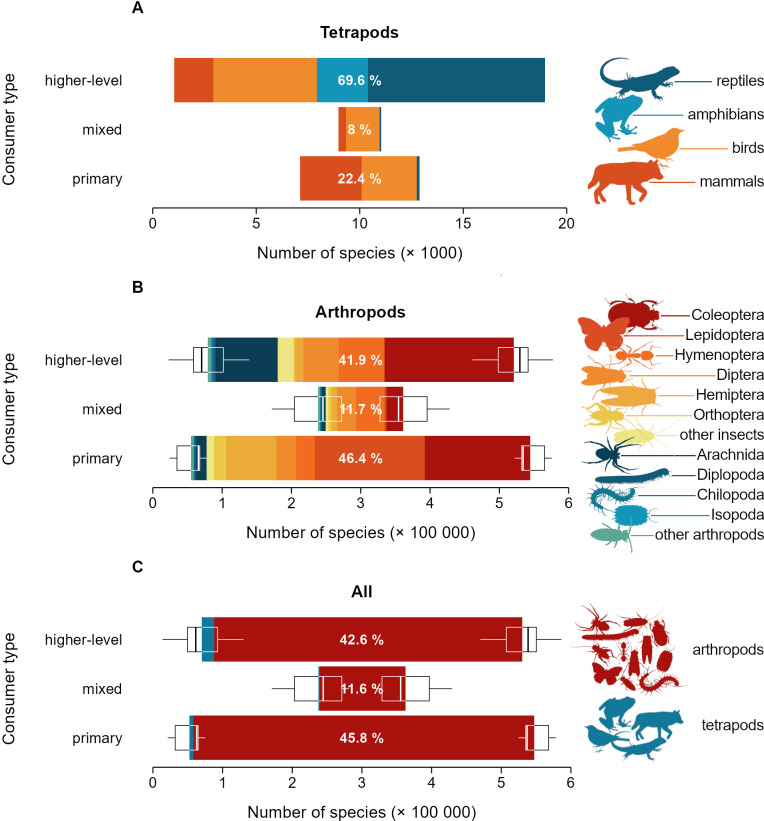 Figure 1
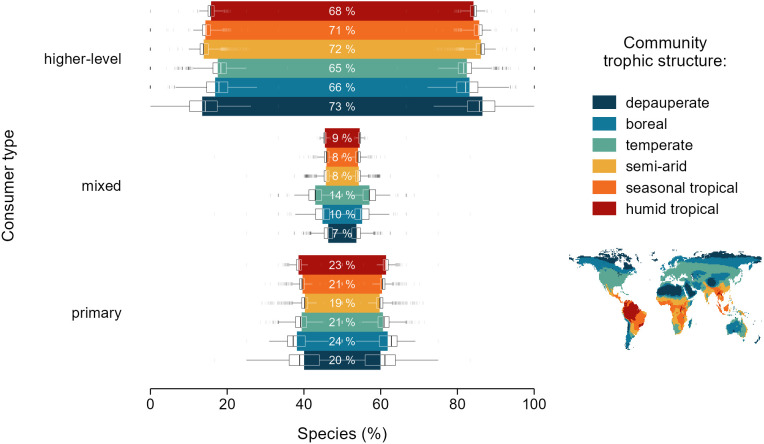 Figure 2
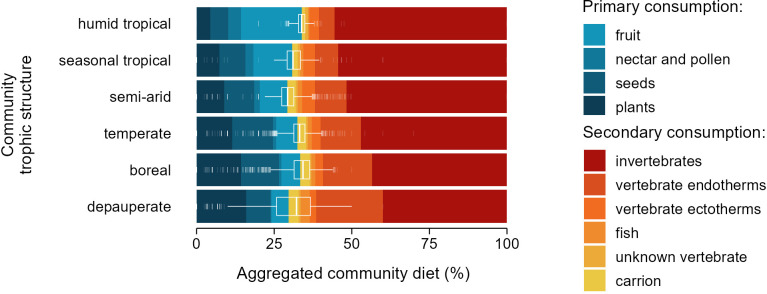 Figure 3
 Figure 4
 Figure 5
 Figure 6
 Figure 7
 Figure 8
 Figure 9
 Figure 10
 Figure 11
 Figure 12
 Figure 13
 Figure 14
 Figure 15
 Figure 16
 Figure 17
 Figure 18
 Figure 19
Peer Reviews
No public reviews on file for this paper yet. If you reviewed it on a platform where reviews are public (OpenReview, ICLR, NeurIPS, ICML), you can paste yours below so the community can read it here.
Videos
No videos yet. Explain this paper in a talk, walkthrough, or lecture? Add one.
Taxonomy
TopicsIsotope Analysis in Ecology · Ecology and Vegetation Dynamics Studies · Plant and animal studies