Association of Noise Exposure, Genetic Susceptibility, and Lifestyle With Type 2 Diabetes: A Prospective Cohort Study
Dongming Wang, Luowen Zhou, Xingjie Hao, Zhaomin Chen, Bing Wang, Wenzhen Li

TL;DR
This study finds that long-term workplace noise exposure increases the risk of developing Type 2 diabetes, especially when combined with an unhealthy lifestyle.
Contribution
The study is the first to investigate the combined effects of noise exposure, genetic risk, and lifestyle on Type 2 diabetes in a large population.
Findings
Prolonged workplace noise exposure is associated with a higher risk of Type 2 diabetes.
Combining noise exposure with an unhealthy lifestyle significantly increases diabetes risk.
High genetic risk alone does not lead to the highest diabetes risk without noise exposure.
Abstract
We aimed to explore the relationship of noise exposure in the workplace, genetic risk, and lifestyle with Type 2 diabetes (T2D). A total of 154,708 participants without T2D in UK Biobank were included. A lifestyle score was determined using smoking, alcohol intake, physical activity, television viewing time, sleep duration, and diet. During a median follow-up of 11.83 years (1,776,919.62 person-years), 5921 T2D cases were observed. Compared to no noise exposure, the hazard ratios (HRs) and 95% confidence intervals (CIs) were 1.06 (0.95–1.18) in less than a year, 1.01 (0.91–1.12) in around 1–5 years, and 1.11 (1.04–1.20) in more than 5 years, respectively. Compared to participants with low genetic risk and no noise exposure, individuals with high genetic risk and noise exposure for more than 5 years did not show the highest risk of T2D (HR = 1.16, 95%CI = 0.98–1.36). However,…
Genes, proteins, chemicals, diseases, species, mutations and cell lines named across the full text — each resolved to its canonical identifier and authoritative record.
Click any figure to enlarge with its caption.
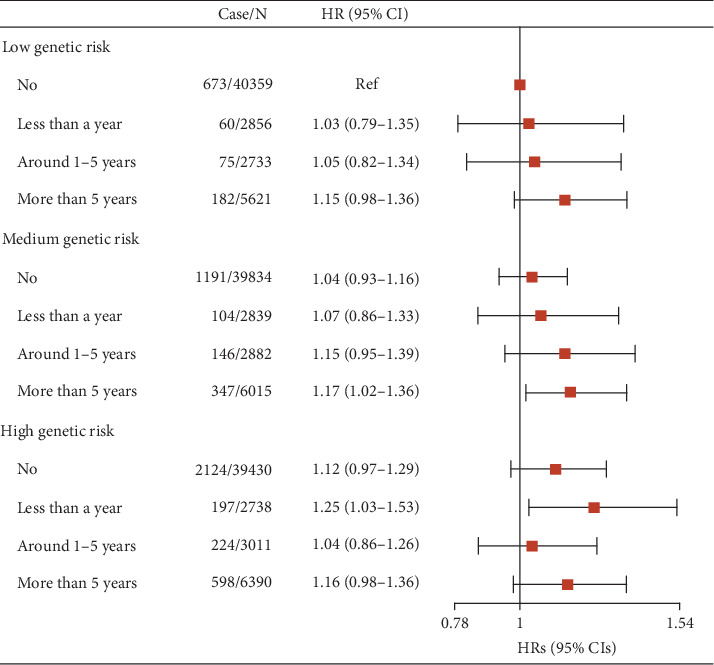 Figure 1
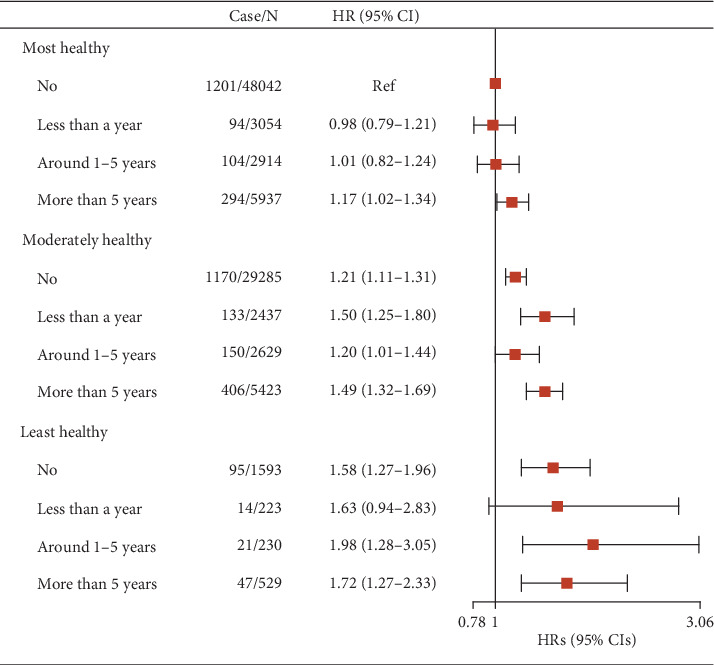 Figure 2
Peer Reviews
No public reviews on file for this paper yet. If you reviewed it on a platform where reviews are public (OpenReview, ICLR, NeurIPS, ICML), you can paste yours below so the community can read it here.
Videos
No videos yet. Explain this paper in a talk, walkthrough, or lecture? Add one.
Taxonomy
TopicsNoise Effects and Management · Hearing, Cochlea, Tinnitus, Genetics · Health, psychology, and well-being