Enhancing Recruitment of Adolescents Aged 16-18 Years in a Web-Based Peer Network Study Through Financial Reimbursements: Randomized Controlled Trial
Sarah Eddy, Rachel Sacks-Davis, Michelle Raggatt, Cassandra Wright, Paul Dietze, Margaret Hellard, Jane Hocking, Megan S C Lim

TL;DR
This study found that offering increasing financial rewards to adolescents improved their willingness to recruit peers for a web-based study, compared to fixed payments.
Contribution
The paper experimentally evaluates scaled vs fixed financial reimbursements for adolescent peer recruitment in web-based studies, revealing a novel incentive structure's effectiveness.
Findings
Scaled reimbursement increased peer recruitment likelihood by 3.8 times compared to fixed reimbursement.
Participants recruited through social media were 2.2 times more likely to recruit peers than those from research panels.
Despite higher recruitment rates, overall peer participation remained low, suggesting need for stronger incentives.
Abstract
Peers are known to influence the health behaviors and attitudes of adolescents, yet recruitment of these networks is challenging. Previous studies have used web-based respondent-driven sampling methods to recruit this population, yet none have experimentally investigated the impact of financial reimbursements. This study aimed to (1) compare the effectiveness of two financial reimbursement strategies for recruiting adolescents and their peer networks and (2) explore factors associated with successfully recruiting peers. A parallel-design randomized controlled trial was conducted in which participants (seeds) were randomly allocated to a fixed cash reimbursement (control) or scaled reimbursement (experimental) group as a strategy to be recruited into a web-based peer network study. Seeds aged 16 to 18 years were recruited through social media advertisements and an online student panel.…
Genes, proteins, chemicals, diseases, species, mutations and cell lines named across the full text — each resolved to its canonical identifier and authoritative record.
Click any figure to enlarge with its caption.
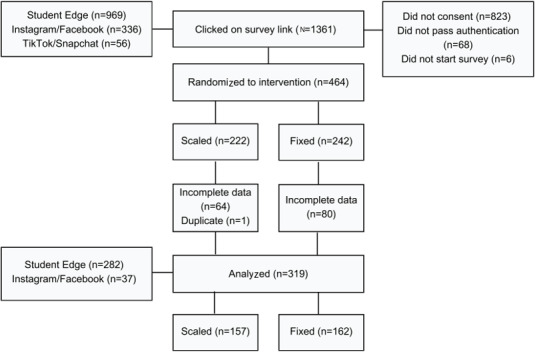 Figure 1
Peer Reviews
No public reviews on file for this paper yet. If you reviewed it on a platform where reviews are public (OpenReview, ICLR, NeurIPS, ICML), you can paste yours below so the community can read it here.
Videos
No videos yet. Explain this paper in a talk, walkthrough, or lecture? Add one.
Taxonomy
TopicsSocial Media in Health Education · Impact of Technology on Adolescents · Mobile Crowdsensing and Crowdsourcing