Constraints on Exchange Edits During Noisy‐Channel Inference
Markus Bader, Michael Meng

TL;DR
This study explores how people infer intended meanings in corrupted sentences by testing if they consider word exchanges in different German sentence structures.
Contribution
The paper introduces new insights into how syntactic structure and task type influence the use of word exchanges in sentence repair.
Findings
Implausible SO and passive sentences rarely led to nonliteral interpretations, unlike OS sentences.
Word exchanges with function words were considered more often than with nouns.
Explicit corrections showed frequent use of noun exchanges, suggesting task-dependent priors.
Abstract
According to the noisy channel framework of sentence processing, communication can succeed even when the input is corrupted because comprehenders rationally infer the speaker's intended meaning based on the prior probability of the literal interpretation and the probability that the input has been corrupted by noise. To test whether and under what conditions comprehenders consider word exchanges as a possible source of corruption, we ran five experiments on processing three types of simple German sentences: subject‐before‐object sentences (SO), object‐before‐subject sentences (OS), and passive sentences. Critical sentences had implausible meanings, but could be “repaired” by exchanging function words or by exchanging nouns. Experiments 1 through 4 presented sentences along with yes‐no questions to probe interpretation. Implausible SO and passive sentences consistently elicited few…
Genes, proteins, chemicals, diseases, species, mutations and cell lines named across the full text — each resolved to its canonical identifier and authoritative record.
Click any figure to enlarge with its caption.
 Figure 1
 Figure 2
 Figure 3
 Figure 4
 Figure 5
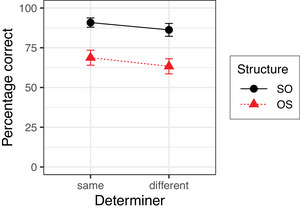 Figure 6
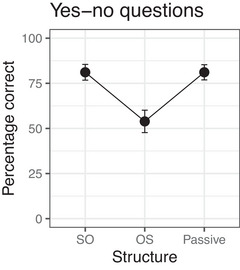 Figure 7
 Figure 8
 Figure 9
 Figure 10
 Figure 11
 Figure 12
 Figure 13
 Figure 14
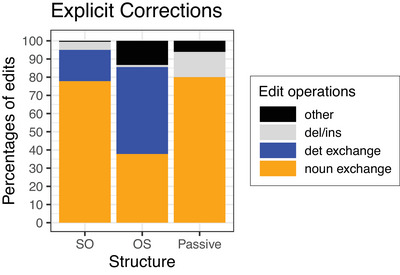 Figure 15
 Figure 16
 Figure 17
 Figure 18
 Figure 19
 Figure 20
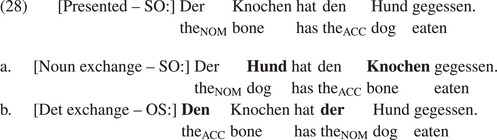 Figure 21
 Figure 22
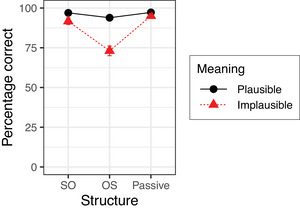 Figure 23
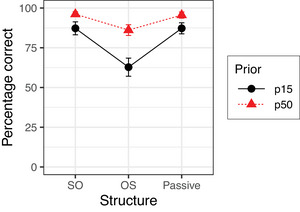 Figure 24
 Figure 25
 Figure 26
 Figure 27
 Figure 28
 Figure 29
 Figure 30
 Figure 31
 Figure 32
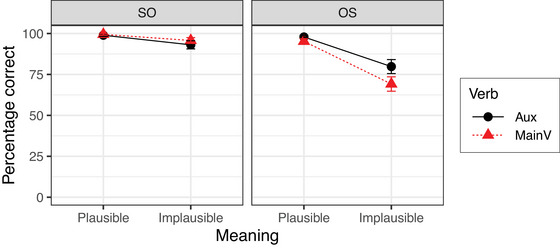 Figure 33
 Figure 34
 Figure 35
Peer Reviews
No public reviews on file for this paper yet. If you reviewed it on a platform where reviews are public (OpenReview, ICLR, NeurIPS, ICML), you can paste yours below so the community can read it here.
Videos
No videos yet. Explain this paper in a talk, walkthrough, or lecture? Add one.
Taxonomy
TopicsNeurobiology of Language and Bilingualism · Language Development and Disorders · Action Observation and Synchronization