The impact of negative emotions on adolescents’ nonsuicidal self-injury thoughts: an integrated application of machine learning and multilevel logistic models
Chan-Young Ahn, Jin-Ha Kim, Sojung Kim, Jae-Won Kim, Jung-Jo Na, Dong Gi Seo, Jong-Sun Lee

TL;DR
This study uses machine learning and statistical models to find that loneliness, anxiety, and emptiness are key predictors of self-harm thoughts in adolescents.
Contribution
The study integrates machine learning with multilevel modeling to identify emotional predictors of nonsuicidal self-injury thoughts in adolescents.
Findings
Loneliness was the strongest predictor of NSSI thoughts with a feature importance of 0.40.
Anxiety and emptiness each increased the odds of NSSI thoughts by 24% per unit increase.
Multilevel modeling showed uniform effects across participants despite individual variability.
Abstract
Non-Suicidal Self-Injury (NSSI) is a prevalent and complex behavior among adolescents, often linked to negative emotions such as loneliness, anxiety, and emptiness. Traditional self-report and experimental methods rely on autobiographical recall and are therefore vulnerable to bias and low ecological validity. Accordingly, approaches that repeatedly sample NSSI-related feelings and contexts in daily life such as Ecological Momentary Assessment (EMA) are needed. This study aimed to identify emotional predictors of NSSI thoughts among adolescents using machine learning and multilevel logistic regression. The study included 42 adolescents (aged 12–15 years) who had engaged in NSSI in the past year. Participants reported their mood and NSSI behaviors three times daily over a 14-day EMA period via a smartphone application. Predictor variables included depression, anxiety, loneliness,…
Genes, proteins, chemicals, diseases, species, mutations and cell lines named across the full text — each resolved to its canonical identifier and authoritative record.
Click any figure to enlarge with its caption.
 Figure 1
 Figure 2
 Figure 3
 Figure 4
 Figure 5
 Figure 6
 Figure 7
 Figure 8
 Figure 9
 Figure 10
 Figure 11
 Figure 12
 Figure 13
 Figure 14
 Figure 15
 Figure 16
 Figure 17
 Figure 18
 Figure 19
 Figure 20
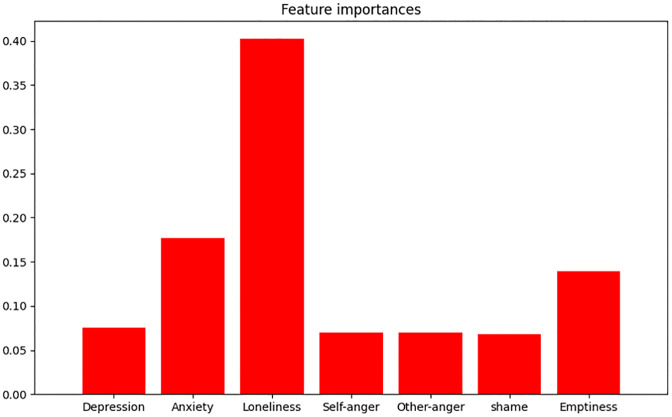 Figure 21
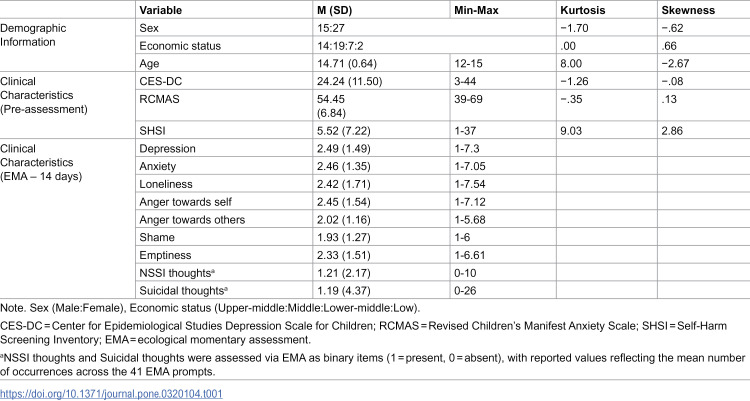 Figure 22
 Figure 23
 Figure 24
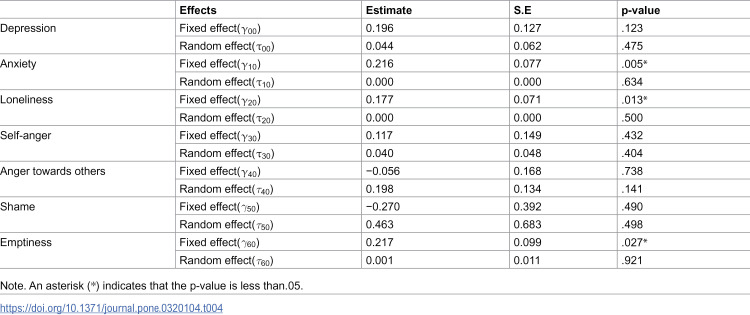 Figure 25
Peer Reviews
No public reviews on file for this paper yet. If you reviewed it on a platform where reviews are public (OpenReview, ICLR, NeurIPS, ICML), you can paste yours below so the community can read it here.
Videos
No videos yet. Explain this paper in a talk, walkthrough, or lecture? Add one.
Taxonomy
TopicsSuicide and Self-Harm Studies · Mental Health via Writing · Digital Mental Health Interventions