University scientists’ willingness to participate in public engagement: A concept explication
Becca Beets, Mikhaila N. Calice, Lindsey Middleton, Dominique Brossard, Dietram A. Scheufele, Luye Bao, Todd P. Newman, Jo Handelsman

TL;DR
This paper explores which public engagement activities university scientists are willing to participate in, identifying key dimensions and factors influencing their willingness.
Contribution
The study provides a systematic categorization of scientists' willingness to engage in public activities and identifies influencing factors.
Findings
Five dimensions of engagement were identified: public scholarship, educational activities, direct engagement, stakeholder collaboration, and industry engagement.
Institutional culture, professional status, and attitudes significantly influence scientists' willingness to participate in engagement activities.
The categorization of engagement dimensions offers a blueprint for future research and institutional support strategies.
Abstract
Public engagement is increasingly recognized as a critical responsibility of the scientific community. Scientists in academic settings are well positioned to lead these efforts, but they are not always willing or able to participate in engagement. Public engagement can encompass a range of activities that may require different resources and skills, and which may have different outcomes for both scientists and non-scientists. Therefore, understanding which activities scientists are willing to participate in is critical for supporting their engagement efforts at the institutional level. Using survey data from a case study of science faculty at a large land-grant university in the United States, we conduct a systematic concept explication to better understand the dimensions of public engagement activities that scientists are willing to participate in. Based on thirteen different…
Genes, proteins, chemicals, diseases, species, mutations and cell lines named across the full text — each resolved to its canonical identifier and authoritative record.
Click any figure to enlarge with its caption.
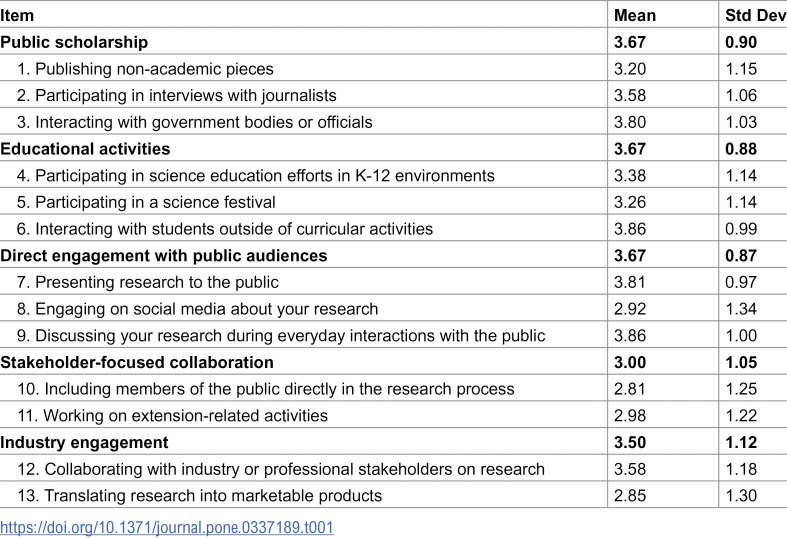 Figure 1
 Figure 2
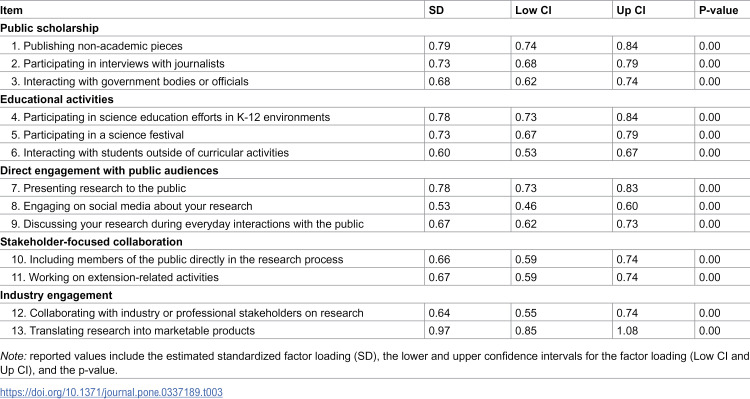 Figure 3
 Figure 4
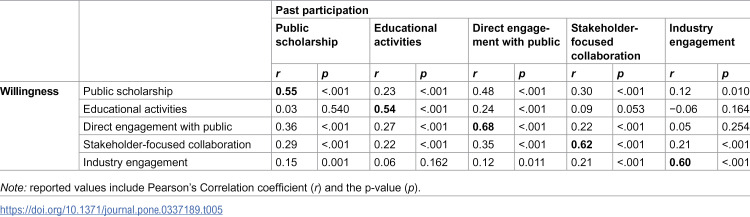 Figure 5
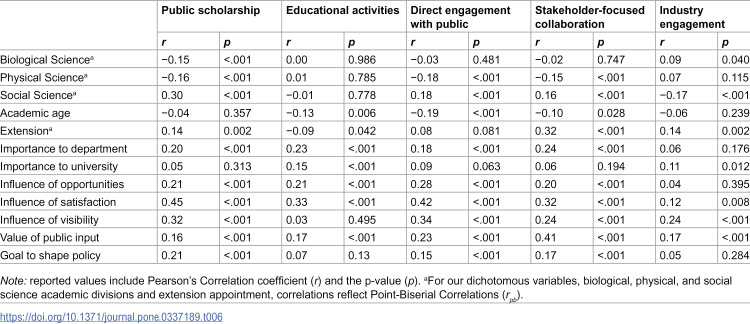 Figure 6
Peer Reviews
No public reviews on file for this paper yet. If you reviewed it on a platform where reviews are public (OpenReview, ICLR, NeurIPS, ICML), you can paste yours below so the community can read it here.
Videos
No videos yet. Explain this paper in a talk, walkthrough, or lecture? Add one.
Taxonomy
TopicsClimate Change Communication and Perception · Service-Learning and Community Engagement · Innovative Approaches in Technology and Social Development