Maternal attachment and perception of motherhood in relation to third-trimester antenatal depression: a cross-sectional analysis
Nicoleta Soldan, Cristiana Glavce, Andrei Kozma, Cristina Stan, Monica Petrescu, Roxana Maier, Suzana Turcu

TL;DR
This study shows that a woman's attachment style and how she feels about becoming a mother can predict antenatal depression in late pregnancy, beyond standard screening tools.
Contribution
The study introduces a pragmatic psychosocial screening approach using perception of motherhood and attachment typology to enhance antenatal depression detection.
Findings
Secure attachment was linked to minimal antenatal depression risk, while anxious–ambivalent attachment increased vulnerability.
A negative perception of motherhood was strongly associated with higher depressive symptoms compared to a positive perception.
In adjusted models, negative perception and anxious–ambivalent attachment independently predicted antenatal depression.
Abstract
Antenatal depression is a common complication of pregnancy, with consequences spanning maternal mental health, obstetric outcomes, and early mother–infant adaptation. Effective early identification requires integrating psychological and contextual information alongside validated screening. This study examined whether adult attachment style and the perception of motherhood are associated with antenatal depressive severity in late pregnancy, beyond socio-demographic factors. In a cross-sectional analysis of 140 third-trimester women, adult attachment (Revised Adult Attachment Scale, R-AAS) and depressive symptoms (Edinburgh Postnatal Depression Scale, EPDS) were assessed together with psychosocial indicators (pregnancy planning, partner support, and perception of motherhood). Bivariate associations were tested with χ2 (Cramér’s V), and multivariable effects with penalized logistic…
Genes, proteins, chemicals, diseases, species, mutations and cell lines named across the full text — each resolved to its canonical identifier and authoritative record.
Click any figure to enlarge with its caption.
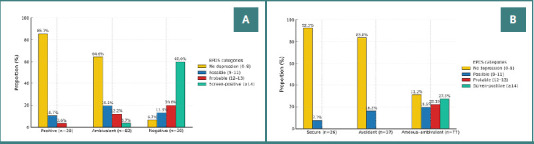 Figure 1
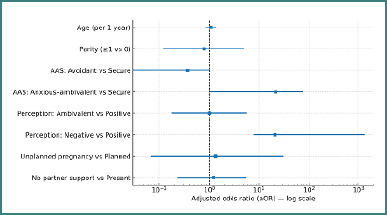 Figure 2
Peer Reviews
No public reviews on file for this paper yet. If you reviewed it on a platform where reviews are public (OpenReview, ICLR, NeurIPS, ICML), you can paste yours below so the community can read it here.
Videos
No videos yet. Explain this paper in a talk, walkthrough, or lecture? Add one.
Taxonomy
TopicsMaternal Mental Health During Pregnancy and Postpartum · Attachment and Relationship Dynamics · Infant Development and Preterm Care