A Reassessment of the Genomic Ancestry of the World's Largest Captive Baboon Colony
Giacomo Mercuri, Fabrizio Dallaspezia, Francesco Montinaro, Cristian Capelli

TL;DR
This study finds that a large baboon colony in Texas has unexpected genetic contributions from other baboon species, which could affect biomedical research.
Contribution
The study reveals previously unreported genetic contributions from additional Papio species in a major biomedical research baboon colony.
Findings
Primary genetic contributions come from P. anubis and P. cynocephalus.
Almost 5% of the colony shows genetic contributions from other Papio species, notably P. hamadryas.
The findings highlight the importance of considering genetic diversity in future biomedical studies using this colony.
Abstract
The Southwest National Primate Research Center of San Antonio, Texas, hosts one of the largest captive colonies of baboons used for biomedical research. Pedigreed animals can be traced back to the second part of the last century from individuals of two Papio species: P. anubis and P. cynocephalus. We leveraged recently published genomic data from more than 800 baboons to investigate the ancestry profile of the colony members. By combining phylogenetic analysis of mitochondrial DNA and nuclear genomic ancestry estimations, we confirmed P. anubis and P. cynocephalus as the main sources of the colony genetic variation. Previously unreported contributions from additional Papio species were also detected in almost 5% of the colony samples, of which P. hamadryas was the most notable, while others occurred sporadically across the data set. This extensive ancestry characterisation will be of…
Genes, proteins, chemicals, diseases, species, mutations and cell lines named across the full text — each resolved to its canonical identifier and authoritative record.
Click any figure to enlarge with its caption.
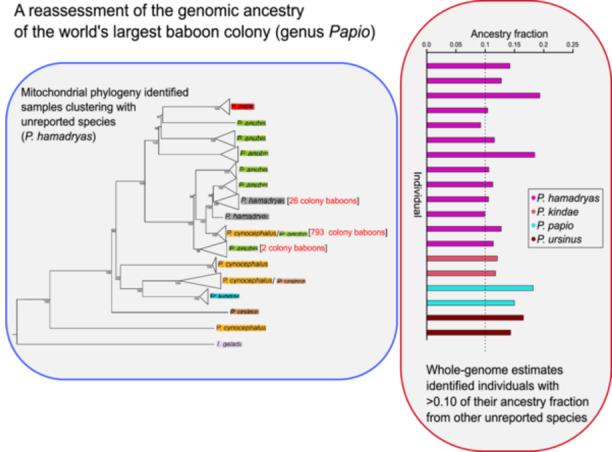 Figure 1
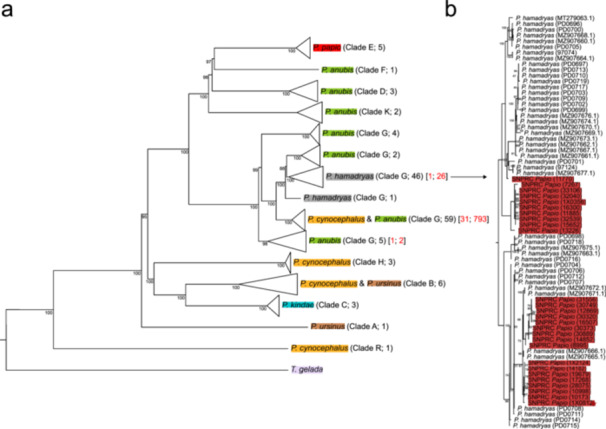 Figure 2
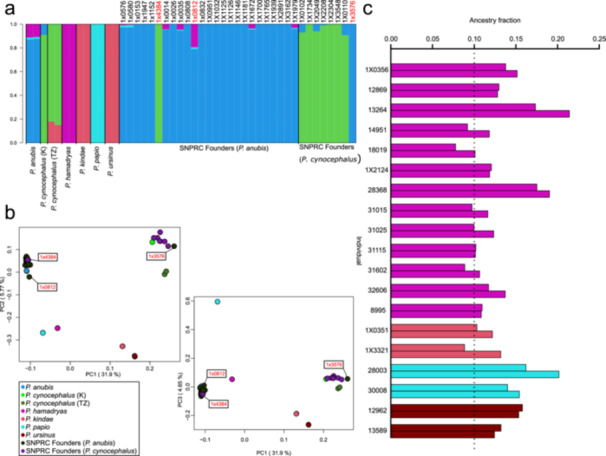 Figure 3
Peer Reviews
No public reviews on file for this paper yet. If you reviewed it on a platform where reviews are public (OpenReview, ICLR, NeurIPS, ICML), you can paste yours below so the community can read it here.
Videos
No videos yet. Explain this paper in a talk, walkthrough, or lecture? Add one.
Taxonomy
TopicsPrimate Behavior and Ecology · Pleistocene-Era Hominins and Archaeology · Forensic and Genetic Research