Esketamine use in real-world clinical practice in patients with treatment-resistant depression
Ismael Conejero, Raquel Alvarez García, Alejandro Porras-Segovia, Ana María De Granda Beltrán, Sergio Benavente López, Ezequiel Di Stasio, Lucía Albarracín-García, Jorge Lopez-Castroman, Philippe Courtet, Enrique Baca-Garcia

TL;DR
This study examines how esketamine helps patients with treatment-resistant depression in real-world settings and finds that more doses increase remission chances.
Contribution
The study identifies factors like completing the full esketamine protocol and receiving more than 19 doses as predictors of remission in TRD patients.
Findings
36 out of 65 patients (55%) achieved remission during the follow-up period.
Patients who completed the standard esketamine protocol had a 67% remission rate.
Receiving more than 19 esketamine administrations was linked to a 70% remission rate.
Abstract
Esketamine has been shown to produce a major antidepressant response in patients with treatment-resistant depression (TRD). We evaluated the factors associated with achieving remission in these individuals. The study was carried out across four psychiatry departments in Madrid, Spain. Patients aged over 18 years were included if they received esketamine as an augmentation treatment for TRD. Standard esketamine protocol included an induction phase (4 weeks) and a maintenance phase (5 to 8 weeks). Subsequent treatment continuation was proposed. Clinical data and scores at the Clinical Global Impression scales were measured following each esketamine administration. Sixty-five patients initiated the treatment, and 45 patients (69.2%) completed the standard protocol. The median number of esketamine administrations was 19. The mean age was 53.09 and 52.3% of the patients were females. Out…
Genes, proteins, chemicals, diseases, species, mutations and cell lines named across the full text — each resolved to its canonical identifier and authoritative record.
Click any figure to enlarge with its caption.
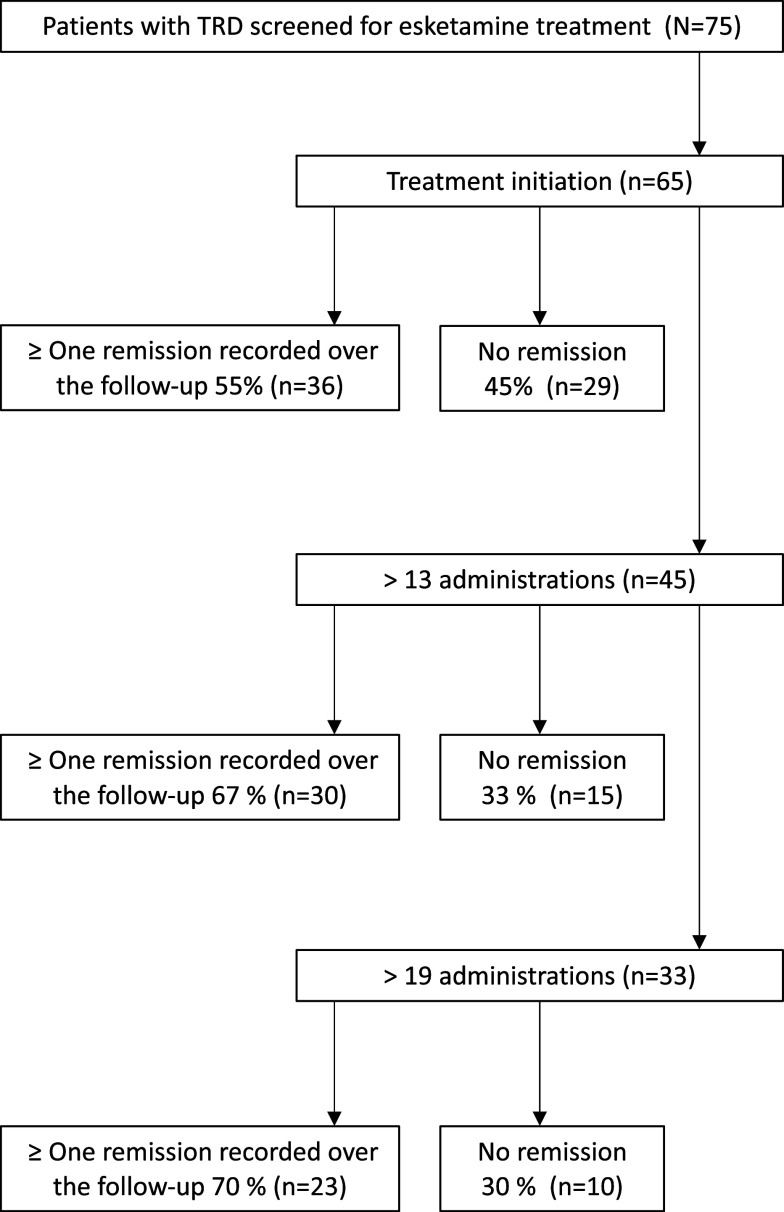 Figure 1
 Figure 2
 Figure 3
 Figure 4
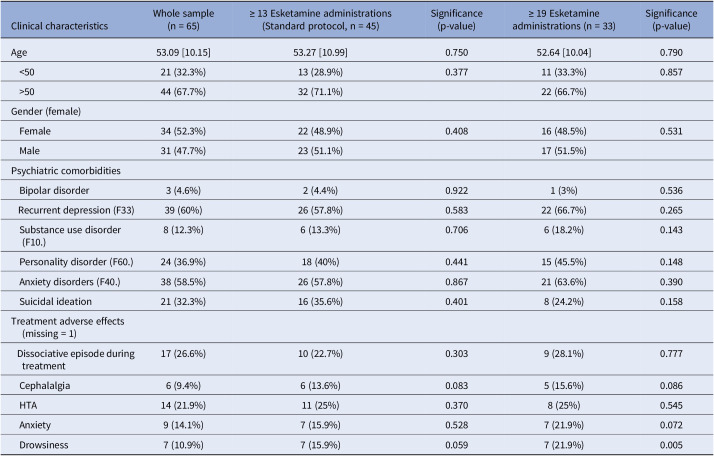 Figure 5
Peer Reviews
No public reviews on file for this paper yet. If you reviewed it on a platform where reviews are public (OpenReview, ICLR, NeurIPS, ICML), you can paste yours below so the community can read it here.
Videos
No videos yet. Explain this paper in a talk, walkthrough, or lecture? Add one.
Taxonomy
TopicsTreatment of Major Depression · Mental Health Research Topics · Schizophrenia research and treatment