A new family of bacterial actin-like proteins regulates cell morphology in a filamentous cyanobacterium
Alicia Nguyen, Garrett M. Jenkins, Peyton D. Brones, Gabriel A. Parrett, Guy M. Hagen, Jeremy M. Bono, Douglas D. Risser

TL;DR
Researchers discovered a new type of bacterial actin protein, FcmB, that helps control cell shape in filamentous cyanobacteria and evolved from a plasmid-related protein.
Contribution
Identification of FcmB, a novel bacterial actin-like protein family, and its role in cell morphology regulation in cyanobacteria.
Findings
FcmB regulates cell morphology in filamentous cyanobacteria, similar to MreB, but is not related to it.
FcmB forms membrane-bound filaments, and FcmC is essential for its proper localization.
FcmB evolved from a plasmid partitioning system through horizontal gene transfer.
Abstract
Actin proteins are common to all domains of life and exhibit ATP-dependent polymerization to form filaments. In bacteria, four families of bacterial actin-like proteins (BALPs) have been identified and characterized. These BALPs are involved in plasmid partitioning (ParM), cell division (FtsA), magnetosome positioning (MamK), and cell morphology (MreB). Here, we report the identification of a fifth family of BALP, FcmB. Using the model filamentous cyanobacterium Nostoc punctiforme, we demonstrate that FcmB is a BALP that regulates cell morphology in filamentous cyanobacteria. Deletion of fcmB, or fcmC, which encodes an FcmB-interacting protein, resulted in the loss of rod morphology, similar to the phenotype reported for mreB mutants in other bacteria, including cyanobacteria. However, despite the apparent functional similarity, fcmB is not a paralog of mreB, but rather was acquired by…
Genes, proteins, chemicals, diseases, species, mutations and cell lines named across the full text — each resolved to its canonical identifier and authoritative record.
Click any figure to enlarge with its caption.
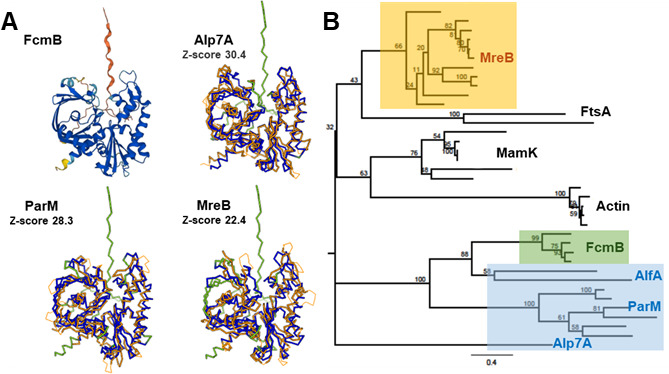 Figure 1
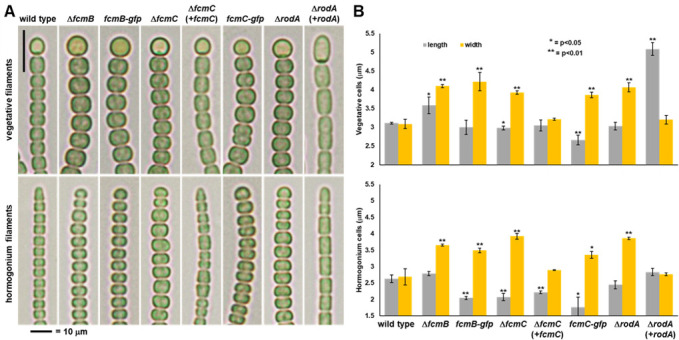 Figure 2
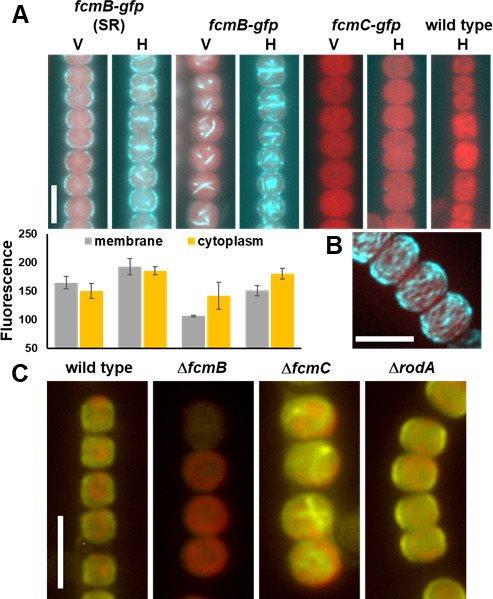 Figure 3
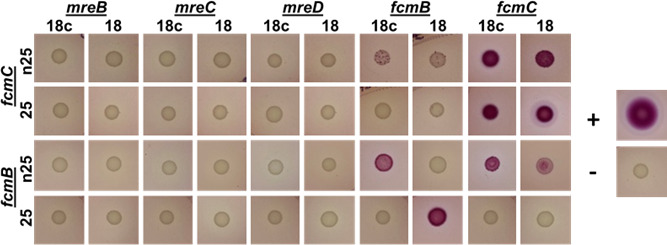 Figure 4
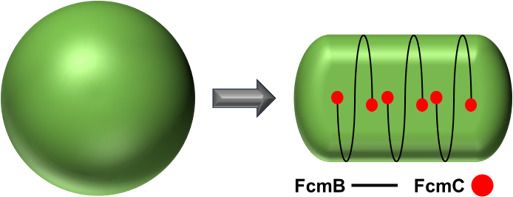 Figure 5
Peer Reviews
No public reviews on file for this paper yet. If you reviewed it on a platform where reviews are public (OpenReview, ICLR, NeurIPS, ICML), you can paste yours below so the community can read it here.
Videos
No videos yet. Explain this paper in a talk, walkthrough, or lecture? Add one.
Taxonomy
TopicsBacterial Genetics and Biotechnology · Geomagnetism and Paleomagnetism Studies · Photosynthetic Processes and Mechanisms