Tiny Bites, a digital health intervention delivered in early childhood education and care centres to support educators and caregivers to prevent childhood obesity: study protocol for a cluster randomised controlled trial
Sze Lin Yoong, Melanie Lum, Gloria K W Leung, Nicole Pearson, Helen Truby, Clare Dix, Najma A Moumin, Luke Wolfenden, Jaithri Ananthapavan, Alice Grady, John Wiggers, Tessa Delaney, Lucie Rychetnik, Maria Romiti, Hannah Lamont, Sonya Stanley, Michelle Lim, Chris Oldmeadow

TL;DR
Tiny Bites is a digital health program aiming to prevent childhood obesity by supporting educators and caregivers in early childhood education centers.
Contribution
This study introduces a novel digital health intervention targeting obesity prevention through early childhood education and caregiver engagement.
Findings
The study will assess the impact of Tiny Bites on child body mass index (zBMI) over 18 months.
Secondary outcomes include breastfeeding duration, diet quality, and responsive feeding practices.
The trial will evaluate program cost-effectiveness and engagement among educators and caregivers.
Abstract
Infant feeding practices in the first 2 years of life are linked to long-term weight trajectories. Despite the importance of obesity prevention interventions, there are no randomised controlled trials (RCTs) evaluating early childhood education and care (ECEC) and primary caregiver-targeted interventions on child weight and feeding outcomes. To assess the efficacy of an 18-month digital health intervention (Tiny Bites) delivered to ECEC services and primary caregivers of children aged 4 to ≤12 months on child age-adjusted and sex-adjusted body mass index-for-age z-score (zBMI) relative to usual care control in the Hunter New England (HNE) region of New South Wales, Australia. This type 1 hybrid cluster RCT will include up to 60 ECEC services and 540 children/caregiver dyads. The intervention supports ECEC services and caregivers to deliver recommended responsive feeding practices to…
Genes, proteins, chemicals, diseases, species, mutations and cell lines named across the full text — each resolved to its canonical identifier and authoritative record.
Click any figure to enlarge with its caption.
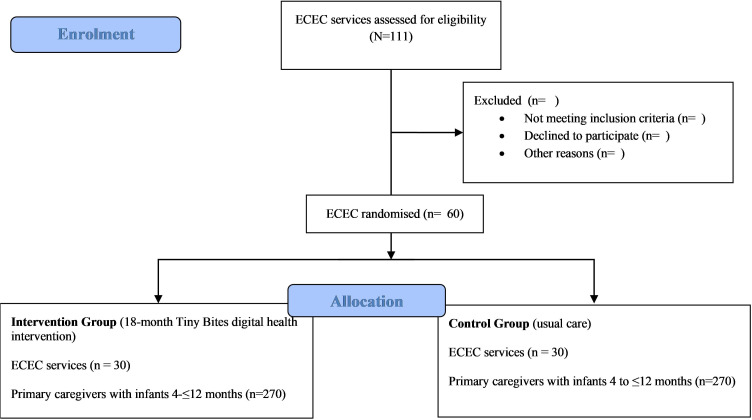 Figure 1
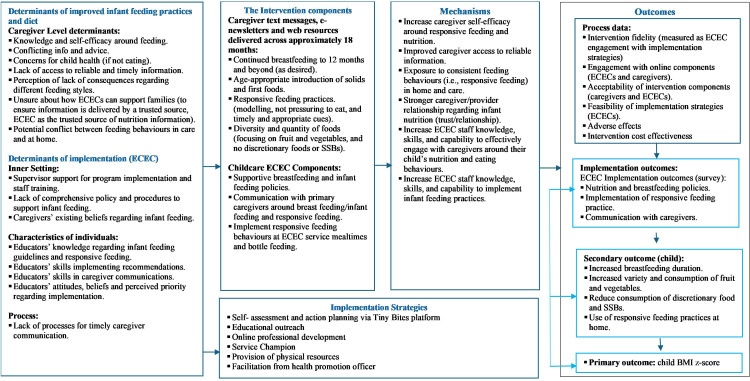 Figure 2
 Figure 3
Peer Reviews
No public reviews on file for this paper yet. If you reviewed it on a platform where reviews are public (OpenReview, ICLR, NeurIPS, ICML), you can paste yours below so the community can read it here.
Videos
No videos yet. Explain this paper in a talk, walkthrough, or lecture? Add one.
Taxonomy
TopicsMobile Health and mHealth Applications · Obesity, Physical Activity, Diet · Child Development and Digital Technology