Protocol for a multicentre randomised controlled trial of the Pharmacy Homeless Outreach Engagement Non-medical and Independent Prescriber (PHOENIx) intervention for people facing severe and multiple disadvantages
Richard Lowrie, Andrew McPherson, Jane Moir, Emma McGilvery, Katherine Vickery, Jen O’Loan, Gordon Rushworth, Vibhu Paudyal, Alex Adam, Elaine Thomson, Alison Rowe, Hannah Ali Akbar, John Murphy, John Budd, Fiona Raeburn, Trudi Marshall, Kirsty Nelson, Zofia Garstka

TL;DR
This study tests a new outreach program in Scotland to help homeless people with severe health and social issues, aiming to reduce drug overdoses and improve care.
Contribution
The PHOENIx intervention introduces a novel, integrated outreach model combining healthcare and social support for people facing severe disadvantage.
Findings
The PHOENIx intervention will be evaluated for its impact on reducing street-drug overdoses in a randomized controlled trial.
A health economic evaluation will assess the cost-effectiveness of PHOENIx compared to standard care.
Qualitative process evaluation will explore participant and stakeholder experiences of the intervention.
Abstract
People experiencing severe and multiple disadvantage (SMD: homelessness, substance use and criminal offending) have multiple intersecting unmet health and social care needs and high mortality rates, often due to street-drug overdose. Pilot randomised controlled trials (RCTs) suggest an integrated, holistic, collaborative outreach intervention (Pharmacy Homeless Outreach Engagement Non-medical Independent Prescribing Rx (PHOENIx)) involving generalist-trained pharmacists, nurses or General Practitioners accompanied by staff from third sector homeless organisations may improve outcomes, including reducing overdose. Multicentre, parallel group, prospective RCT with parallel economic and process evaluation. Set in six areas of Scotland, UK, 378 adults with SMD will be recruited and randomised (stratified by setting and previous non-fatal overdoses) to PHOENIx intervention in addition to…
Genes, proteins, chemicals, diseases, species, mutations and cell lines named across the full text — each resolved to its canonical identifier and authoritative record.
Click any figure to enlarge with its caption.
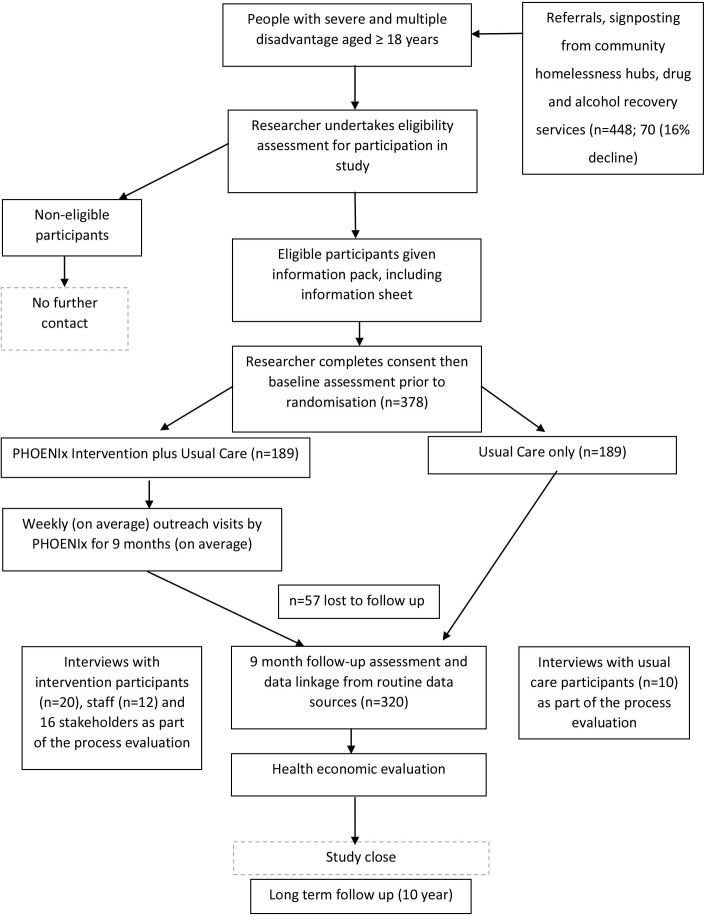 Figure 1
Peer Reviews
No public reviews on file for this paper yet. If you reviewed it on a platform where reviews are public (OpenReview, ICLR, NeurIPS, ICML), you can paste yours below so the community can read it here.
Videos
No videos yet. Explain this paper in a talk, walkthrough, or lecture? Add one.
Taxonomy
TopicsHomelessness and Social Issues · Pharmaceutical Practices and Patient Outcomes · Opioid Use Disorder Treatment