Inefficiencies identified in healthcare professional-to-patient handover practices for atrial fibrillation: a mixed-methods study in Brazil, China and Sri Lanka
Tiffany E Gooden, Jingya Wang, Alessandra C Goulart, Sheron A Vethanayagam, Hao Wang, Ana C Varella, Elisabete Paschoal, Powsiga Uruthirakumar, Shribavan Kanesamoorthy, Shivany Shanmugathas, Hui Zhang, Jiaoyue Zhong, Mei Feng, Xiaojing Li, Mahesan Guruparan

TL;DR
This study finds that healthcare professionals in Brazil, China, and Sri Lanka inconsistently share information with patients about atrial fibrillation, affecting care quality and patient safety.
Contribution
The study identifies cross-country inefficiencies in patient handover practices for atrial fibrillation in low- and middle-income countries.
Findings
Patient-held health records are inconsistently used for self-care and information continuity across the three countries.
Patients often rely on external sources for additional information, which disadvantages those with limited resources, especially in China.
A global standard for patient-held health records is recommended to improve healthcare resilience and patient outcomes in LMICs.
Abstract
Information continuity and self-care are important for optimal management of atrial fibrillation (AF) to reduce complications (eg, stroke) and improve prognosis and patient satisfaction. This can be achieved through handover of information from healthcare professionals (HCPs) to patients. In Brazil, China and Sri Lanka, we conducted a mixed-methods study to identify cross-country differences, similarities, barriers and facilitators regarding HCP-to-patient handover on AF. Adults (≥18 years) with AF who spoke the local languages were included. Anyone with hearing or cognitive impairment was excluded. A questionnaire was administered and focus group discussions (FGDs) conducted. χ2 tests identified differences within and between countries on use of patient-held health records (PHRs); a content analysis identified perspectives and experiences of HCP-to-patient handover. Data were then…
Genes, proteins, chemicals, diseases, species, mutations and cell lines named across the full text — each resolved to its canonical identifier and authoritative record.
Click any figure to enlarge with its caption.
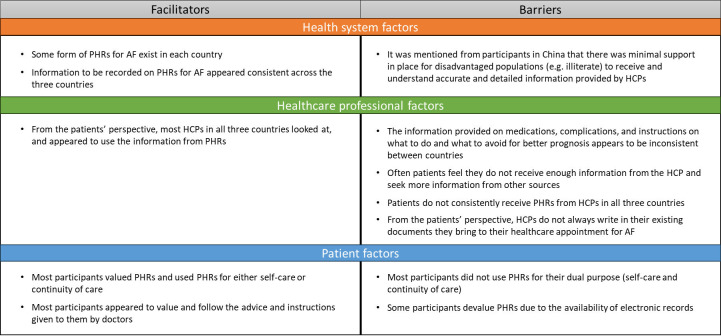 Figure 1
Peer Reviews
No public reviews on file for this paper yet. If you reviewed it on a platform where reviews are public (OpenReview, ICLR, NeurIPS, ICML), you can paste yours below so the community can read it here.
Videos
No videos yet. Explain this paper in a talk, walkthrough, or lecture? Add one.
Taxonomy
TopicsHospital Admissions and Outcomes · Atrial Fibrillation Management and Outcomes · Cardiac pacing and defibrillation studies