Ene-Allenes: Access from Dialkynes by an Intramolecular anti-Carbopalladation Cascade
Pedram Kalvani, Catherine Vanbel, Heinrich F. von Köller, Daniel B. Werz

TL;DR
A new palladium-catalyzed reaction creates complex ene-allenes from dialkynes, forming multiple carbon-carbon bonds efficiently.
Contribution
A novel intramolecular palladium-catalyzed cascade combining anti- and syn-carbopalladation is introduced for ene-allene synthesis.
Findings
The cascade reaction forms two new carbon–carbon bonds across the first double bond.
The process terminates via β-hydride elimination from a vinyl Pd(II) complex.
Diverse ene-allenes in oligo(hetero)cyclic systems are synthesized with up to 73% yield.
Abstract
Herein, an intramolecular palladium-catalyzed cascade reaction is reported consisting of both formal anti-carbopalladation and syn-carbopalladation of internal alkynes. This process leads to two new carbon–carbon bonds across the first double bond formed. The cascade is terminated by β-hydride elimination from the emerging vinyl Pd(II) complex. As a result, di-, tri-, and tetrasubstituted ene-allenes embedded in an oligo(hetero)cyclic ring system are synthesized in yields of up to 73%.
Genes, proteins, chemicals, diseases, species, mutations and cell lines named across the full text — each resolved to its canonical identifier and authoritative record.
Click any figure to enlarge with its caption.
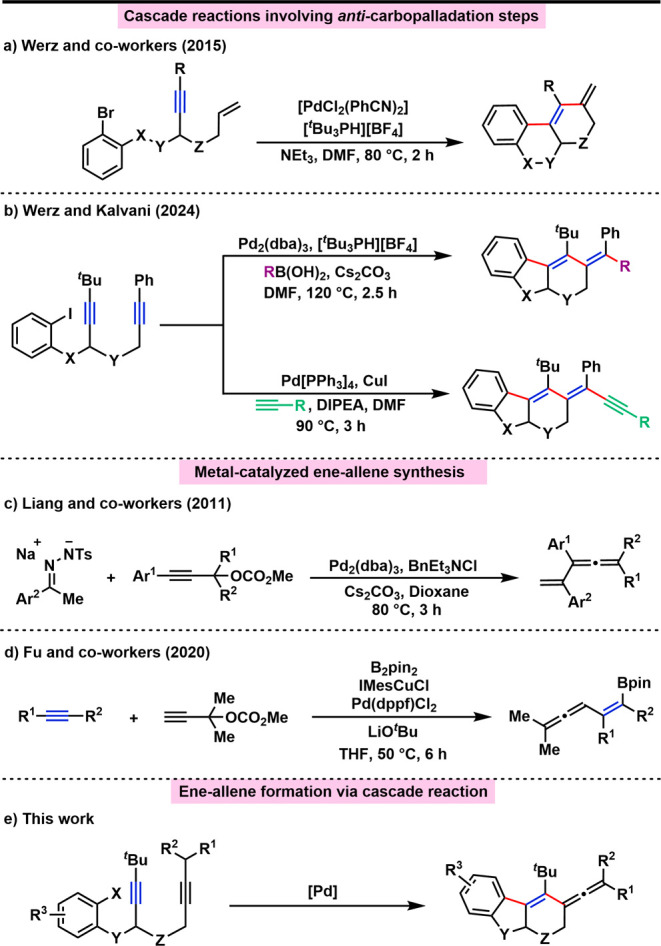 Figure 1
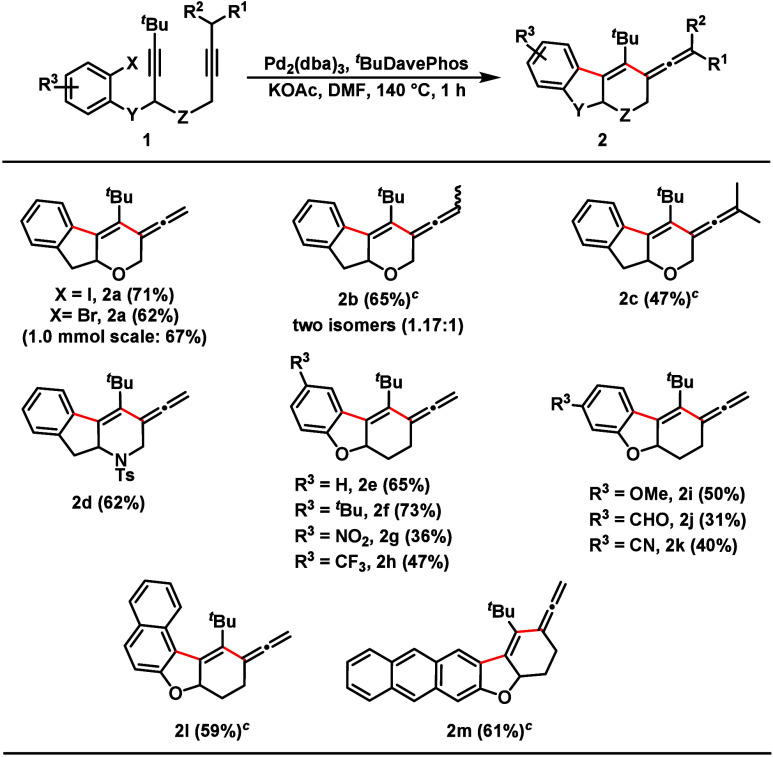 Figure 2
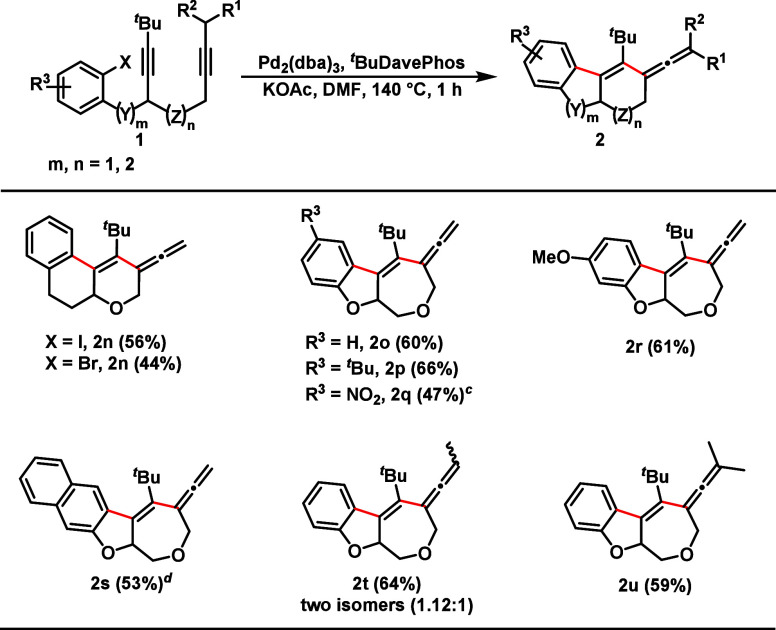 Figure 3
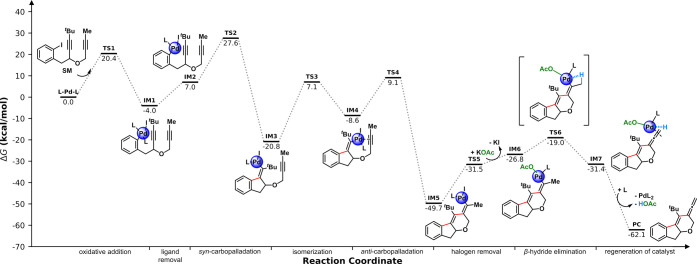 Figure 4
 Figure 5
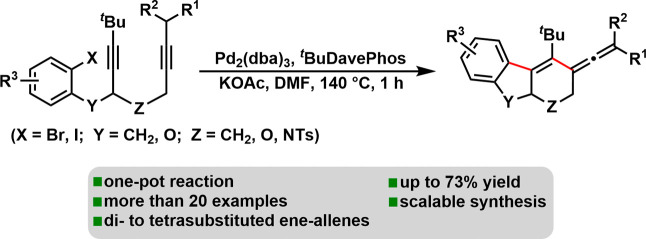 Figure 6
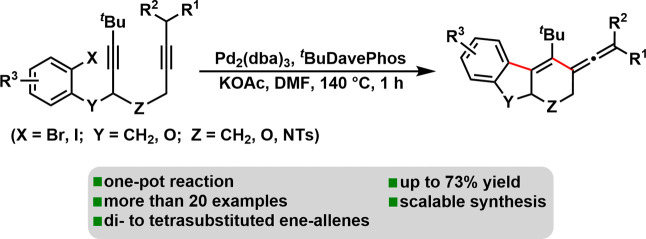 Figure 7
Peer Reviews
No public reviews on file for this paper yet. If you reviewed it on a platform where reviews are public (OpenReview, ICLR, NeurIPS, ICML), you can paste yours below so the community can read it here.
Videos
No videos yet. Explain this paper in a talk, walkthrough, or lecture? Add one.
Taxonomy
TopicsCatalytic C–H Functionalization Methods · Catalytic Alkyne Reactions · Catalytic Cross-Coupling Reactions