Presentation of multiple endocrine neoplasia type 2A-associated ectopic cushing’s syndrome: case report and a systematic review
Wei Wang, Wei-Ying Chen, Mei-Xian Zhang, Zhen-Yu Chen, Zhi-Lie Cao, Jun-Wei Wang, Wu-Gen Yao, Jian-Qiang Zhao, Fei-Ping Li, Hong-Yuan Yu, Jun Lu, Xiao-Ping Qi

TL;DR
This paper reports a rare case of Cushing’s syndrome linked to a genetic disorder and reviews 21 similar cases to better understand the condition and its treatment.
Contribution
The study provides a comprehensive case report and systematic review of MEN 2-related ectopic Cushing’s syndrome, highlighting clinical patterns and treatment outcomes.
Findings
MEN 2B patients developed Cushing’s syndrome earlier than MEN 2A patients.
Bilateral adrenalectomy achieved cure in most cases of Cushing’s syndrome caused by pheochromocytoma.
Prognosis for Cushing’s syndrome due to advanced medullary thyroid carcinoma remains poor despite treatment.
Abstract
Multiple endocrine neoplasia type 2 (MEN 2)-related ectopic Cushing’s syndrome (ECS) continues to present a clinical challenge due to its rarity and complexity. This study combines case analysis with a systematic literature review to elucidate the disease patterns. We present a 55-year-old male with MEN 2-associated ECS caused by metastatic medullary thyroid carcinoma (MTC) and review 21 literature cases. The mean age of ECS diagnosis was 37.0 years (range: 13-72), with a male predominance (64%). MEN 2A (16 cases) and MEN2B (6 cases) involved RET exons 10, 11, 16, with MEN2B patients developed ECS earlier than MEN 2A (P = 0.002). Of these, 14 presented ECS due to advanced-MTC (50% with distant metastasis), with the diagnosis of ECS following that of MTC in 57% of patients after an average interval of 72 months, while 43% had concurrent diagnoses. 7 were due to pheochromocytoma (PHEO),…
Genes, proteins, chemicals, diseases, species, mutations and cell lines named across the full text — each resolved to its canonical identifier and authoritative record.
Click any figure to enlarge with its caption.
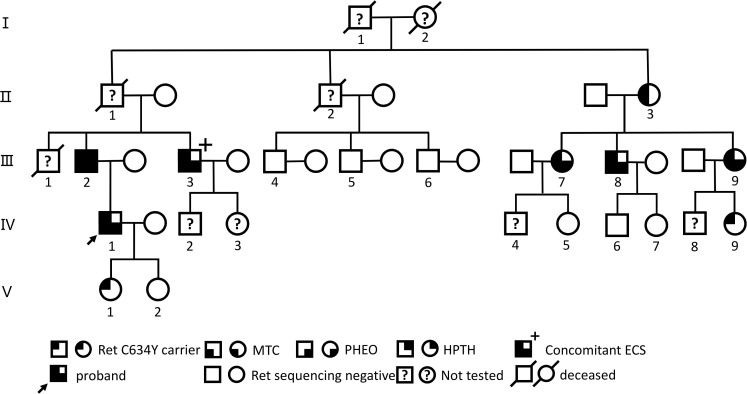 Figure 1
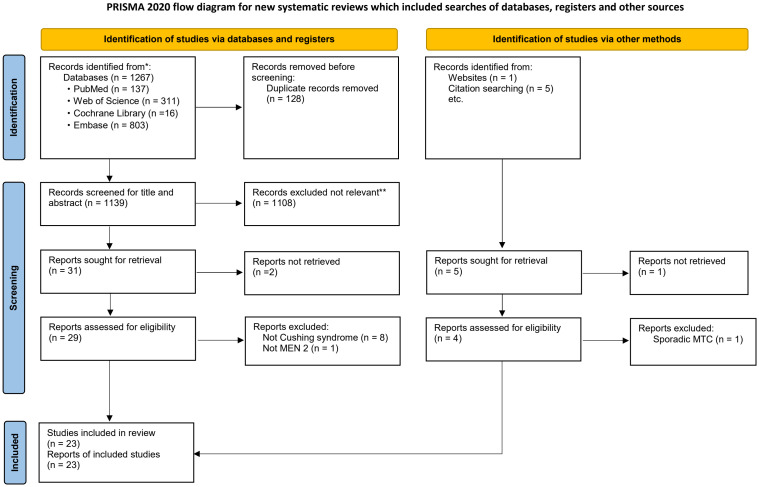 Figure 2
Peer Reviews
No public reviews on file for this paper yet. If you reviewed it on a platform where reviews are public (OpenReview, ICLR, NeurIPS, ICML), you can paste yours below so the community can read it here.
Videos
No videos yet. Explain this paper in a talk, walkthrough, or lecture? Add one.
Taxonomy
TopicsPituitary Gland Disorders and Treatments · Adrenal and Paraganglionic Tumors · Neuroendocrine Tumor Research Advances