Electronic structure blurring-mediated solid-state H2O2 electrosynthesis with high productivity
Yuxiang Zhang, Jingjing Duan, Markus Antonietti, Sheng Chen

TL;DR
This paper introduces a method to produce stable solid-state hydrogen peroxide (H2O2) using a one-step electrosynthesis process, offering a safer and more efficient alternative to traditional liquid H2O2.
Contribution
The paper presents a novel one-step electrosynthesis method for solid-state H2O2 with high productivity and stability, enabled by electronic structure blurring.
Findings
Solid-state H2O2 was produced with a productivity of 0.943 mol L−1 h−1.
The solid-state H2O2 showed high gravimetric density (>30 wt%) and stability over 100 cycles and 160 days.
Electronic structure blurring homogenizes charge distributions, preventing bond breakage in H2O2 molecules.
Abstract
The development of H2O2 economy is hampered by the instability of liquid-state bulk H2O2 solutions (2H2O2 → 2H2O + O2; ΔG° = −117 kJ mol−1). Comparatively, dispersing H2O2 molecules in solid-state materials would offer good physical stability with less of handling, leak and exposure risks, but suffers from fabrication schemes irrelevant to commercial applications. Mediated by the concept of electronic structure blurring, here we elaborate one-step electrosynthesis of solid-state H2O2 with productivity up to 0.943 mol L−1 h−1. Notably, the as-fabricated solid-state H2O2 features not only high H2O2 gravimetric densities ( > 30 wt%) but also good stability for repeated H2O2 loading/deloading over 100 cycles and shelf life over 160 days. Mechanism study underscores the electronic structure blurring formed at local catalytic environments that contributes to homogenizing charge distributions…
Genes, proteins, chemicals, diseases, species, mutations and cell lines named across the full text — each resolved to its canonical identifier and authoritative record.
Click any figure to enlarge with its caption.
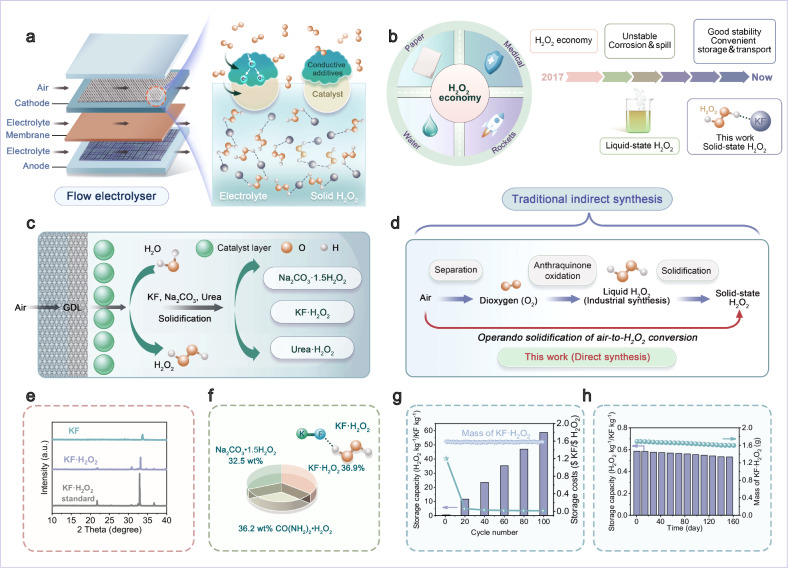 Figure 1
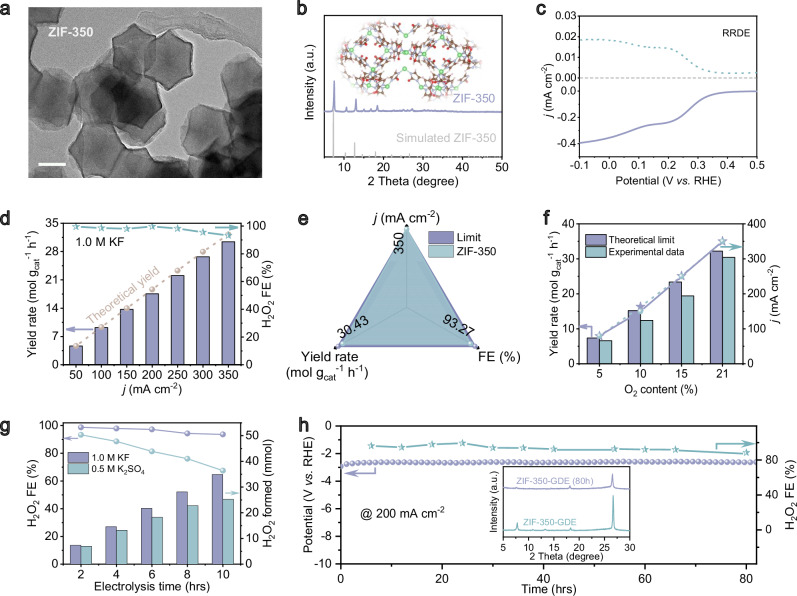 Figure 2
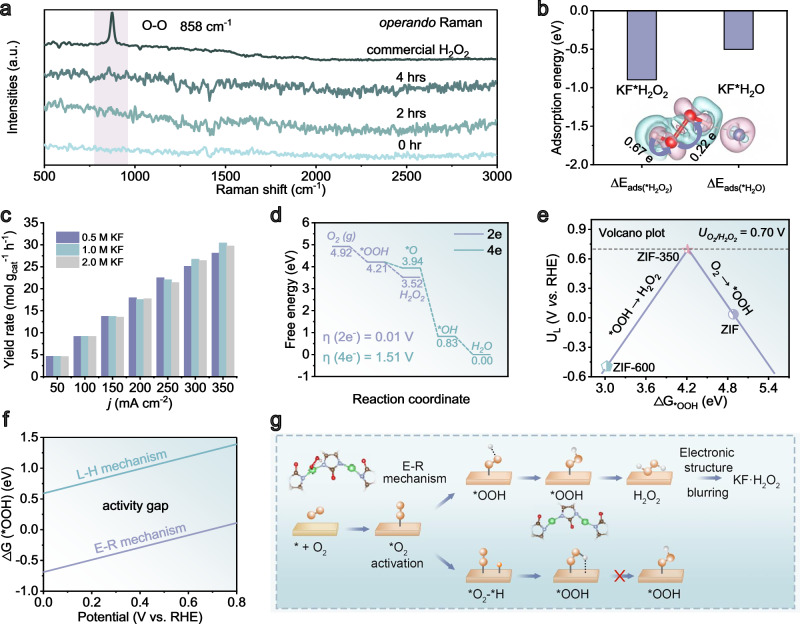 Figure 3
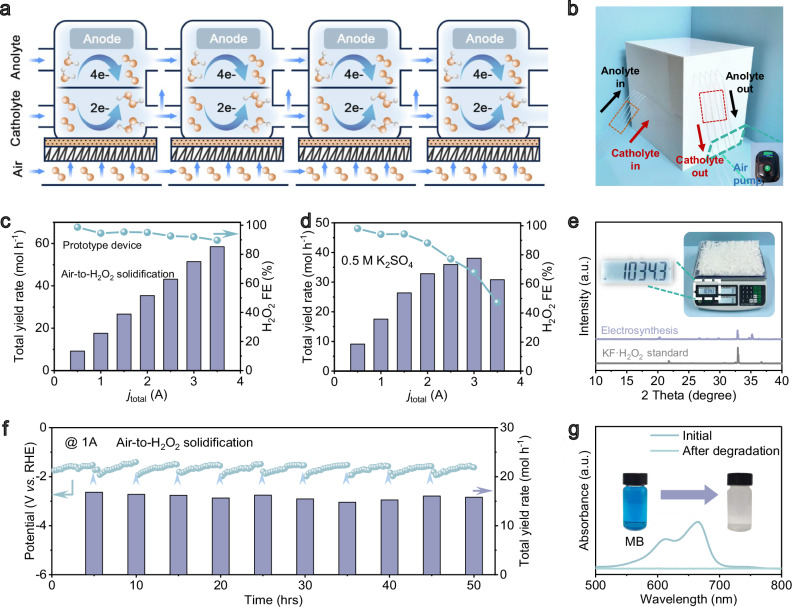 Figure 4
- —Jiangsu Natural Science Foundation (Grant No. BK 20230097), National Natural Science Foundation (Grant No. 92163124 and 52376193), European Union’s Framework Program for Research and Innovation Horizo
Peer Reviews
No public reviews on file for this paper yet. If you reviewed it on a platform where reviews are public (OpenReview, ICLR, NeurIPS, ICML), you can paste yours below so the community can read it here.
Videos
No videos yet. Explain this paper in a talk, walkthrough, or lecture? Add one.
Taxonomy
TopicsAdvanced battery technologies research · Electrocatalysts for Energy Conversion · Advanced Photocatalysis Techniques
Introduction
Conversion of renewable sources (like solar and winds) into electricity is an appealing pathway for developing sustainable society^1^. However, because of the temporal and spatial fluctuations of renewable sources, it is challenging to realize a steady generation of electricity; thus, the storage of electricity in the form of energy carrier is required^2^. In a hydrogen peroxide (H_2_O_2_) economy^2,3^, unstable H_2_O_2_ molecule is illustrated as a carrier of renewable electricity, beneficial from its high specific energy density (3.0 MJ^−1^, 60 wt%), hydrogen percentage (H_2_, 5.9 wt%) and only degradation product of water^2,4^. While the feasibility of H_2_O_2_ economy has been frequently questioned owning to the instability of H_2_O_2_ molecules, which are prone to decompose into H_2_O and O_2_ (2H_2_O_2_ → 2H_2_O + O_2_; ΔG° = −117 kJ mol^−1^) associated with elevated temperatures/pHs^5,6^, light illumination^7^ and/or trace metal ion impurities (like Fe^2+^, Cu^2+^, and Mn^2+^)^8,9^. The corrosion, spill and leakage hazards of liquid bulk H_2_O_2_ solutions (particularly at high concentrations >30 wt%) create dangerous runaway situations in the scheme of storage, transport and applications.
Comparatively, the dispersion of H_2_O_2_ molecules in solid-state materials can offer good physical stability with less of handling, leak and exposure risks. This would form a class of “solid-state H_2_O_2_” for sustainable H_2_O_2_ economy, e.g., starting by storing H_2_O_2_ molecules in solid host compounds, followed by transporting to consumption places, which is then released from the storage materials, leaving the primary solid compound for further storage to closes the cycle:
\documentclass[12pt]{minimal} \usepackage{amsmath} \usepackage{wasysym} \usepackage{amsfonts} \usepackage{amssymb} \usepackage{amsbsy} \usepackage{mathrsfs} \usepackage{upgreek} \setlength{\oddsidemargin}{-69pt} \begin{document}$${{{{\rm{H}}}}}_{2}{{{{\rm{O}}}}}_{2}+{{{\rm{h}}}}{{{\rm{ost\; materials}}}}\leftrightharpoons {{{{\rm{H}}}}}_{2}{{{{\rm{O}}}}}_{2}*{{{\rm{h}}}}{{{\rm{ost\; materials}}}}$$\end{document}To develop such an economy, a prerequisite for solid-state H_2_O_2_ materials is, among many other factors, high H_2_O_2_ gravimetric densities, H_2_O_2_ loading/deloading cycles and long shelf life. The improvement of performances requires each of these parameters to be optimized, but increasing one of them without compromising the others is difficult. For example, a vast array of materials can store H_2_O_2_ with high gravimetric densities (>30 wt%), but few of them can sustain loading/deloading cycles because of too strong (chemical bindings, like metal peroxides)^10^ or weak interactions (like van der waals forces). The repeated loading/deloading cycles requires reversible bindings between H_2_O_2_ molecules and host materials, while this leads to structure deterioration and consequently short shelf life (i.e., stability-cyclability trade-off).
Actually, researches since decade ago have already proposed the concept of solid-state H_2_O_2_ (i.e., CaO_2_·2H_2_O_2_(s)/H_2_O_2_)^11^. Yet in practice, no examples have been reported to satisfy all above criteria. In the preliminary research of this work, we have unexpectedly overcome the stumbling relationship of stability-cyclability trade-off. We have experimentally demonstrated peroxosolvates, a category of solid compounds formed by H_2_O_2_ molecules interacting with metal salts (i.e., KF·H_2_O_2_, CO(NH_2_)2·H_2_O_2_ and Na_2_CO_3_·1.5H_2_O_2_)^12^, which can show not only high H_2_O_2_ gravimetric densities (32.5–36.9 wt%) but also good physical stability for H_2_O_2_ loading/de-loading over 100 cycles and long shelf life over 160 days (Fig. 1g, h; Supplementary Figs. 1–6 and Supplementary Table 1). This result indicates peroxosolvates a very promising candidate for developing H_2_O_2_ economy, despite of their production schemes based on performed H_2_O_2_/O_2_ feedstocks (Fig. 1d)^12,13^, which are irrelevant to commercial applications because of high cost, complicated produces and/or productivities two orders of magnitude below benchmark industrial anthraquinone process (0.588 mol L^−1^ h^−1^).Fig. 1. Schematic illustration of H_2_O_2_ production.a Direct solid-state H_2_O_2_ electrosynthesis in flow cells. b Overview of the development for H_2_O_2_ economy. c Sketch of solid-state H_2_O_2_ electrosynthesis in the form of peroxosolvates at three-phase boundary. d Traditional and the present production diagrams for solid-state H_2_O_2_. e XRD patterns of KF·H_2_O_2_ as comparison to KF. f Theoretical H_2_O_2_ storage percentages for peroxosolvates like KF·H_2_O_2_, CO(NH_2_)2·H_2_O_2_ and Na_2_CO_3_·1.5H_2_O_2_. g, h Changes in accumulative H_2_O_2_ storage capacity and cost for KF·H_2_O_2_ after 100 cycles or 160 days.
As comparison to H_2_O_2_/O_2_, atmospheric air is unarguably the most abundant and cost-free source for oxygen-involved chemical reactions^14^, although the direct air fixation known to be challenging, and according to Le Chatelier’s principle^15^, generally leading to compromised reaction rates owning to low O_2_ level (21%). Recently, we and other groups have addressed this problem by reporting direct air-to-diluted H_2_O_2_ (<10 wt%) conversion at high selectivity by mediating gas diffusion electrodes^16,17^, ionic liquid^18^ and/or catalyst materials^19,20^. By blending this conversion with host materials, it would be possible to directly produce solid-state H_2_O_2_ from atmospheric air feedstock. Yet, the conversion productivity is still unable to rival anthraquinone route to H_2_O_2_ production, which is primarily due to the inherent instability of H_2_O_2_ molecules. Whenever the key H_2_O_2_ product is in situ generated and accumulated to high concentrations at local conditions, it spontaneously decomposes into H_2_O and O_2_. In line with this hypothesis, preventing H_2_O_2_ decomposition, and thereby stabilizing H_2_O_2_ at local environments, should promote efficient solid-state H_2_O_2_ electrosynthesis.
In this work, we report to stabilize H_2_O_2_ by borrowing the concept of “blurring effect” from image processing research field. Generally, blurring effect is a parasitic process of removing noise and artifacts during image optimization, which exhibits negative role of reducing image quality^21,22^. Here we extend this concept to electrochemistry and describe a stabilization mechanism of electronic structure blurring, which arises from charge redistribution between electrochemically generated H_2_O_2_ and host compounds (e.g., KF). This effect then homogenizes electron density across H–O and O–O bonds, blurring their localized charge polarization to prevent bond cleavage, and promoting solid-state H_2_O_2_ electrosynthesis approaching theoretical limit efficiency (93.3% at the limit current of ~350 mA cm^−2^). Experimentally, starting in an air-to-H_2_O_2_ conversion system in a flow-type cell (Fig. 1a), we have explored each possible parameter of local environments (like pHs^23^, solvents^24^, wettability^25^ and electric fields^26^), and unexpectedly observed operando interaction formed between solutes (i.e., KF) and local H_2_O_2_ molecules, which enables in situ electrosynthesis of solid-state H_2_O_2_. Notably, O_2_ from air diffuses through gas diffusion layer, adsorbs and is activated on the catalyst surface, which then couples with protons (H⁺) generated from H_2_O electrolysis to form H_2_O_2_. The operando formation of solid-state H_2_O_2_ has been achieved generally through its reaction with KF, urea, and Na_2_CO_3_, leading to the formation of peroxosolvates (Fig. 1c). By circumventing the instability of H_2_O_2_, this method offers a strategy that eliminates the need for the cumbersome and energy-intensive steps of traditional indirect solid H_2_O_2_ synthesis, enabling direct operando electrosynthesis of solid-state H_2_O_2_ (Fig. 1b, d).
Results
The feasibility of solid-state H2O2 storage in peroxosolvates
To facilitate H_2_O_2_ sequestration in solid compounds, the first requirement is high gravimetric density (wt.%). Figure 1e, f and Supplementary Fig. 1 present three primary proposed compounds, KF·H_2_O_2_, CO(NH_2_)2·H_2_O_2_ and Na_2_CO_3_·1.5H_2_O_2_, chemically synthesized via the following equations:
\documentclass[12pt]{minimal} \usepackage{amsmath} \usepackage{wasysym} \usepackage{amsfonts} \usepackage{amssymb} \usepackage{amsbsy} \usepackage{mathrsfs} \usepackage{upgreek} \setlength{\oddsidemargin}{-69pt} \begin{document}$${{{\rm{KF}}}}+{{{{\rm{H}}}}}_{2}{{{{\rm{O}}}}}_{2}\to {{{\rm{KF\cdot }}}}{{{{\rm{H}}}}}_{2}{{{{\rm{O}}}}}_{2}$$\end{document} \documentclass[12pt]{minimal} \usepackage{amsmath} \usepackage{wasysym} \usepackage{amsfonts} \usepackage{amssymb} \usepackage{amsbsy} \usepackage{mathrsfs} \usepackage{upgreek} \setlength{\oddsidemargin}{-69pt} \begin{document}$${{{{\rm{CO}}}}({{{{\rm{NH}}}}}_{2})}_{2}+{{{{\rm{H}}}}}_{2}{{{{\rm{O}}}}}_{2}\to {{{{\rm{CO}}}}({{{{\rm{NH}}}}}_{2})}_{2}\cdot{{{{\rm{H}}}}}_{2}{{{{\rm{O}}}}}_{2}$$\end{document} \documentclass[12pt]{minimal} \usepackage{amsmath} \usepackage{wasysym} \usepackage{amsfonts} \usepackage{amssymb} \usepackage{amsbsy} \usepackage{mathrsfs} \usepackage{upgreek} \setlength{\oddsidemargin}{-69pt} \begin{document}$${{{{\rm{Na}}}}}_{2}{{{{\rm{CO}}}}}_{3}+{1.5{{{\rm{H}}}}}_{2}{{{{\rm{O}}}}}_{2}\to {{{{\rm{Na}}}}}_{2}{{{{\rm{CO}}}}}_{3}\cdot{1.5{{{\rm{H}}}}}_{2}{{{{\rm{O}}}}}_{2}$$\end{document}Experimental evidence for formation of these peroxosolvates has been demonstrated by X-ray diffractions (XRD, Fig. 1e and Supplementary Fig. 2) and Fourier transform infrared spectra (FTIR, Supplementary Fig. 3). Mass ratio calculations show the nominal H_2_O_2_ gravimetric densities of 36.9 wt% for KF·H_2_O_2_, 36.2 wt% for CO(NH_2_)2·H_2_O_2_ and 32.5 wt% for Na_2_CO_3_·1.5H_2_O_2_, respectively (Fig. 1f). These peroxosolvates can be isolated as stable powder samples under ambient condition owning to intermolecular bondings formed between H atoms (from H_2_O_2_) and F/N/O atoms (from KF/CO(NH_2_)2/Na_2_CO_3_).
The second requirement for solid-state H_2_O_2_ storage lies in the ability to build up a reasonable loading/deloading cycle with long shelf life of the loaded state. In a typical cycle for KF, the low-temperature heating of KF·H_2_O_2_ simply releases H_2_O_2_, and then KF is left to be used again for further storage that closes the cycle. We explored this process for 100 repetitive storage-release cycles, and KF maintained its storage capacity, with only minor decay in H_2_O_2_ gravimetric densities (<1%, Fig. 1g and Supplementary Table 1). This underlines that side reactions, even with impurities present in the cycle, are rare. Using the 100 cycles lifetime as a base of calculation, the H_2_O_2_ storage capacity of KF increases linearly from 0.587 H_2_O_2_ kg^−1^/KF kg^−1^ to 58.73 H_2_O_2_ kg^−1^/KF kg^−1^. Correspondingly, the cost per unit mass of KF decreases sharply from 1.2 to 0.06 H_2_O_2_ (after 20 cycles) and then gradually to 0.012 H_2_O_2_ (after 100 cycles). We also analyzed the shelf life and found for KF·H_2_O_2_ stored under ambient, standard lab conditions a mass decline of 5.28% within 160 days (~mass decline, Fig. 1h). Similar results have also been recorded for CO(NH_2_)2·H_2_O_2_ and Na_2_CO_3_·1.5H_2_O_2_ (Supplementary Figs. 5, 6), thus highlighting the potential of using these peroxosolvates for H_2_O_2_ storage.
Direct solid-state H2O2 electrosynthesis
A key step for a future H_2_O_2_ energy cycle lies in the efficient electrochemical synthesis of such peroxosolvates, ideally from stranded green electricity and atmospheric air feedstock. For illustration, we have synthesized a metal-organic framework-derived catalyst for this purpose. The synthesis started by the coordinative assembly of Zn nodes and organic ligand (2-methylimidazole), followed by low-temperature calcination at 350 °C (the product is denoted as ZIF-350; Fig. 2a, b and Supplementary Figs. 7–15). Firstly, the catalytic activities of air-to-H_2_O_2_ solidification have been evaluated in KF electrolyte (Fig. 2c), showing oxygen reduction with electron transferred numbers of 2.1–2.5 in a rotating ring-disk electrode (RRDE) system, closely aligning with the theoretical two-electron transfer pathway (Supplementary Fig. 20). Quantitatively, the H_2_O_2_ Faradaic efficiencies (FEs) of ZIF-350 consistently exceeded 90% across the entire range of applied current densities, the values being 99.5–93.3% at 50–350 mA cm^−2^, respectively (Fig. 2d, e and Supplementary Figs. 21–24). Even at the theoretical limiting current density of air-to-H_2_O_2_ solidification (~350 mA cm^−2^), the FE reaches 93.3%, together with the high H_2_O_2_ yield rate of 30.64 mol g_cat_^−1^ h^−1^. The great activities for ZIF-350 have been further verified by high Faradaic efficiencies at low O_2_ concentrations (5, 10 and 15% O_2_; Fig. 2f and Supplementary Figs. 25–27), in addition to a high durability for 80 h with minimal fluctuation in Faradaic efficiencies at 200 mA cm^−2^ (Fig. 2h and Supplementary Figs. 28, 29).Fig. 2. Direct solid-state H_2_O_2_ electrosynthesis.a High-resolution transmission electron microscopy (HR-TEM) image of ZIF-350 catalyst (scale bar: 200 nm). b X-ray diffraction (XRD) pattern and structure illustration of ZIF-350 catalyst. c RRDE linear sweep voltammetry (LSV) of ZIF-350 catalyst recorded at a rotation rate of 1600 rpm, along with the detected H_2_O_2_ currents on a Pt ring electrode at a fixed potential of 1.2 V vs. RHE. d, e Faradaic efficiency (FE) and yield rates in flow cells. f The current densities at low O_2_-content environments in flow cells. g Cumulative H_2_O_2_ concentrations in different electrolytes in flow cells. h The stability test at 200 mA cm^−2^ in flow cells, with the inset showing the XRD patterns of catalyst before and after test.
Interestingly, without KF, the Faradic efficiencies for ZIF-350 substantially decline to 84.9% at 350 mA cm^−2^ in K_2_SO_4_ electrolyte (Supplementary Fig. 30). We attribute that to the stabilization of H_2_O_2_ by KF in the form of peroxosolvates already from the solution phase. This is also reflected in the analysis of H_2_O_2_ self-decomposition in K_2_SO_4_ electrolyte (Fig. 2g), where the overall H_2_O_2_ Faradaic efficiencies continuously decrease from 93.35 to 67.52% (H_2_O_2_ concentrations from 6.96 to 25.26 mmol) after prolonged electrolysis from 1 to 10 h. This is to be compared with data in KF electrolyte, where overall H_2_O_2_ Faradaic efficiencies only decline from 98.7 to 93.6%, while the cumulative H_2_O_2_ concentration nearly linearly grows from 7.36 to 34.9 mmol. The stabilization of H_2_O_2_ is verified by analyzing the further H_2_O_2_ reduction reaction to H_2_O, where the activities of H_2_O_2_ reduction in KF are significantly lower when compared to that in K_2_SO_4_ (Supplementary Fig. 31). All these experiments indicate additional advantages of KF solute for stabilizing H_2_O_2_ during electrosynthesis. Notably, the stabilizing mechanism observed with KF can be readily extended to other systems such as urea and Na_2_CO_3_, demonstrating the generality of this approach (Supplementary Fig. 32).
Mechanism study
The interaction between KF and H_2_O_2_ has been monitored by operando Raman spectra in a flow cell at the current density of 200 mA cm^−2^ in 1.0 M KF electrolyte, using an excitation wavelength of 750 nm (Fig. 3a). Starting with pristine KF electrolyte at 0 h, only weak Raman signal could be observed, due to the small Raman scattering cross-section of ionic KF compound. After 2-h electrolysis, a Raman vibration has emerged at 858 cm^−1^, whose peak intensity increases with elongated electrolysis at 4 h (Fig. 3a and Supplementary Fig. 33), leading to a sharp spectral band corresponding to the O–O stretching vibration in H_2_O_2_^20^. This result indicates continuous H_2_O_2_ accumulation in the electrode during electrolysis. Notably, the Raman band in the spectrum is shifted by 15 cm^−1^ compared to commercial H_2_O_2_ (873 cm^−1^). This shift may be attributed to the interaction between KF and H_2_O_2_ produced electrochemically in the electrolyte. This result is consistent to our density functional theory (DFT) calculations revealing a stronger adsorption of KFH_2_O_2_ at the electrode surface compared to KFH_2_O (adsorption energy: −0.90 vs. −0.50 eV, Fig. 3b), which leads to blur the charge distribution of H–O and O–O bonds inside H_2_O_2_ molecules (charge transfer of 0.67 and 0.22 e) and thereby inhibiting the break of these bonds. To further validate the stabilizing role of electronic structure blurring on H_2_O_2_ molecule, we have calculated bond energies for isolated H_2_O_2_ and H_2_O_2_ in peroxosolvates (i.e., KF·H_2_O_2_, CO(NH_2_)2·H_2_O_2_ and Na_2_CO_3_·1.5H_2_O_2_, Supplementary Fig. 34)^27^. Generally, the instability of H_2_O_2_ molecule originates from nonuniform charge distributions between different bonds, with a bonding energy difference of 1.07 eV between O–H and O–O bonds. Interestingly, both bond energies of O–H and O–O in peroxosolvate have been reduced, attributable to bond elongation (i.e., O–H⋯N, O–H⋯O and O–H⋯F, Supplementary Fig. 35). The difference between the O–H and O–O bond energies in peroxosolvates has also been reduced to 0.90 eV for KF·H_2_O_2_, 0.91 eV for CO(NH_2_)2·H_2_O_2_ and 0.92 eV for Na_2_CO_3_·1.5H_2_O_2_, respectively (Supplementary Fig. 34d). Accordingly, we consider the electronic structure blurring between O–H and O–O bonds that enables high stability of H_2_O_2_ molecule. Further molecular dynamics (MD) simulations provide insight into the electronic structure blurring (Supplementary Fig. 36)^28^. It demonstrates that during energy minimization, H_2_O_2_ molecules undergo directed migration towards KF species. This spontaneous reconfiguration, driven by favorable electrostatic interactions and hydrogen bonding, leads to a significant reduction in the total system energy. Our DFT calculations suggest potential trends in the catalytic mechanism rather than definitive conclusions, given the inherent challenges in accurately modeling the exact material structure and its dynamic evolution under realistic catalytic conditions. We have provided the computational models as Supplementary Data 1, 2, and 3.Fig. 3. Mechanistic investigation.a The operando Raman spectra for air-to-H_2_O_2_ conversion. b Adsorption energy of KF with H_2_O_2_ and H_2_O (inset shows the charge transport inside KF*H_2_O_2_, the red, white and purple atoms denote oxygen, hydrogen, and fluorine, respectively). c H_2_O_2_ yield rates in different KF concentrations in flow cells. d Free-energy diagrams for 2e- and 4e-ORR pathways. e The theoretical volcano curve for 2e-ORR. f Kinetic barriers for *O_2_ → *OOH via Eley-Rideal (E-R) and Langmuir-Hinshelwood (L-H) mechanisms. g Schematic air-to-H_2_O_2_ solidification pathway.
With such a stabilization mechanism, KF concentration should played a vital role in the electrochemical reaction (Supplementary Fig. 37). In a diluted 0.5 M KF electrolyte, the system shows Faradaic efficiencies of 99.32–96.31% (yield rates of 4.62–17.95 mol g_cat_^−1^ h^−1^) in the range of 50–200 mA cm^−2^, which however decline to 85.68% (yield rate: 28.14 mol g_cat_^−1^ h^−1^) at elevated current densities at 350 mA cm^−2^ (Fig. 3c and Supplementary Fig. 38). After these experiments, we elevated KF concentration, and found that the H_2_O_2_ Faradaic efficiencies increased again, achieving 93.27% for 1.0 M, 91.82% for 2.0 M and 90.35% for 4.0 M KF at 350 mA cm^−2^, respectively. These findings underscore the stabilizing role of electronic structure blurring in regulating H_2_O_2_ electrosynthesis. Further, the electronic structure blurring is not exclusive to KF. Our additional tests using NaF and K_2_CO_3_ as electrolytes were conducted in the same condition. For NaF electrolyte, the H_2_O_2_ Faradaic efficiencies (FEs) of ZIF-350 consistently exceeded 90% across the entire range of applied current densities, the values being 97.5–90.8% at 50–350 mA cm^−2^, respectively (Supplementary Fig. 39a). Even at the theoretical limiting current density of air-to-H_2_O_2_ solidification (~350 mA cm^−2^), the FE reaches 90.8%, together with the high H_2_O_2_ yield rate of 29.62 mol g_cat_^−1^ h^−1^. On the other hand, for K_2_CO_3_ electrolyte, the H_2_O_2_ Faradaic efficiencies (FEs) of ZIF-350 is 97.9–87.8% at 50–350 mA cm^−2^ (Supplementary Fig. 39b), and reaching 87.8% and 28.64 mol g_cat_^−1^ h^−1^ at ~350 mA cm^−2^. These results suggest that electrolytes capable of interacting with H_2_O_2_ can also introduce electronic structure blurring.
We have also modeled the role of the ZIF-350 catalyst to realize such high air-to-H_2_O_2_ solidification efficiencies (Fig. 3d). The theoretical structure of ZIF-350 has been constructed with cluster model (Supplementary Figs. 40–42) according to experimental characterizations (Fig. 2b and Supplementary Figs. 11–15). On the surface of ZIF-350 catalyst, 2e-ORR pathway occurs with a low energy barrier of 0.01 V thorough two consecutive proton-coupled electron transfer (PCET) hydrogenation steps of O_2_ → *OOH → H_2_O_2_, while the 4e-ORR pathway with a much higher energy barrier of 1.51 V thorough four consecutive steps of O_2_ → *OOH → O → OH → H_2_O. The above result is consistent with the volcano plot (Fig. 3e), where on the left-hand side is ZIF counterpart (synthesized without calcinations; ΔG_OOH_ = 4.88 eV) with weak adsorption to OOH intermediate, while on the right-hand side is ZIF-600 counterpart (synthesized by calcinations at 600 °C; ΔG_OOH_ = 3.03 eV) with strong adsorption to OOH intermediate. For the ZIF-350, the ΔG_OOH_ value (4.21 eV) is close to the peak of the volcano (ΔG_OOH_ of 4.22 eV and limiting potential of 0.7 V)^29^, thus delivering the highest 2e-ORR selectivity (Supplementary Fig. 43).
Finally, we have elucidated the origin of the proton for the key O_2_ → *OOH step in 2e-ORR along two mechanisms (Supplementary Fig. 44): (i) it could directly stem from the bulk phase of aqueous electrolytes via Eley-Rideal mechanism^30^; (ii) it comes from the adjacent adsorbed *H along a Langmuir-Hinshelwood mechanism^31^. As illustrated in Fig. 3f, ZIF-350 shows a preference for the Eley-Rideal mechanism, exhibiting a free energy change of −0.69 eV, which is significantly lower as compared to 0.59 eV for the Langmuir–Hinshelwood counterpart.
To combine all above information, a scheme is illustrated for the solidification of air-to-H_2_O_2_ solidification (Fig. 3g), starting by O_2_ activation through spontaneous adsorption at zinc sites, followed by the first electron-coupled-proton transfer to produce *OOH intermediate with proton sourced from Eley–Rideal mechanism. Subsequently, the *OOH intermediates take up the second couple of electron and proton to produce *H_2_O_2_, rapidly desorb from the surface of electrode. In the process of H_2_O_2_ removal, it simultaneously interacts with KF to form stable peroxosolvate (KF·H_2_O_2_) pairs, which is stabilized by electronic structure blurring at local conditions, and finally zinc sites are left again on the surface of catalysts that closes this catalytic cycle.
Scale-up production
We also demonstrated the feasibility of the present catalytic system for a scaled-up production, increasing the electrode area from 1 to 16 cm^2^ by using a flow-cell stack. Firstly, following the conventional configuration, we have built the flow-cell stack comprised of four flow cells by connecting both cathode and anode electrolytes in tandem and circuits in parallel (Supplementary Fig. 45). However, here the system achieved only lower activities, with the Faradaic efficiencies of 91.16% at 0.5 A, 92.91% at the applied current of 1.0 A, 73.63% at 1.5 A, and 31.56% at 2 A (Supplementary Fig. 46). This phenomenon is attributable to the instability of H_2_O_2_ prone to self-decomposition or further reduction reaction in the flow-cell stack as discussed above.
Consequently, we have modified the flow-cell stack by keeping the anode electrolyte in tandem, while changed the cathode electrolyte and circuits in parallel (Fig. 4a). The overall prototype device is present in the form of a cuboid in the size of 50 cm × 40 cm × 50 cm consisting of an air pump for feeding air, a peristaltic pump for circulating KF electrolyte and a flow-cell stack equipped with ZIF-350 catalyst (Fig. 4b). Under these conditions, the 2e-ORR activity has been quantified through a chronoamperometric tests at different applied currents (Fig. 4c and Supplementary Fig. 47). The activities of the device show only a minor decay in the current range of 0.5–2.0 A, demonstrating the Faradaic efficiencies of 98.6% at 0.5 A, 94.5% at 1.0 A, 95.4% at 1.5 A, and 95.0% at 2 A, respectively (Fig. 4c). Analogously, the corresponding H_2_O_2_ yield rates are 9.19, 17.61, 26.67 and 35.42 mol h^−1^ at applied currents from 0.5, 1.0, 1.5 and 2.0 A, respectively. Even by further elevating the current to 3.5 A, the prototype device can still maintain high Faradaic efficiency of 89.6% and H_2_O_2_ yield rate of 58.47 mol h^−1^ with the KF electrolyte. For reference, we also analyzed the standard K_2_SO_4_ electrolyte under the same conditions, and significant worse behavior could be noted (Faradaic efficiency of 47.27% and yield rate of 30.84 mol h^−1^, Fig. 4d). In addition, our device can achieve a higher H_2_O_2_ productivity as comparison to benchmark industrial anthraquinone method^32^, indicating that it is indeed a promising candidate for large-scale electrosynthesis. As shown by comparisons with existing literature, our device demonstrates competitive performance relative to a larger share of documented studies when considering air-to-H_2_O_2_ conversion (Supplementary Table 9).Fig. 4. Scale-up production.a Schematic configuration of our developed tandem/parallel prototype device. b The optical picture of the prototype device. c The H_2_O_2_ yield rates under ampere-level currents in KF electrolyte. d The 2e-ORR performance under ampere-level currents in K_2_SO_4_. e XRD patterns of electro-synthesized KF·H_2_O_2_ as comparison to commercial counterpart, with the inset showing the production of kilogram-scale KF·H_2_O_2_. f The stability test at 1 A for 50 h. The arrows represent electrolyte refresh. g Potential application of KF·H_2_O_2_ for the degradation of methylene blue pollutants.
Beside great activities, the potential for industrial production of our flow-cell stack has been further verified by additional tests. For example, the device has demonstrated excellent stability for 50 hrs at ampere-level current, showing seldom decline in yield rates (Fig. 4f). The as-produced KF·H_2_O_2_ in electrolyte was collected, concentrated and dried through evaporation, which can achieve up to 1.0343 kg with purity comparable to commercial counterpart (Fig. 4e). Based on the electrochemical performances of the prototype device, industrial-scale technoeconomic analysis (TEA) has been conducted that shows the capital cost of H_2_O_2_ much smaller than industrial anthraquinone oxidation method ($0.539 vs. 1.5 kg^−1^, Supplementary Fig. 48). Finally, additional application of KF·H_2_O_2_ was demonstrated for direct oxidative degradation of a model dye (Fig. 4g), where a portion of KF·H_2_O_2_ was mixed with an aqueous methylene blue (MB) solution (20 mg mL^−1^). This has triggered vigorous bubbling and a noticeable fading of the solution color as revealed by the optical images and UV–vis spectra.
Outlook
In recent literature, there is a surge of discussion on the potential of H_2_^33^, NH_3_^34^, and CH_3_OH economies and cycles^35^, which is based on the fact that these small molecules bearing high specific energy densities, can be made from abundant sources using green electricity, offering well-established production processes and most importantly, showing a chemically stable nature under ambient condition, in spite of their energy content. In this work, we have tried to demonstrate that the chemically rather unstable H_2_O_2_ molecule can be tamed upon solidification with peroxosolvates. To our opinion, this holds great promise for implementing at least in industrial environments a “H_2_O_2_ economy”. We illustrate here significant air-to-H_2_O_2_ solidification activities in both single flow-type cell and prototype stacks, while the electronic structure blurring stabilized operando preparation process for achieving high concentration storage behavior. This work not only advances the field of large-scale H_2_O_2_ electrosynthesis and applications, but also indicates broader implications for solidifying other unstable molecules (such as HClO and N_2_H_4_)^2^ for next-generation energy carriers.
Methods
Chemicals
Zinc nitrate hexahydrate (Zn(NO_3_)2·6H_2_O, 99%), Potassium fluoride (KF, 99%), Potassium sulfate (K_2_SO_4_, 99%), Nafion dispersion (5%wt in water and 1-propanol), 2-methylimidazole (98%), were purchased from Alfa Aesar. Methanol and ethanol were obtained from Sinopharm Chemical. Nafion 117 membrane was purchased from Dupont.
Synthesis of ZIF-350 catalyst
2-methylimidazole (2.464 g) and Zn (NO_3_)2·6H_2_O (2.232 g) were dissolved in 60 mL and 30 mL of methanol, respectively. Next, these solutions were mixed with stirring for 1 h. The as-obtained ZIF product was washed, centrifuged and dried under vacuum. Finally, the synthesized ZIF sample was placed in a tube furnace to pyrolyze at 350 °C for 2 h (under air atmosphere) with the heating rate of 1 °C min^−1^ (Supplementary Fig. 7).
Material characterizations
The morphological and structural properties of the materials were investigated using a suite of characterization techniques. A JEOL 7800 F field emission scanning electron microscope (FESEM) was employed for scanning electron microscopy (SEM) imaging. Microstructural analysis was performed via transmission electron microscopy (TEM) on an aberration-corrected FEI Titan 80-300 instrument operating at 300 kV. Crystal phase identification was carried out by X-ray diffraction (XRD) on a Smartlab 9 kW diffractometer (40 kV, 40 mA) using Cu Kα radiation (λ = 1.5418 Å)^36^. Surface chemical states were analyzed by X-ray photoelectron spectroscopy (XPS) using a Thermo ESCALAB 250XI spectrometer with an Al Kα source (1486.6 eV), scanning a binding energy range of 0−1350 eV. Functional groups were characterized by Fourier transform infrared (FT-IR) spectroscopy on a Thermo Fisher NICOLET IS 10 spectrometers. Furthermore, local electronic structure and atomic coordination environment were probed by X-ray absorption near-edge structure (XANES) and extended X-ray absorption fine structure (EXAFS) measurements at the Shanghai Synchrotron Radiation Facility.
Rotating ring disk electrode (RRDE) system
The rotating ring-disk electrode (RRDE) measurements were conducted using a commercial setup (Pine Research Instrumentation, USA) featuring a glassy carbon disk and a platinum ring. To prepare the working electrode, 5 mg of catalyst was dispersed in a mixture of 1 mL isopropanol/deionized water (3:1 v/v) and 40 μL Nafion solution. After one hour of sonication to form a homogeneous ink, 10 μL of the dispersion was drop-cast onto the glassy carbon disk (area: 0.2475 cm^2^) and dried to form a uniform catalyst layer^37^. The electrochemical cell was assembled using the catalyst-loaded RRDE as the working electrode, a carbon rod as the counter electrode, and a saturated Ag/AgCl electrode as the reference. ORR performance was evaluated in O_2_ or air-saturated 0.5 M K_2_SO_4_ electrolyte via linear sweep voltammetry (LSV) at 1600 rpm. During LSV, the Pt ring potential was held at +1.2 V (vs. RHE) to monitor the oxidation of peroxide species.
The hydrogen peroxide selectivity (%) and electrons transferred numbers (n) were derived from the disk (Id) and ring current (Ir) currents according to the following equations:
\documentclass[12pt]{minimal} \usepackage{amsmath} \usepackage{wasysym} \usepackage{amsfonts} \usepackage{amssymb} \usepackage{amsbsy} \usepackage{mathrsfs} \usepackage{upgreek} \setlength{\oddsidemargin}{-69pt} \begin{document}$${H}_{2}{O}_{2}\,selectivity\,(\%)=200\times \frac{{I}_{r}/{N}_{c}}{|{I}_{d}|\,+\,{I}_{r}/{N}_{c}}$$\end{document} \documentclass[12pt]{minimal} \usepackage{amsmath} \usepackage{wasysym} \usepackage{amsfonts} \usepackage{amssymb} \usepackage{amsbsy} \usepackage{mathrsfs} \usepackage{upgreek} \setlength{\oddsidemargin}{-69pt} \begin{document}$$n=4\times \frac{|{I}_{d}|}{|{I}_{d}|+\,{I}_{r}/{N}_{c}}$$\end{document}Single flow cell assembly
Firstly, the working electrode was prepared by solution casting method. In detail, 5 mg of catalysts and 50 μL of Nafion solution (5 wt%) were dispersed in 950 μL of isopropanol by ultrasonication for 1 hr to form a uniform catalyst ink. The ink was then drop-cast onto carbon fiber paper (28BC) as a cathode using a micropipette. The catalyst loading of 0.2 mg cm^−2^ was determined by weighing the mass of carbon fiber paper before and after spraying, which was dried under ambient conditions to form gas diffusion electrolyte (Supplementary Table 10). The electrocatalytic test were operated on a CHI 760E electrochemical workstation connected with a CHI 680 C high current amplifier. The catalyst-based GDE, Ag/AgCl (saturated KCl) and titanium-based metal oxide coated electrode (DSA, IrO_2_ coating) were used as working, reference, and counter electrodes, respectively. Cathode and anode compartments were separated by proton exchange membrane (PEM, Nafion 117). In addition, different concentrations of KF and 0.5 M K_2_SO_4_ aqueous solution were used as cathode and anode electrolytes, respectively. The air flow rate used at each current density for the flow cell tests is 20 sccm.
Prototype flow-cell stack assembly
The device was assembled into a standalone box (size: 50 cm × 40 cm × 50 cm) composed of battery power, gas pump, two peristaltic pumps, four electrolysis cells and two flasks for holding electrolytes. The electrocatalytic performances of this prototype device were tested in natural air. The solidified H_2_O_2_ product from the prototype unit was obtained by evaporation and concentration. Finally, certain amount of the product was mixed in methylene blue with a concentration of 20 ppm to explore its potential for dye degradation experiments.
Product analyses
The H_2_O_2_ concentrations were quantified by UV–Vis spectroscopy method^38^. In brief, solution A was prepared by mixing 0.4 M of KI, 0.06 M of NaOH, and 10^−4^ M of ammonium molybdate. Solution B was prepared by using a 0.1 M of KHP aqueous solution. Next, equal volumes of solutions A and B were mixed, where a certain amount of H_2_O_2_-containing solution was added. The UV-vis absorbance of the resulted mixture was measured at the wavelength of 351 nm. The H_2_O_2_ yield rate (mol g_cat_^−1^ h^−1^) and Faradaic efficiency (FE) were calculated according to the following equation:
\documentclass[12pt]{minimal} \usepackage{amsmath} \usepackage{wasysym} \usepackage{amsfonts} \usepackage{amssymb} \usepackage{amsbsy} \usepackage{mathrsfs} \usepackage{upgreek} \setlength{\oddsidemargin}{-69pt} \begin{document}$${Yield}\,{rate}=\frac{{C}_{{H}_{2}{O}_{2}}{V}_{electrolyte}}{t\,{m}_{cat}}$$\end{document} \documentclass[12pt]{minimal} \usepackage{amsmath} \usepackage{wasysym} \usepackage{amsfonts} \usepackage{amssymb} \usepackage{amsbsy} \usepackage{mathrsfs} \usepackage{upgreek} \setlength{\oddsidemargin}{-69pt} \begin{document}$${Yield}\,{rate}=\frac{{C}_{{H}_{2}{O}_{2}}{V}_{electrolyte}}{t\,{m}_{cat}}$$\end{document} \documentclass[12pt]{minimal} \usepackage{amsmath} \usepackage{wasysym} \usepackage{amsfonts} \usepackage{amssymb} \usepackage{amsbsy} \usepackage{mathrsfs} \usepackage{upgreek} \setlength{\oddsidemargin}{-69pt} \begin{document}$$FE\,(\%)=\frac{2F{C}_{{H}_{2}{O}_{2}}{V}_{electrolyte}}{34It}\times 100\%$$\end{document}Where \documentclass[12pt]{minimal} \usepackage{amsmath} \usepackage{wasysym} \usepackage{amsfonts} \usepackage{amssymb} \usepackage{amsbsy} \usepackage{mathrsfs} \usepackage{upgreek} \setlength{\oddsidemargin}{-69pt} \begin{document}$${C}_{{H}_{2}{O}_{2}}$$\end{document} is H_2_O_2_ concentration (mg L^−1^), \documentclass[12pt]{minimal} \usepackage{amsmath} \usepackage{wasysym} \usepackage{amsfonts} \usepackage{amssymb} \usepackage{amsbsy} \usepackage{mathrsfs} \usepackage{upgreek} \setlength{\oddsidemargin}{-69pt} \begin{document}$${V}_{electrolyte}$$\end{document} is the volume of cathodic electrolyte (L), F is the Faradaic constant (96485 C mol^−1^), 34 is the molar mass of H_2_O_2_ (g mol^−1^), t is reaction duration, I is the applied steady current (A) and \documentclass[12pt]{minimal} \usepackage{amsmath} \usepackage{wasysym} \usepackage{amsfonts} \usepackage{amssymb} \usepackage{amsbsy} \usepackage{mathrsfs} \usepackage{upgreek} \setlength{\oddsidemargin}{-69pt} \begin{document}$${m}_{cat}$$\end{document} is catalyst mass loading (mg cm^−2^).
Supplementary information
Supplementary Information Description of Additional Supplementary Files Supplementary Data 1 Supplementary Data 2 Supplementary Data 3 Transparent Peer Review file
Source data
Source Data
The reference list from the paper itself. Each links out to its DOI / PubMed record.
- 1Li, D. et al. Direct conversion of N 2 and O 2: status, challenge and perspective. Natl. Sci. Rev. 9, nwac 042 (2022).10.1093/nsr/nwac 042PMC 988543136726637 · doi ↗ · pubmed ↗
- 2Crete, F., Dolmiere, T., Ladret, P. & Nicolas, M. The blur effect: perception and estimation with a new no-reference perceptual blur metric. Proc.SPIE 6492–16 (2007).