Efficacy of Telerehabilitation for Ankylosing Spondylitis: A Case Report
Kensuke Nakamura, Ryosuke Tozawa

TL;DR
A case study shows that telerehabilitation can help reduce pain and improve function in a young woman with ankylosing spondylitis.
Contribution
This case report demonstrates the feasibility and potential efficacy of telerehabilitation for AS patients with limited access to traditional care.
Findings
Telerehabilitation led to reduced pain in six of seven sites and improved lower back pain from 7 to 3 on the NRS.
Physical function improved as shown by decreased J-HAQ and BASDAI scores.
The patient gained independence in daily tasks like dressing and grooming.
Abstract
Ankylosing spondylitis (AS) is a chronic inflammatory disease that causes significant pain and mobility limitations. In Japan, patients with AS often face difficulties accessing specialized rehabilitation due to physical restrictions and the uneven distribution of healthcare resources. Telerehabilitation, utilizing information and communication technology, has emerged as a promising alternative to address these barriers. This case study reports on the implementation of telerehabilitation for a patient with AS experiencing substantial daily life limitations, which resulted in improvements in pain, physical function, and disease activity. A woman in her 20s, diagnosed with AS in September 2024, experienced exacerbated lower back pain and arthralgia in multiple joints, leading to marked restrictions in daily activities and reduced exercise tolerance. Because of her difficulty commuting to…
Genes, proteins, chemicals, diseases, species, mutations and cell lines named across the full text — each resolved to its canonical identifier and authoritative record.
Click any figure to enlarge with its caption.
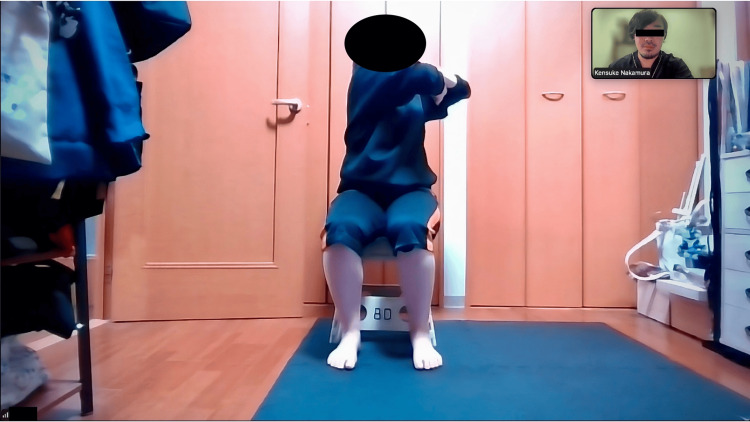 Figure 1
| Body Part | Baseline Evaluation (NRS) | Final Evaluation (NRS) |
| Shoulder | 3 | 5 |
| Low Back | 7 | 3 |
| Hip | 5 | 4 |
| Knees | 2 | 0 |
| Ankle | 3 | 0 |
| Fingers | 3 | 0 |
| Toes | 3 | 0 |
| Category | Baseline Score | Final Score |
| Dressing | 2 | 1 |
| Arising | 1 | 1 |
| Eating | 2 | 1 |
| Walking | 1 | 1 |
| Hygiene | 2 | 2 |
| Reach | 2 | 2 |
| Grip | 2 | 2 |
| Activities | 2 | 2 |
| Categories needing help | Dressing, Reach, Grip, Activities | Reach, Grip, Activities |
| Self-help tools | Bathtub chair, Bathtub grab bars | Bathtub chair, Bathtub grab bars |
| Total Mean J-HAQ Score | 1.75 | 1.5 |
| Category | Baseline Evaluation | Final Evaluation |
| 1: How would you describe the overall level of fatigue/tiredness you have experienced? | 8 | 6 |
| 2: How would you describe the overall level of neck, back, or hip pain you have had? | 5 | 4 |
| 3: How would you describe the overall level of pain/swelling in joints other than your neck, back, hips? | 4 | 3 |
| 4: How would you describe the overall level of discomfort you have from any areas tender to touch or pressure? | 4 | 3 |
| 5: How would you describe the overall level of discomfort you have had from the time you wake up? | 6 | 4 |
| 6: How long does your morning stiffness last from the time you wake up?(5 = 1 hour or more) | 4 | 5 |
Peer Reviews
No public reviews on file for this paper yet. If you reviewed it on a platform where reviews are public (OpenReview, ICLR, NeurIPS, ICML), you can paste yours below so the community can read it here.
Videos
No videos yet. Explain this paper in a talk, walkthrough, or lecture? Add one.
Taxonomy
TopicsSpondyloarthritis Studies and Treatments · Spine and Intervertebral Disc Pathology · Rheumatoid Arthritis Research and Therapies
Introduction
Ankylosing spondylitis (AS), a chronic immune-mediated inflammatory disease classified within the axial spondyloarthritis group, primarily affects males under 45 years of age [1]. In Japan, the reported prevalence is 2.6 per 100,000 individuals [2]. In 2015, AS was designated an intractable disease, making patients eligible for subsidies for medical expenses. The main symptoms of AS include lower back and buttock pain due to sacroiliitis and spondylitis, as well as pain in large peripheral joints, such as the hips, knees, and shoulders, which can significantly limit daily activities. As AS progresses, joint contracture and ankylosis of the spine and peripheral joints may occur, leading to severe mobility loss, restrictions in daily life, and even bedridden states [2]. Furthermore, reduced spinal mobility decreases chest wall expansion and can result in pulmonary complications, such as restrictive ventilatory impairment [3]. Given these challenges, early intervention by healthcare professionals is crucial to prevent reductions in joint range of motion and associated complications in patients with AS.
Several studies have reported the effectiveness of rehabilitation interventions for AS. A systematic review by Dagfinrud et al. demonstrated that group-based rehabilitation and aquatic exercise were more effective in improving spinal mobility and reducing pain compared with home-based exercise programs [4]. Similarly, Gurpinar et al. conducted a randomized controlled trial comparing physical therapist-supervised aquatic exercise, land-based exercise, and home-based exercise in patients with AS [5]. They found that supervised aquatic and land-based exercises significantly improved pain, spinal mobility, and functional capacity, whereas the home-based exercise group showed no significant improvements [5]. Gravaldi et al. also concluded in their systematic review that, although supervised physical therapy is effective, its benefits require maintenance through ongoing structured home exercise programs [6]. These studies highlight the limitations of patient-led home exercise programs and underscore the importance of continuous professional supervision and guidance. However, many patients with AS face barriers to accessing specialized rehabilitation services due to physical limitations, geographical constraints, and the uneven distribution of healthcare resources. In response to these challenges, telerehabilitation using information and communication technology (ICT) has emerged as a promising alternative [7,8]. Previous studies have reported that telerehabilitation provides improvements in physical function and quality of life compared to conventional in-clinic rehabilitation [8,9]. Despite these findings, evidence regarding the feasibility and effectiveness of telerehabilitation for AS in Japan remains limited.
The aim of this study is to present a detailed case of a Japanese patient with AS experiencing significant pain and restricted joint mobility, in whom telerehabilitation using ICT was implemented. By examining the outcomes of this intervention, we sought to explore the potential of telerehabilitation as a feasible and effective approach to overcoming access barriers and improving the quality of life in patients with AS.
Case presentation
The participant in this study was a woman in her 20s. Her present illness began in early April 2024, with symptoms including low-grade fever, fatigue, and arthralgia of the shoulders, fingers, and knees. She initially consulted a local clinic, where she was diagnosed with suspected polymyalgia rheumatica and initiated on oral steroid therapy. However, by mid-May 2024, her symptoms had not improved, leading to her transfer to a university hospital for further evaluation. In September 2024, after tapering of the steroids prescribed by the previous physician, plain radiography and MRI were performed again. Abnormal findings were observed in the sacroiliac joints. Following specialist evaluation, Reiter’s syndrome and SAPHO (synovitis, acne, pustulosis, hyperostosis, osteitis) syndrome were ruled out, and the patient was diagnosed with AS. During steroid tapering, she experienced worsening lower back pain and exacerbated arthralgia in multiple joints. Methotrexate was initiated in early October 2024. By mid-October 2024, symptomatic improvement remained minimal, resulting in significant limitations in her daily life and a reduction in the frequency of her outings. The decreased frequency of leaving home led to reduced exercise tolerance, making it difficult for her to commute to medical facilities. Given this situation, the patient requested rehabilitation to alleviate her pain and improve her daily activities. Consequently, telerehabilitation using ICT was initiated in late October 2024, with approval from her attending physician.
This case report was conducted in accordance with the principles of the Declaration of Helsinki. The purpose and content of the study were explained to the participant both in writing and orally, and written informed consent was obtained. She was clearly informed of her right to withdraw consent at any time without disadvantage.
The intervention protocol was developed with reference to a study by Gurpinar et al. [5]. Telerehabilitation consisted of chair and floor exercises. Chair exercises are primarily focused on spinal rotation, lateral flexion, and hamstring stretching. Floor exercises included hip lifts, bird-dog poses, and cat-cow poses. Exercise intensity was guided to remain within the "somewhat easy" to "somewhat hard" range of perceived exertion, with repetitions and sets adjusted as needed according to pain levels. If compensatory or deviated movements were observed during exercise, immediate verbal instructions and demonstrative gestures were provided to prompt correction. The content of the intervention was standardized across all sessions, which lasted approximately 60 min, with adequate rest periods to prevent exacerbation of pain. Exercise instruction was provided remotely using the web conferencing service Zoom (Zoom Video Communications, Inc.). Sessions were held every 7-14 days, depending on the patient's physical condition, for a total of four sessions. Evaluation items included pain, daily physical function, and disease activity. Pain was assessed using the numerical rating scale (NRS). Daily physical function was evaluated using the Japanese version of the Health Assessment Questionnaire (J-HAQ) [10]. Disease activity was assessed using the Bath Ankylosing Spondylitis Disease Activity Index (BASDAI) [11]. Assessments were conducted twice: at baseline and after completion of the four telerehabilitation sessions.
Implementation and conduct of synchronous telerehabilitation for ankylosing spondylitis in a home environment.The figure illustrates the visual arrangement for the real-time, synchronous tele-rehabilitation session.
Tables 1-3 present the baseline and final evaluation results for pain, J-HAQ, and BASDAI, respectively. Regarding pain assessment, a decrease in NRS scores was observed in six of the seven self-reported painful sites. Notably, lower back pain showed substantial improvement, decreasing from 7 to 3 on the NRS. However, shoulder joint pain increased from an NRS score of 3 to 5. The mean J-HAQ score decreased from 1.75 at baseline to 1.50 at the final evaluation (Table 2). For the J-HAQ category "Dressing and Grooming," which required assistance at baseline, the patient became able to perform the activity independently by the final evaluation. The BASDAI score improved from 5.20 at baseline to 4.10 at the final evaluation. While five of the six BASDAI categories showed decreased scores, the category "How long does your morning stiffness last from the time you wake up?" showed an increase. No notable adverse events were observed during the intervention period.
Discussion
This case study reports the outcomes of a patient with AS who received four sessions of telerehabilitation using ICT. The findings suggest that telerehabilitation may be a viable option for patients who have difficulty accessing specialized rehabilitation because of physical limitations, geographical constraints, or the uneven distribution of medical resources.
In this case, the patient presented with significant limitations in daily life due to pain in multiple joints, including the lower back, prior to the intervention. Telerehabilitation led to marked improvement, particularly in lower back pain. This effect is likely attributable to exercises designed to improve spinal mobility and core stability, which were incorporated into the chair- and floor-based program. Reductions in J-HAQ and BASDAI scores were also observed, reflecting clinically meaningful improvements based on the minimum clinically important differences for AS [12,13]. Numerous studies have reported the effectiveness of exercise therapy and rehabilitation in patients with AS [5,6]. Most of these studies have involved direct rehabilitation by professionals such as physical therapists or supervised exercises [6,14]. Consistent with these findings, groups receiving direct professional guidance generally demonstrate greater improvements than those performing unsupervised home exercises [5,14]. Gravaldi et al. concluded that, although supervised physical therapy is effective, its benefits are difficult to maintain with home exercise programs alone [6]. This case reinforces the importance of continuous professional guidance for patients with AS. The telerehabilitation approach provided here is significant because it enabled ongoing professional input for patients with limited access to medical resources.
However, some negative outcomes were also observed. Shoulder joint pain increased from an NRS score of 3 to 5, and the BASDAI item on morning stiffness also worsened. The increase in shoulder pain may be explained by the exercise program’s primary focus on spinal and lower limb movements, with insufficient emphasis on shoulder-specific exercises. Soker et al. reported that nearly half of patients with AS (49.1%) had abnormal shoulder joint findings on MRI, underscoring that shoulder involvement is frequently overlooked and should be addressed early [15]. This highlights the need for targeted upper limb interventions alongside spinal exercises. The increase in morning stiffness could have been influenced by factors unrelated to the intervention, such as fluctuations in disease activity or sleep quality. Limitations inherent to remote rehabilitation, particularly the difficulty of performing detailed physical assessments and tailoring programs in real time, may also have contributed. These observations emphasize the need for refinement of remote rehabilitation approaches to better address the full spectrum of symptoms in AS.
Remote exercise instruction using ICT offers several advantages. Despite reduced exercise tolerance, which made it difficult for the patient to attend medical institutions, telerehabilitation reduced the burden of travel and enabled her to receive therapy. Performing exercises in a familiar home environment also lowered psychological barriers and supported the development of consistent exercise habits. To the best of our knowledge, only one prior study has investigated remote exercise interventions for AS. Acar et al. reported that eight weeks of thrice-weekly remote yoga group sessions improved disease activity and quality of life in patients with AS, suggesting that remote exercise may be both safe and effective [16]. Together with our case, these findings support the potential utility of telerehabilitation in this patient population. Nevertheless, several challenges remain. First, therapists cannot perform hands-on assessments or corrections during remote sessions, limiting the precision of movement guidance and the ability to evaluate muscle activity. Second, communication may be affected by video or audio disruptions. To address these issues, future studies should integrate objective assessments, such as wearable sensor technology, or consider hybrid models that combine remote and in-person sessions.
The limitations of this case study must also be acknowledged. The single-case design limits the generalizability of the findings. The intervention period of only four sessions was relatively short, and thus the sustainability of the observed benefits over the long term remains unclear. The evaluations relied primarily on patient-reported outcomes, underscoring the need to incorporate more objective measures of physical function in future research. Despite these limitations, this case provides valuable insights, suggesting that professional telerehabilitation using ICT can reduce pain and improve quality of life for patients with AS who face barriers to traditional rehabilitation. Future research should include multicenter collaborative studies with larger cohorts, interventions tailored to patients with varying disease activity, and randomized controlled trials with long-term follow-up to more robustly evaluate the efficacy and feasibility of telerehabilitation.
Conclusions
This case study demonstrates that telerehabilitation delivered via ICT can improve pain, daily physical function, and disease activity in patients with AS who face limited access to conventional rehabilitation. Despite the short duration of the four-session intervention, significant reductions in pain, particularly lower back pain, were observed, alongside clinically meaningful improvements in J-HAQ and BASDAI scores. Although some challenges were noted, including increased shoulder pain and greater morning stiffness, the findings suggest that telerehabilitation is a feasible and effective approach to providing continuous professional guidance and enhancing the quality of life of patients with AS. Future studies involving larger cohorts, longer intervention periods, and objective outcome measures are warranted to confirm the efficacy and generalizability of these results.
The reference list from the paper itself. Each links out to its DOI / PubMed record.
- 1Recent advances in ankylosing spondylitis: understanding the disease and management F 1000 Res Garcia-Montoya L Gul H Emery P 07201810.12688/f 1000 research.14956.1PMC 617310430345001 · doi ↗ · pubmed ↗
- 2A nationwide questionnaire survey on the prevalence of ankylosing spondylitis and non-radiographic axial spondyloarthritis in Japan Mod Rheumatol Matsubara Y Nakamura Y Tamura N 9609673220223475518710.1093/mr/roab 096 · doi ↗ · pubmed ↗
- 3Cardiopulmonary manifestations of ankylosing spondylitis Int J Rheumatol Momeni M Taylor N Tehrani M 728471201120112154703810.1155/2011/728471 PMC 3087354 · doi ↗ · pubmed ↗
- 4Physiotherapy interventions for ankylosing spondylitis Cochrane Database Syst Rev Dagfinrud H Kvien TK Hagen KB 02008200810.1002/14651858.CD 002822.pub 3PMC 845325918254008 · doi ↗ · pubmed ↗
- 5Do mobility exercises in different environments have different effects in ankylosing spondylitis?Acta Reumatol Port Gurpinar B Ilcin N Savci S Akkoc N 297316462021 https://pubmed.ncbi.nlm.nih.gov/34962245/34962245 · pubmed ↗
- 6Effectiveness of physiotherapy in patients with ankylosing spondylitis: a systematic review and meta-analysis Healthcare (Basel) Gravaldi LP Bonetti F Lezzerini S De Maio F 1321020223505229610.3390/healthcare 10010132 PMC 8775656 · doi ↗ · pubmed ↗
- 7[Fact-finding survey and report on the use of telerehabilitation around the world]J Musculoskelet Phys Ther Yoshikawa K Taima H 475722022
- 8Bidirectional and multi-user telerehabilitation system: clinical effect on balance, functional activity, and satisfaction in patients with chronic stroke living in long-term care facilities Sensors (Basel) Lin KH Chen CH Chen YY Huang WT Lai JS Yu SM Chang YJ 12451124661420142501963210.3390/s 140712451 PMC 4168417 · doi ↗ · pubmed ↗