Approach to closure of large mucosal wound after endoscopic resection of duodenal descending lesion: combining endoscopic hand-suturing techniques with metal clip application
Yong Liu, Zeliang Yang, Shun He, Hoi-Loi Ng, Xia Hu, Chengyu Yang, Guiqi Wang

Abstract
Genes, proteins, chemicals, diseases, species, mutations and cell lines named across the full text — each resolved to its canonical identifier and authoritative record.
Click any figure to enlarge with its caption.
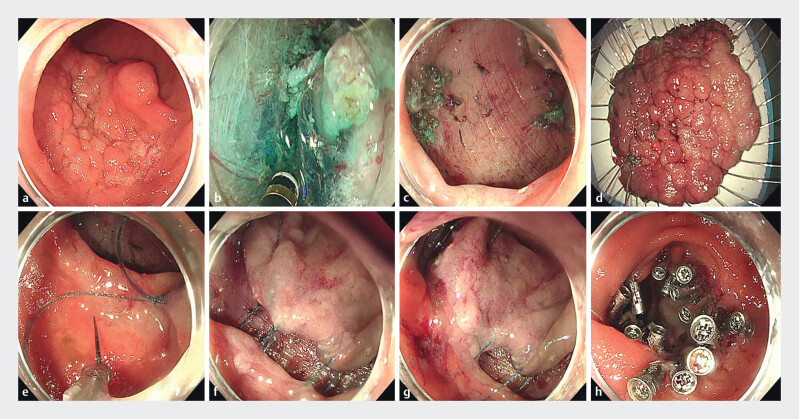 Fig. 1
- —Sanming Project of Medicine in Shenzen Municipality10.13039/501100012151
- —CAMS Innovation Fund for Medical Sciences (CIFMS)
Peer Reviews
No public reviews on file for this paper yet. If you reviewed it on a platform where reviews are public (OpenReview, ICLR, NeurIPS, ICML), you can paste yours below so the community can read it here.
Videos
No videos yet. Explain this paper in a talk, walkthrough, or lecture? Add one.
Taxonomy
TopicsEsophageal and GI Pathology · Gastric Cancer Management and Outcomes · Minimally Invasive Surgical Techniques
Endoscopic submucosal dissection (ESD) is a promising method for achieving complete resection of large superficial duodenal lesions 1 . However, post-ESD wound management is crucial for patient outcomes. If left open, the wound may lead to delayed bleeding, perforation, or infection due to gastric acid, bile, and pancreatic juice. For large wounds, endoscopic metal clip closure or hand-suturing closure alone is often ineffective, while laparoscopic closure increases trauma. This study introduces a novel method combining endoscopic hand suturing with metal clip closure ( Video 1 ).
Demonstration of endoscopic hand-suturing combined with clip closure for the large duodenal descending wound.Video 1
The case involves a high-grade intraepithelial neoplasia in the duodenal descending part, situated just below the papilla and predominantly involving the posterior and both lateral walls ( Fig. 1 a ). After obtaining informed consent, ESD was performed ( Fig. 1 b ). Post-ESD, the wound measured approximately 8 cm × 6 cm ( Fig. 1 c ). The resected specimen measured 8 cm × 5.7 cm ( Fig. 1 d ). Initially, endoscopic hand-suturing was used to reduce the wound size to a manageable dimension for metal clip closure ( Fig. 1 e–g ). Subsequently, metal clips were applied to reinforce the closure, effectively reducing tension and achieving secure wound closure ( Fig. 1 h ). The resected specimen’s pathology confirmed R0 resection. The ESD procedure took 158 minutes, the endoscopic suturing took 58 minutes, and the patient was discharged on postoperative day 14 without complications.
Endoscopic views. a An elevated lesion was identified in the descending duodenum. b Endoscopic submucosal dissection. c The wound after endoscopic submucosal dissection. d The resected specimen. e–f Endoscopic hand-suturing. g The wound after endoscopic hand-suturing. h The wound after application of the metal clip closure.
This study is the first to report the use of endoscopic hand-suturing combined with metal clip closure for a large duodenal descending part wound post-ESD. This approach offers a feasible alternative to laparoscopic closure, reducing surgical time and trauma while avoiding excessive.
Endoscopy_UCTN_Code_TTT_1AO_2AO
The reference list from the paper itself. Each links out to its DOI / PubMed record.