Thermoelectric transport with band non-parabolicity
Wenqing Zhang

Abstract
Genes, proteins, chemicals, diseases, species, mutations and cell lines named across the full text — each resolved to its canonical identifier and authoritative record.
Click any figure to enlarge with its caption.
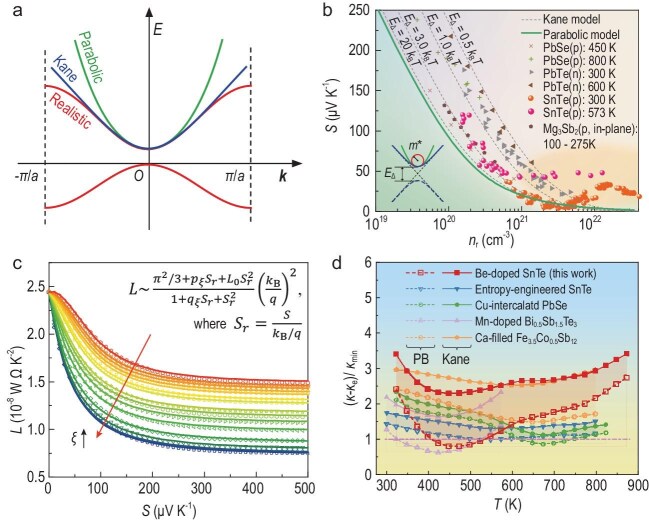 Figure 1
Peer Reviews
No public reviews on file for this paper yet. If you reviewed it on a platform where reviews are public (OpenReview, ICLR, NeurIPS, ICML), you can paste yours below so the community can read it here.
Videos
No videos yet. Explain this paper in a talk, walkthrough, or lecture? Add one.
Taxonomy
TopicsAdvanced Thermoelectric Materials and Devices
Despite the feasibility of obtaining accurate band structures in density-functional computations and angle-resolved photoemission spectroscopy experiments, the classical parabolic band (PB) approximation remains dominant in both theoretical and experimental studies due to its simplicity and analytical tractability. The PB approach simply describes the carrier dispersion near the band extrema with a quadratic energy–momentum relation, \documentclass[12pt]{minimal} \usepackage{amsmath} \usepackage{wasysym} \usepackage{amsfonts} \usepackage{amssymb} \usepackage{amsbsy} \usepackage{upgreek} \usepackage{mathrsfs} \setlength{\oddsidemargin}{-69pt} \begin{document} E=\hbar^2k^2/2m^\end{document} , where m represents the effective mass (Fig. 1a). In thermoelectrics, the PB model serves as a foundational framework, although it is known to be unreliable for complex structures, for analysing transport properties. Key applications include estimating carrier effective mass by using the Pisarenko relation [1] and determining the maximum power factor at an optimal doping concentration through the electronic quality factor [2]. The PB model could also be applied for separating thermal conductivity into the electronic and lattice contributions by using the relationship between the Lorenz numbers (L) and the Seebeck coefficients (S) and sometimes estimating the potential extra scattering effects from multiple and non-parabolic bands [3].
In a recent work published in National Science Review, Zhu and co-workers re-examined the predictions of the classical PB model against density functional theory calculations across various classical semiconductors [4]. Surprisingly, even for certain lightly doped systems in which the PB model is expected to work well, Zhu et al. found strong deviation of transport properties from the PB-based Pisarenko relation
and the L–S relation. By analysing the transport in full bands in Boltzmann transport theory, the authors revealed that L and S possess distinct non-parabolicity-induced non-local features in the energy dimension. Consequently, the carrier transport behaviour remains profoundly influenced by the linear dispersion regions deep within the conduction or valence bands (Fig. 1b), well beyond the classical Fermi window (a few k_B_T). This finding underscores
the necessity for incorporating band non-parabolicity when analysing transport properties in thermoelectric materials.
Interestingly, the study also found that a simple parameter—the non-parabolicity factor ξ—could be defined to accurately quantify the impact of band non-parabolicity on thermoelectric transport properties. The ξ defined by referring to Seebeck under the non-degenerate limit transits from 0 to 1 with the evolution of the band from the quadratic PB to the non-parabolic linear band. The study proves that the optimal power factor decreases proportionally to (1 – ξ)^2^, while L declines as 2 – 2ξ + ξ^2^ for non-degenerate semiconductors. An analytical ξ-corrected L–S relation (Fig. 1c) could also be established to enable the rapid determination of accurate L at practical doping concentrations, facilitating reliable estimations of electronic and lattice thermal conductivities. The study shows that, in several classic thermoelectric materials including SnTe, CoSb_3_ and Bi_2_Te_3_, the lattice thermal conductivity estimated by using the PB model can be unphysically low—even falling below the Cahill thermal conductivity limit [5]. By incorporating ξ-based corrections, these underestimations can be effectively corrected (Fig. 1d).
In summary, the band non-parabolicity and the factor ξ provide an easy and robust framework for refining the classical PB model and enhance the reliability of thermoelectric property evaluations. They may also facilitate innovations in optimizing material performance across various semiconductor applications.
The reference list from the paper itself. Each links out to its DOI / PubMed record.
- 1Lee KH, Kim SI, Lim JC et al. Adv Funct Mater 2022; 32: 2203852.10.1002/adfm.202203852 · doi ↗
- 2Zhang X, Bu Z, Shi X et al. Sci Adv 2020; 6: eabc 726.10.1126/sciadv.abc 0726 · doi ↗
- 3Kim H, Gibbs ZM, Tang Y et al. APL Mater 2015; 3: 41506.10.1063/1.4908244 · doi ↗
- 4Zhu J, Liu M, Dong X et al. Natl Sci Rev 2025; 12: nwaf 216.10.1093/nsr/nwaf 21640635675 PMC 12236334 · doi ↗ · pubmed ↗
- 5Cahill DG, Watson SK, Pohl RO. Phys Rev B 1992; 46: 6131–40.10.1103/Phys Rev B.46.613110002297 · doi ↗ · pubmed ↗