Correction to Application of Invertebrate‐Derived DNA Barcoding (iDNA) in Blood‐Sucking Leeches From West Sumatra: A Discovery of Blue‐Eyed Litter Frog Leptobrachium waysapuntiense

Abstract
Genes, proteins, chemicals, diseases, species, mutations and cell lines named across the full text — each resolved to its canonical identifier and authoritative record.
Click any figure to enlarge with its caption.
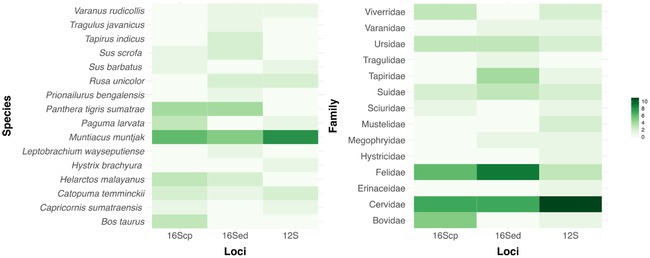 Figure 1
Peer Reviews
No public reviews on file for this paper yet. If you reviewed it on a platform where reviews are public (OpenReview, ICLR, NeurIPS, ICML), you can paste yours below so the community can read it here.
Videos
No videos yet. Explain this paper in a talk, walkthrough, or lecture? Add one.
Taxonomy
TopicsLeech Biology and Applications · Identification and Quantification in Food · Aquatic life and conservation
Irawan, A. D., and Eguchi, K. (2025). Application of Invertebrate‐Derived DNA Barcoding (iDNA) in Blood‐Sucking Leeches From West Sumatra: A Discovery of Blue‐Eyed Litter Frog Leptobrachium waysapuntiense. Ecology and Evolution, 15(10), e72235. https://doi.org/10.1002/ece3.72235
Several errors were identified in Figure 4, Table 3, and the final paragraph of the “Acknowledgments” section.
In Figure 4, the species‐level heatmap contains incorrect labels. Specifically, the “16Scp” and “12S” columns were mislabelled, and the column order does not match that of the family‐level heatmap on the right. In addition, the row labelled “Prionailurus planiceps” should read “Prionailurus bengalensis.” Despite these labeling inaccuracies, the numerical data within the heatmap remains correct. The corrected figure is shown below.
In Table 3, the row labelled “Panthera tigris sumatraensis” should be consistently corrected to “Panthera tigris sumatrae.”
In the “Acknowledgments” section, two minor errors were identified in the final paragraph regarding funding periods. The correct information is as follows: the funding period for JSPS KAKENHI (No. 23K05299) is 2023–2025 and for the Nagao Natural Environment Foundation, 2025.
We apologize for these errors.