Pediatric Healthcare Worker Perspectives on Implementation of a Secure Firearm Storage Program: A Qualitative Study
Claire R. Waller, Mallika Pandey, Jennifer M. Boggs, Arne Beck, Ruth P. Bedoy, Alison M. Buttenheim, Marisa E. Elias, Katelin Hoskins, Shari Jager-Hyman, Christina Johnson, Melissa Maye, Bridget McArdle, Celeste Pappas, Dylan S. Small, LeeAnn M. Quintana, Courtney Benjamin Wolk

TL;DR
This study explores how healthcare workers in pediatric clinics implemented a program to promote safe firearm storage, focusing on factors that helped or hindered its success.
Contribution
The study provides new insights into healthcare worker perspectives and practical strategies for implementing secure firearm storage programs in pediatric care.
Findings
Healthcare workers emphasized the importance of preserving family autonomy and privacy in promoting firearm safety.
Clear training and program adaptability were key to successful implementation of the S.A.F.E. Firearm program.
A nonjudgmental, universal approach increased program acceptability among healthcare workers and families.
Abstract
Primary care-based secure firearm storage programs are well-positioned to prevent firearm-related injury, the leading cause of death for young people in the United States. While recommended by the American Academy of Pediatrics and US Surgeon General, these programs have yet to become routine practice. Our cluster randomized hybrid effectiveness-implementation trial tested implementation strategies across 30 clinics in two large health systems for a universal evidence-based secure firearm storage program, S.A.F.E. Firearm (Suicide and Accident Prevention through Family Education). S.A.F.E. Firearm includes a brief discussion between a clinician and parent on secure firearm storage and an offer of free cable locks at pediatric well-child visits for youth ages 5–17. The ASPIRE trial demonstrated meaningful clinician behavior change, with S.A.F.E. Firearm delivered to a significantly…
Genes, proteins, chemicals, diseases, species, mutations and cell lines named across the full text — each resolved to its canonical identifier and authoritative record.
Click any figure to enlarge with its caption.
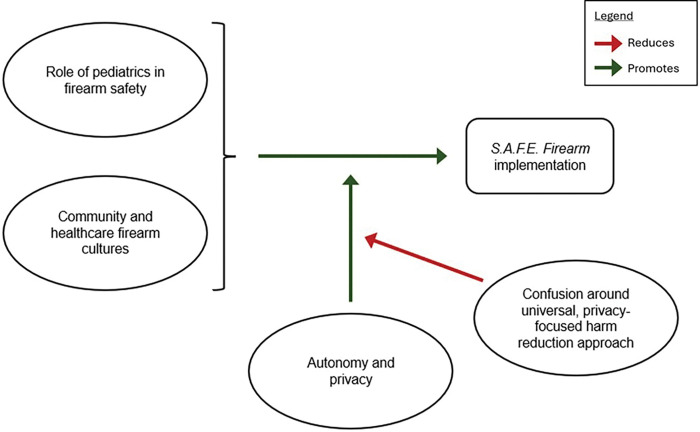 Figure 1
Peer Reviews
No public reviews on file for this paper yet. If you reviewed it on a platform where reviews are public (OpenReview, ICLR, NeurIPS, ICML), you can paste yours below so the community can read it here.
Videos
No videos yet. Explain this paper in a talk, walkthrough, or lecture? Add one.
Taxonomy
TopicsGun Ownership and Violence Research · Suicide and Self-Harm Studies · Injury Epidemiology and Prevention