The Role of the Anion Insertion‐Extraction Reaction in Amorphous Carbon Thin Film Electrodes on the Vanadium(IV/V) Reaction Probed by Scanning Electrochemical Cell Microscopy
Maximilian Hamann, Jens Carthäuser, Diana Rata, Nico Remmler, Michael Bron, Matthias Steimecke

TL;DR
This study investigates how high potentials affect carbon thin film electrodes in vanadium redox reactions, showing that sulfate anion insertion dominates and can be reversed with reductive potentials.
Contribution
The study reveals the significant role of sulfate anion insertion in inhibiting vanadium redox reactions in carbon electrodes and demonstrates their reversibility.
Findings
Sulfate anion insertion is the main process occurring alongside the vanadium(IV/V) redox reaction.
Pyridine/pyrrole groups stabilize the insertion compound, strongly inhibiting the vanadium redox reaction.
Electrochemical features and Raman spectra can be fully restored using reductive potentials after high polarization.
Abstract
The influence of high potentials on amorphous nitrogen‐free and nitrogen‐doped hydrogenated carbon thin film electrodes with thicknesses of 9 to 30 nm is probed toward the vanadium(IV/V) redox reaction by scanning electrochemical cell microscopy (SECCM), which mimics the reaction of the positive side of the all‐vanadium redox flow battery (VRFB). Besides the evaluation of the peak separation (EPP) from cyclic voltammograms (CV), the localized probing is adapted in a way that the influence of high overpotentials on the stability of the carbon materials, as well as competitive electrochemical processes, can be analyzed. The sulfate anion insertion process is found to be the predominant process in all samples, with its onset appearing in parallel to the vanadium(IV/V) reaction. The presence of pyridine/pyrrole groups can stabilize the insertion compound, which inhibits the vanadium(IV/V)…
Genes, proteins, chemicals, diseases, species, mutations and cell lines named across the full text — each resolved to its canonical identifier and authoritative record.
Click any figure to enlarge with its caption.
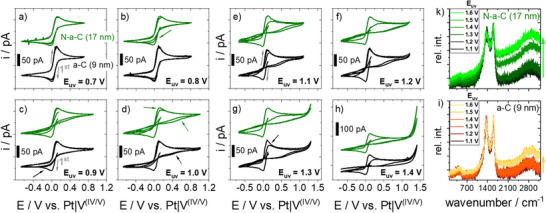 Figure 1
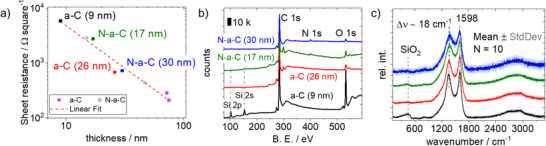 Figure 2
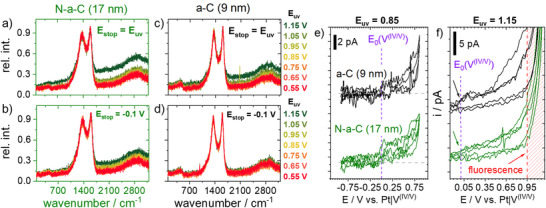 Figure 3
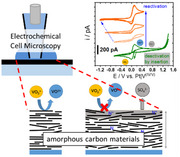 Figure 4
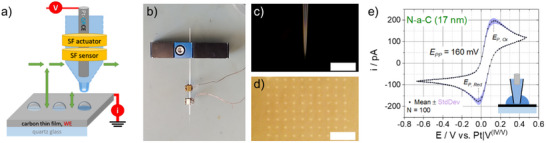 Figure 5
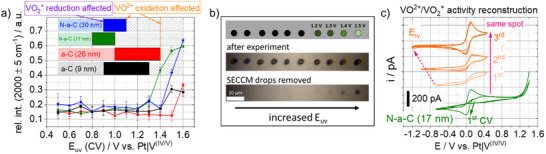 Figure 6
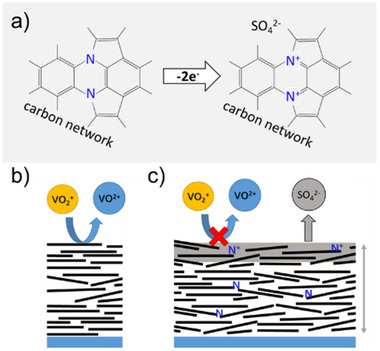 Figure 7
Peer Reviews
No public reviews on file for this paper yet. If you reviewed it on a platform where reviews are public (OpenReview, ICLR, NeurIPS, ICML), you can paste yours below so the community can read it here.
Videos
No videos yet. Explain this paper in a talk, walkthrough, or lecture? Add one.
Taxonomy
TopicsAdvanced battery technologies research · Electrochemical Analysis and Applications · Electrocatalysts for Energy Conversion