Color‐Tunable Organic Nano‐Dots: Synthesis and Applications in Color Conversion and Security Inks
Yeasin Khan, Rasheeda Ansari, Khandoker Asiqur Rahaman, Bright Walker, Jang Hyuk Kwon

TL;DR
Researchers created water-based organic nanodots that can emit various colors, including white light, and are useful for displays and security inks.
Contribution
The study introduces a scalable method for making color-tunable organic nanodots with high energy transfer efficiency and color conversion performance.
Findings
CTONDs achieve over 90% energy transfer efficiency in film state due to close packing.
They show over 60% color conversion efficiency in light-emitting devices with four-month photostability.
The nanodots are aqueous-processable and suitable for eco-friendly displays and security inks.
Abstract
This study explores the synthesis of water‐based color‐tunable organic nanodots (CTONDs) capable of emitting multiple colors, including white light, by adjusting the molar ratio of blue, green, and red emissive fluorophores in the particles. Spectroscopic analyses reveal that the emissions are due to Forster resonance energy transfer (FRET) between the energy donor and acceptor nanoparticles. The energy transfer efficiencies are high, reaching over 90% in the film state due to the close packing of NDs while in their film state. Various molar ratios produced different colors in both liquid dispersions and in the solid state. These CTONDs demonstrate over 60% color conversion efficiency (CCE) when applied as color conversion layers (CCLs) in light‐emitting devices, maintaining photostability for over four months under ambient conditions. Additionally, their aqueous processability and…
Genes, proteins, chemicals, diseases, species, mutations and cell lines named across the full text — each resolved to its canonical identifier and authoritative record.
Click any figure to enlarge with its caption.
 Figure 1
 Figure 2
 Figure 3
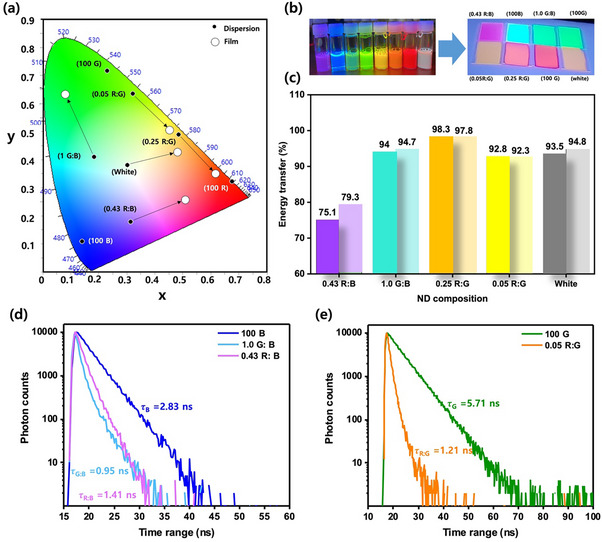 Figure 4
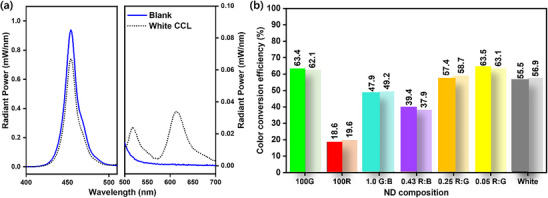 Figure 5
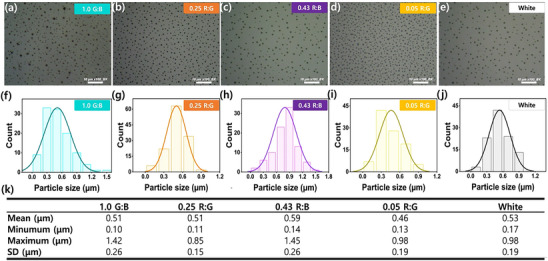 Figure 6
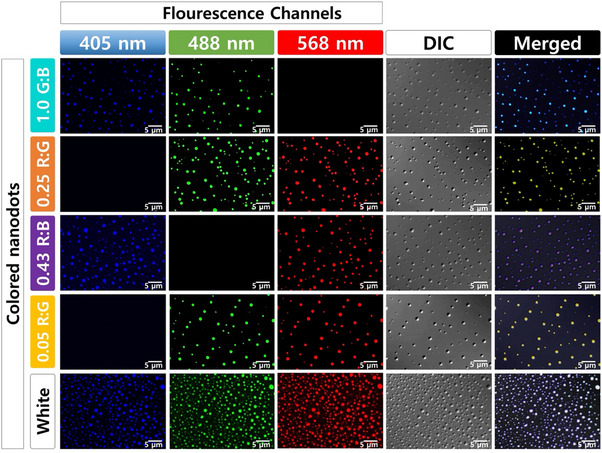 Figure 7
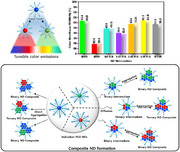 Figure 8
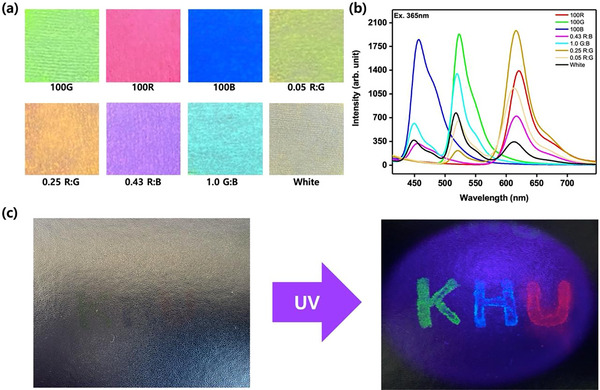 Figure 9
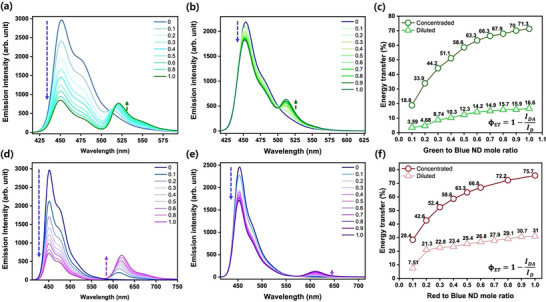 Figure 10
Peer Reviews
No public reviews on file for this paper yet. If you reviewed it on a platform where reviews are public (OpenReview, ICLR, NeurIPS, ICML), you can paste yours below so the community can read it here.
Videos
No videos yet. Explain this paper in a talk, walkthrough, or lecture? Add one.
Taxonomy
TopicsLuminescence and Fluorescent Materials · Polydiacetylene-based materials and applications · Carbon and Quantum Dots Applications