The type IV pilus steering committee: how Pil-Chp controls directional motility
Kaitlin D. Yarrington, Dominique H. Limoli

TL;DR
This paper reviews how the Pil-Chp system in Pseudomonas aeruginosa controls surface movement using type IV pili and whether it functions in bacterial chemotaxis.
Contribution
The paper synthesizes recent findings to clarify the role of the Pil-Chp system in directional motility and chemotaxis in Pseudomonas aeruginosa.
Findings
The Pil-Chp system in Pseudomonas aeruginosa is involved in twitching motility via type IV pili.
The system shares similarities with flagellar chemotaxis systems but has notable differences.
Recent studies aim to determine if Pil-Chp biases movement in response to environmental gradients.
Abstract
Many microbial species live on surfaces and employ various strategies for initiation of and survival within a surface-attached community. One such strategy implemented by many bacterial species is to move across surfaces using grappling hook-like appendages called type IV pili (TFP) which extend, attach to the surface, and retract to pull the cell body forward. In the bacterium Pseudomonas aeruginosa, TFP motility, or twitching, is controlled by the Pil-Chp system. P. aeruginosa uses this system to traverse surfaces and gather information about the local chemical and physical environment. The Pil-Chp system shares many similarities to the well-studied flagellar chemotaxis system (Che), which biases locomotion of swimming cells up or down gradients of chemical stimuli. However, many important differences have been described, while others await discovery. Some of these differences have…
Genes, proteins, chemicals, diseases, species, mutations and cell lines named across the full text — each resolved to its canonical identifier and authoritative record.
Click any figure to enlarge with its caption.
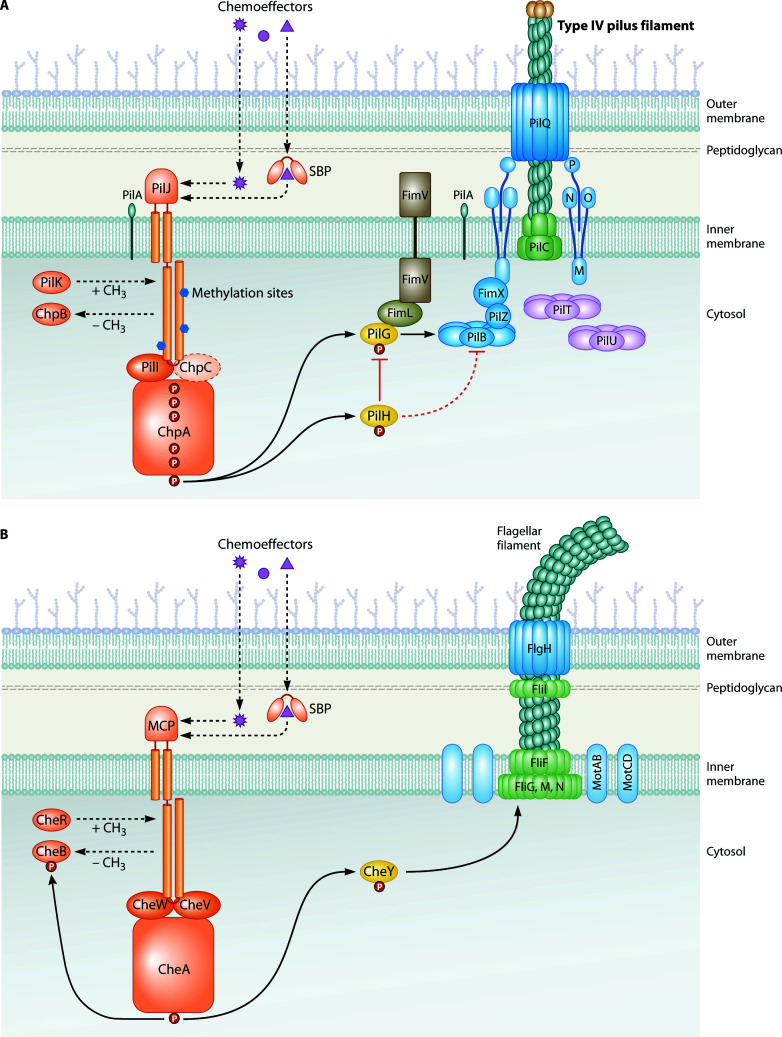 Figure 1
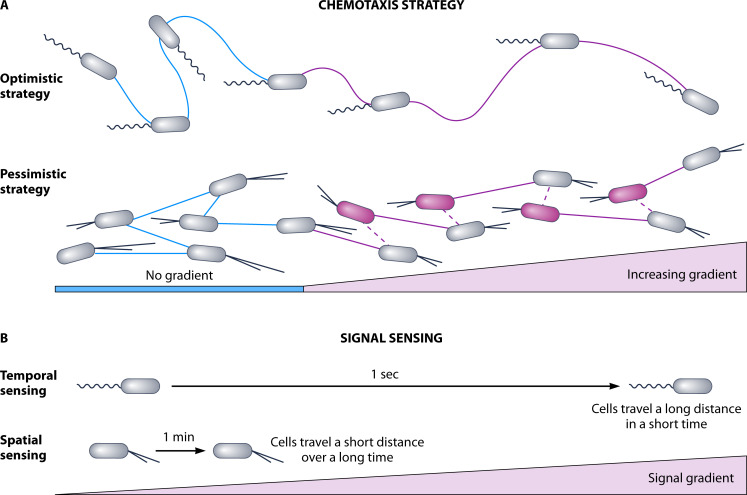 Figure 2
 Figure 3
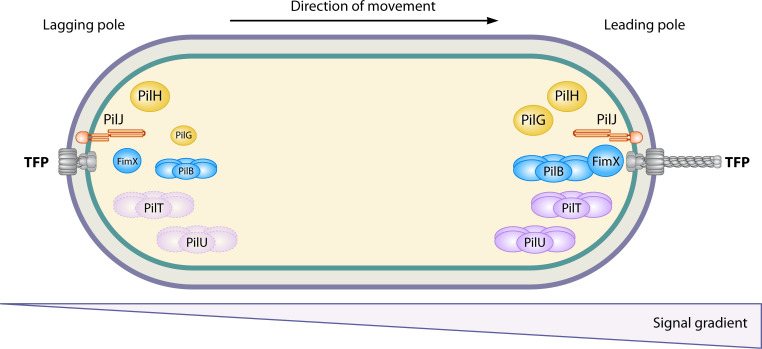 Figure 4
Peer Reviews
No public reviews on file for this paper yet. If you reviewed it on a platform where reviews are public (OpenReview, ICLR, NeurIPS, ICML), you can paste yours below so the community can read it here.
Videos
No videos yet. Explain this paper in a talk, walkthrough, or lecture? Add one.
Taxonomy
TopicsBacterial biofilms and quorum sensing · Micro and Nano Robotics · Microfluidic and Bio-sensing Technologies