Inhibitory proteins of Bacillus subtilis interact within the membrane to block intramembrane protease activity
Saikat Mandal, Alanah Soriano, Caroline Erpelding, Jackson Ruffner, Eric Smith, Benjamin J. Orlando, Lee Kroos

TL;DR
This paper shows how inhibitory proteins in bacteria interact with a membrane protease to block its activity, which could help in developing new treatments.
Contribution
First experimental evidence of physical contacts between BofA and SpoIVFA in the membrane-bound inhibition complex of SpoIVFB.
Findings
BofA's C-terminal region is close to SpoIVFA's transmembrane segment in the inhibition complex.
BofA and SpoIVFA likely interact to block SpoIVFB's cleavage of Pro-σK during endosporulation.
Orthologs of BofA and SpoIVFA in pathogenic Bacilli may function similarly to inhibit virulence.
Abstract
Intramembrane proteases (IPs) are crucial for diverse signaling pathways, including some that regulate the virulence of pathogenic bacteria. A better understanding of mechanisms controlling IP activity is necessary to guide therapeutic development. Bacillus subtilis SpoIVFB is an IP with two natural inhibitory proteins, BofA and SpoIVFA. These proteins form a complex with SpoIVFB and prevent it from cleaving Pro-σK during endosporulation. We investigated proximity between BofA and SpoIVFA in the SpoIVFB inhibition complex using in vivo disulfide crosslinking in Escherichia coli. We discovered that two parts of the BofA C-terminal region are proximal to the SpoIVFA transmembrane segment (TMS). Our results support predictions that the BofA C-terminal region adopts an unusual structure within the membrane and interacts with the SpoIVFA TMS to block SpoIVFB cleavage of Pro-σK.…
Genes, proteins, chemicals, diseases, species, mutations and cell lines named across the full text — each resolved to its canonical identifier and authoritative record.
Click any figure to enlarge with its caption.
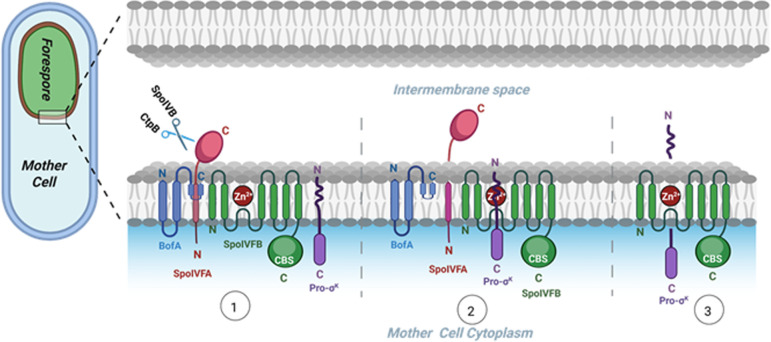 Figure 1
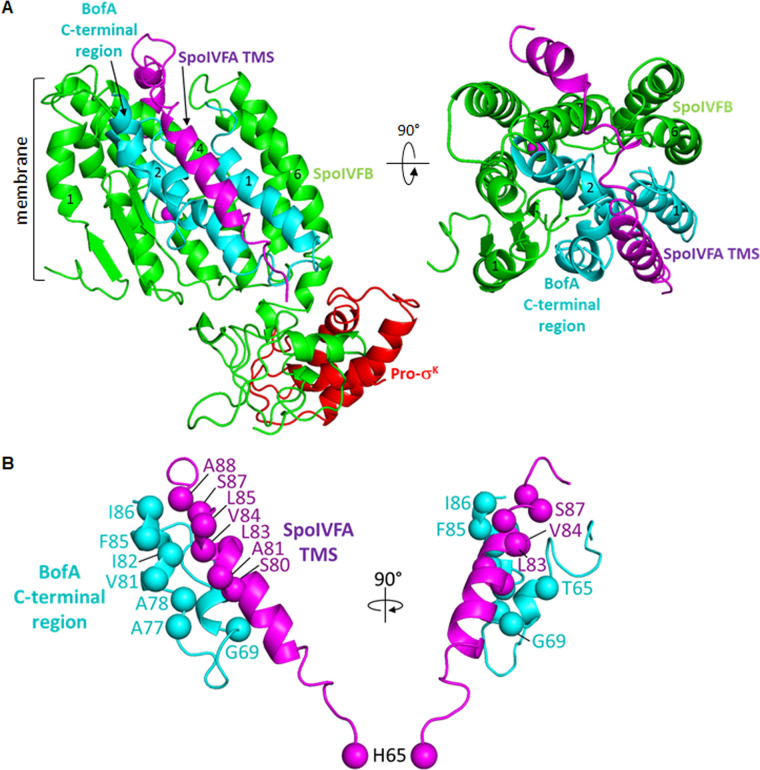 Figure 2
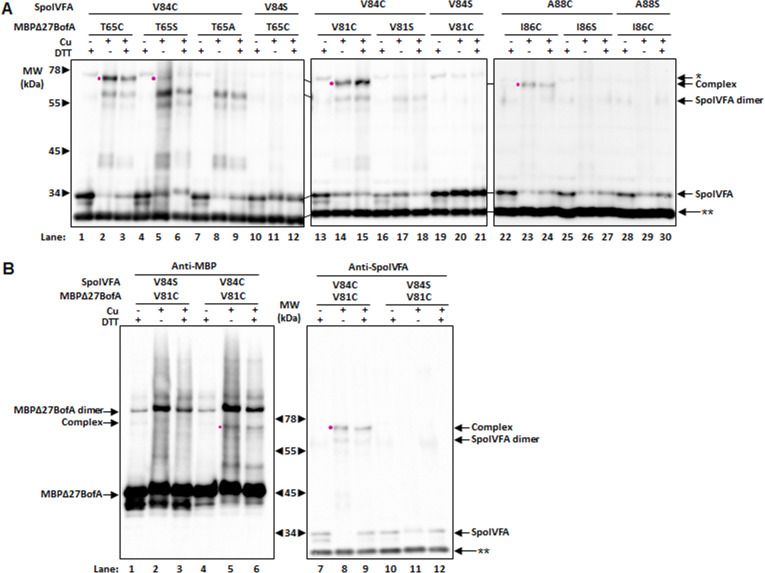 Figure 3
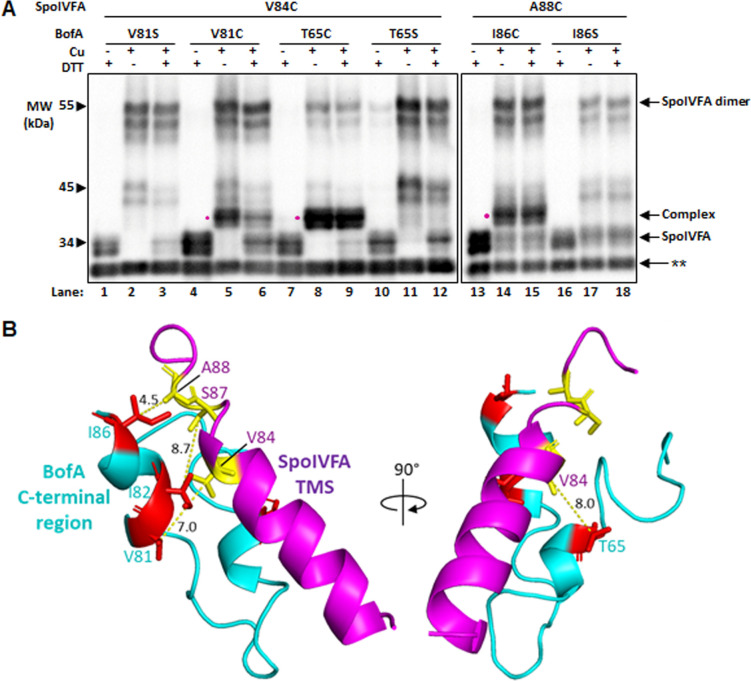 Figure 4
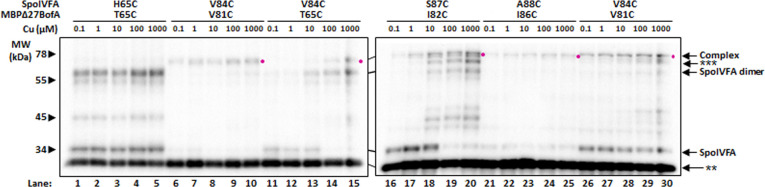 Figure 5
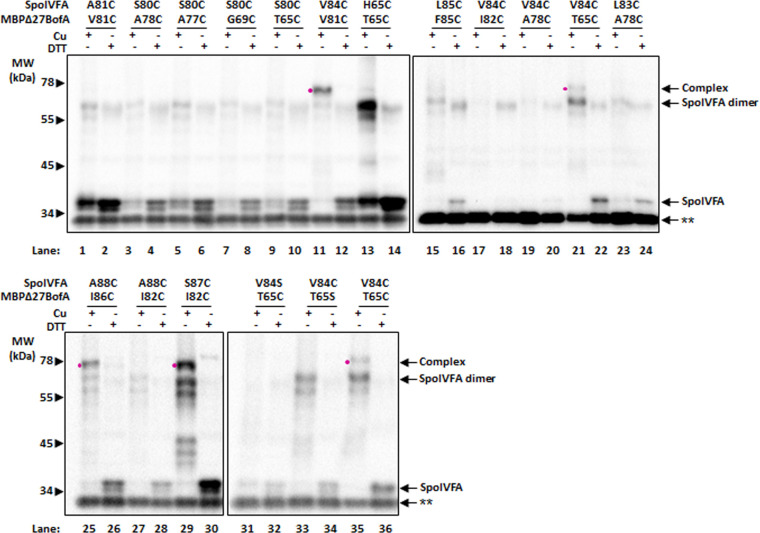 Figure 6
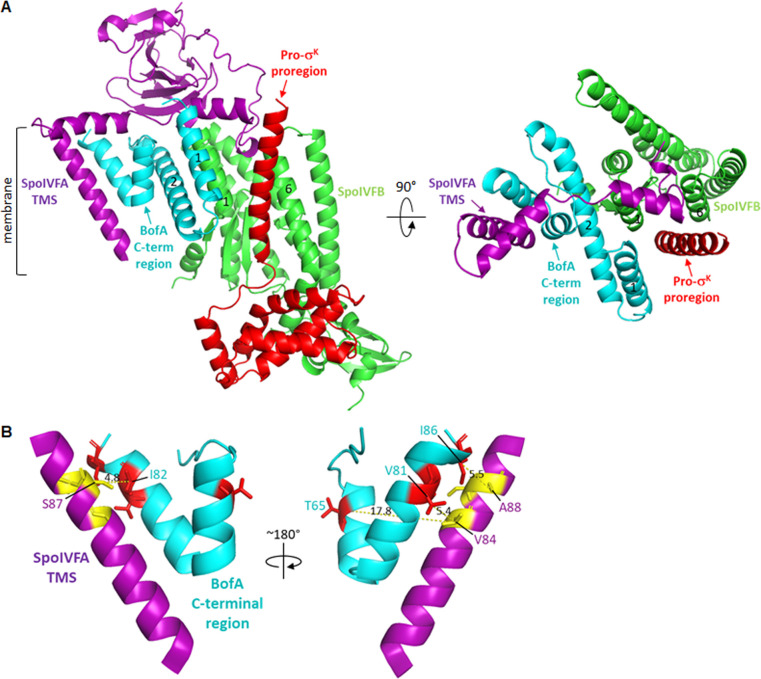 Figure 7
Peer Reviews
No public reviews on file for this paper yet. If you reviewed it on a platform where reviews are public (OpenReview, ICLR, NeurIPS, ICML), you can paste yours below so the community can read it here.
Videos
No videos yet. Explain this paper in a talk, walkthrough, or lecture? Add one.
Taxonomy
TopicsBacterial Genetics and Biotechnology · Bacterial biofilms and quorum sensing · Cellular transport and secretion