Impact of differentiating between persistent and new infections on colposcopy referral in HPV-positive triage-negative women: results from the NTCC2 study
Annarosa Del Mistro, Pamela Mancuso, Francesca Carozzi, Laura De Marco, Simonetta Bisanzi, Giampaolo Pompeo, Guglielmo Ronco, Silvia Gori, Elena Allia, Daniela Gustinucci, Helena Frayle, Anna Iossa, Elena Cesarini, Simonetta Bulletti, Basilio Passamonti, Jessica Viti

TL;DR
This study shows that distinguishing between persistent and new HPV infections can reduce unnecessary colposcopy referrals in women who tested HPV-positive but had no initial cervical abnormalities.
Contribution
The study introduces extended HPV genotyping to differentiate persistent from new infections, potentially reducing colposcopy referrals.
Findings
All CIN3 cases occurred in women with persistent HPV infections, not new ones.
New infection rates were higher in women with single-channel HPV positivity compared to multiple-channel positivity.
Baseline p16/ki67 positivity was associated with higher persistent infection rates and negativity with higher new infection rates.
Abstract
In cervical screening, human papillomavirus (HPV)-positive women at 1-year retesting are typically referred to colposcopy. This study, by the use of extended genotyping, estimates the impact of distinguishing persistent from new infections in an effort to reduce colposcopy referral. It also evaluates whether the new infection rate varies according to genotyping, cytology, p16/ki67, and E6/E7 mRNA results. We analyzed data from HPV-DNA-positive women at baseline in the NTCC2 trial genotyped with the Onclarity HPV assay. Eligible participants were Onclarity-positive women without baseline CIN2+ who had a cervicovaginal sample collected at least 10 months after baseline. Persistent infections were defined as cases with at least one common genotype between baseline and follow-up specimens. New infections were defined as cases positive for different genotypes at follow-up, with no baseline…
Genes, proteins, chemicals, diseases, species, mutations and cell lines named across the full text — each resolved to its canonical identifier and authoritative record.
Click any figure to enlarge with its caption.
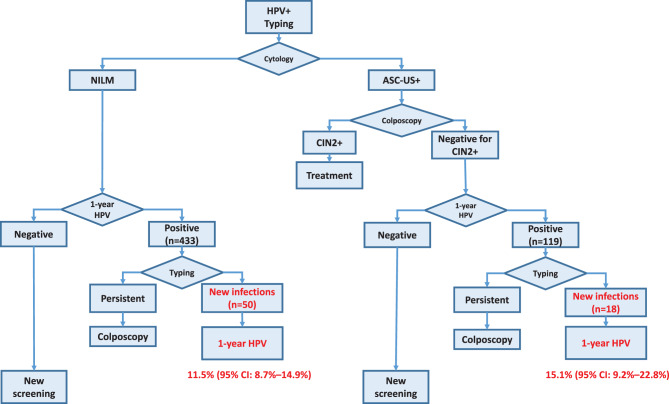 Figure 1
Peer Reviews
No public reviews on file for this paper yet. If you reviewed it on a platform where reviews are public (OpenReview, ICLR, NeurIPS, ICML), you can paste yours below so the community can read it here.
Videos
No videos yet. Explain this paper in a talk, walkthrough, or lecture? Add one.
Taxonomy
TopicsCervical Cancer and HPV Research · Women's cancer prevention and management · Reproductive tract infections research