Cationic Peptoids for Systemic In Vivo Cartilage‐Targeting
Chaonan Zhang, Rongmao Qiu, Yongjie Huang, Yinghua Liu, Kui Huang, Suwen Zhao, Yang Li

TL;DR
Scientists developed a new molecule that can target cartilage in living animals, enabling better imaging and potential drug delivery for cartilage-related diseases.
Contribution
A novel cationic peptoid with systemic cartilage-targeting ability and high stability is introduced for the first time.
Findings
Cationic peptoids with Nlys residues bind specifically to cartilage's glycosaminoglycans and penetrate deep into the tissue.
The peptoids are stable in serum and can be systemically administered without toxicity, enabling whole-body cartilage imaging in mice and zebrafish.
The compounds allow detection of glycosaminoglycan loss in aged and inflamed joints, suggesting potential for disease monitoring.
Abstract
Although cartilage damage is key to the pathogenesis of many musculoskeletal diseases, including osteoarthritis and rheumatoid arthritis (RA), imaging and drug delivery to cartilage remain a demanding challenge. Cartilage is an avascular tissue with a dense matrix constraining the penetration of imaging and targeting agents. Here, a unique class of cationic peptidomimetics featuring peptoid residue Nlys (N‐substituted butyl‐amino glycine) is reported for cartilage targeting. Sulfo‐Cyanine5 (Cy5) labeled Nlys‐rich sequences are found to penetrate and be retained within millimeter‐deep cartilage plugs in vitro by specific binding to the tissue's polyanionic glycosaminoglycan (GAG) chains. Owing to the unnatural sequences being undegradable by common proteases, these Nlys‐peptidomimetics overcome the problem of low serum stability of existing benchmark cartilage‐binding peptides (e.g.,…
Genes, proteins, chemicals, diseases, species, mutations and cell lines named across the full text — each resolved to its canonical identifier and authoritative record.
Click any figure to enlarge with its caption.
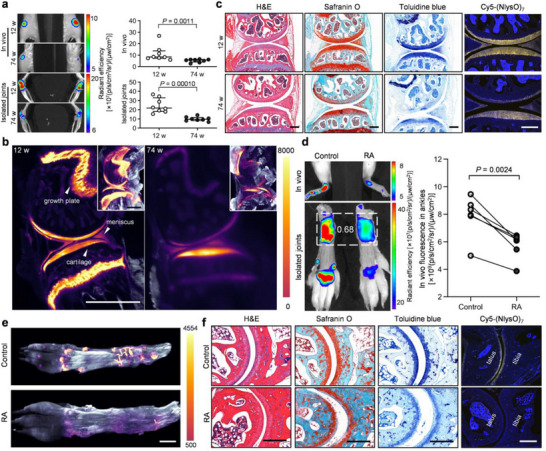 Figure 1
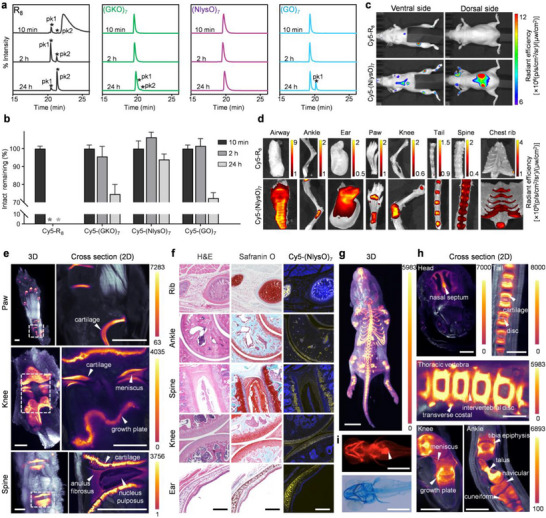 Figure 2
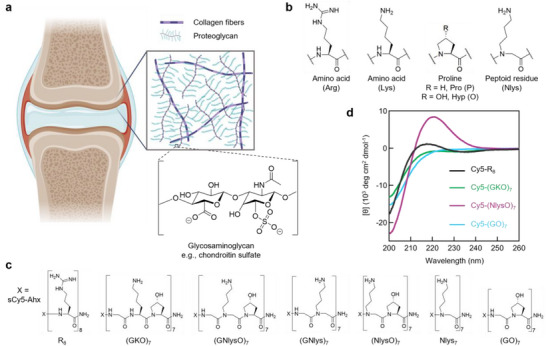 Figure 3
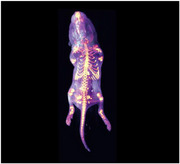 Figure 4
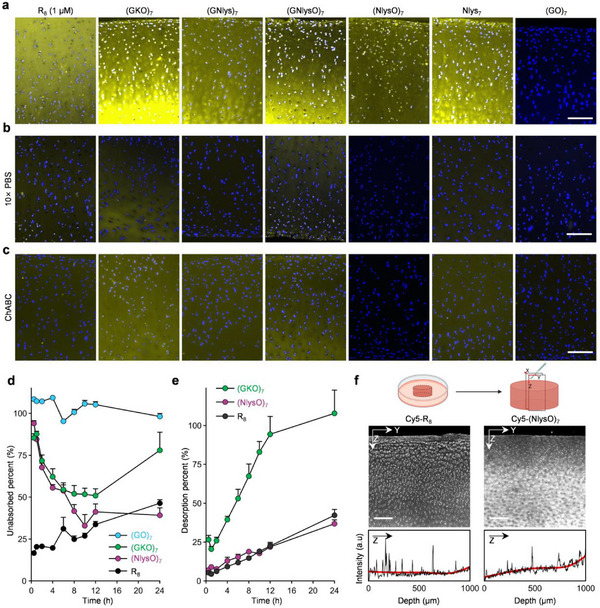 Figure 5
Peer Reviews
No public reviews on file for this paper yet. If you reviewed it on a platform where reviews are public (OpenReview, ICLR, NeurIPS, ICML), you can paste yours below so the community can read it here.
Videos
No videos yet. Explain this paper in a talk, walkthrough, or lecture? Add one.
Taxonomy
TopicsChemical Synthesis and Analysis · Antimicrobial Peptides and Activities · Click Chemistry and Applications