Laser‐Induced 3D Graphene Enabled Polymer Composites with Improved Mechanical and Electrical Properties Toward Multifunctional Performance
Fu Liu, Sida Luo, Jingyang Li, Zhe Wang, Xu Wang, Wenqian Hao, Yanan Wang

TL;DR
This paper introduces a new method to create strong and conductive 3D graphene-polymer composites using laser-induced 3D graphene and printing, suitable for flexible electronics and sensors.
Contribution
A novel fabrication method combining laser-induced 3D graphene with polymer infiltration to enhance mechanical and electrical properties of composites.
Findings
The 3D-LIG/epoxy composites achieved 3.54 S m⁻¹ electrical conductivity and 5.4 MPa tensile strength.
The composites showed 230% tensile-failure strain and 50% high linear elastic strain.
The materials demonstrated functional properties for de-icing, microwave absorption, and flexible sensors.
Abstract
Conductive graphene‐based composites are attracting substantial interest due to their excellent mechanical and electrical properties for potential applications in electronics. Typically, such composites are fabricated by infiltrating the 3D graphene framework with the polymer matrix. However, the production of 3D graphene foams is limited by the challenges in preparing graphene dispersions, while 3D printing presents a significant breakthrough in the fabrication of desired 3D graphene‐based structures. Here, the utilization of the 3D printing technique driven by laser‐induced graphene (LIG) and a conventional penetration process for assembling graphene‐based conductive polymer composites is described. The synergistic integration endowed the proposed 3D‐LIG/epoxy composites with an electrical conductivity of 3.54 S m−1 in through‐plane, and a tensile strength of ≈5.4 MPa by a 7606%…
Genes, proteins, chemicals, diseases, species, mutations and cell lines named across the full text — each resolved to its canonical identifier and authoritative record.
Click any figure to enlarge with its caption.
 Figure 1
 Figure 2
 Figure 3
 Figure 4
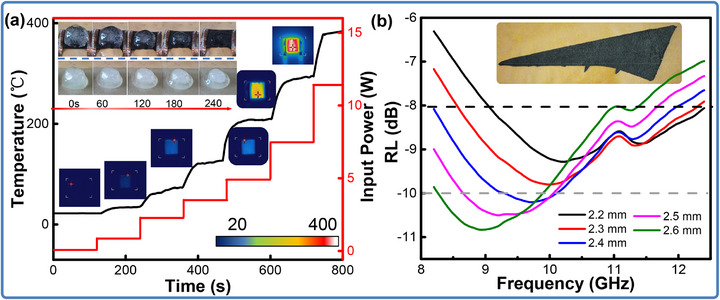 Figure 5
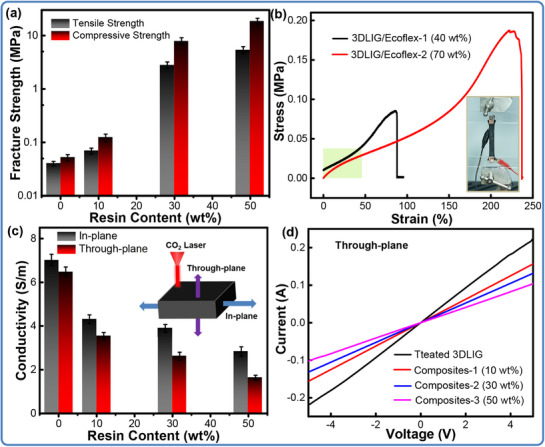 Figure 6
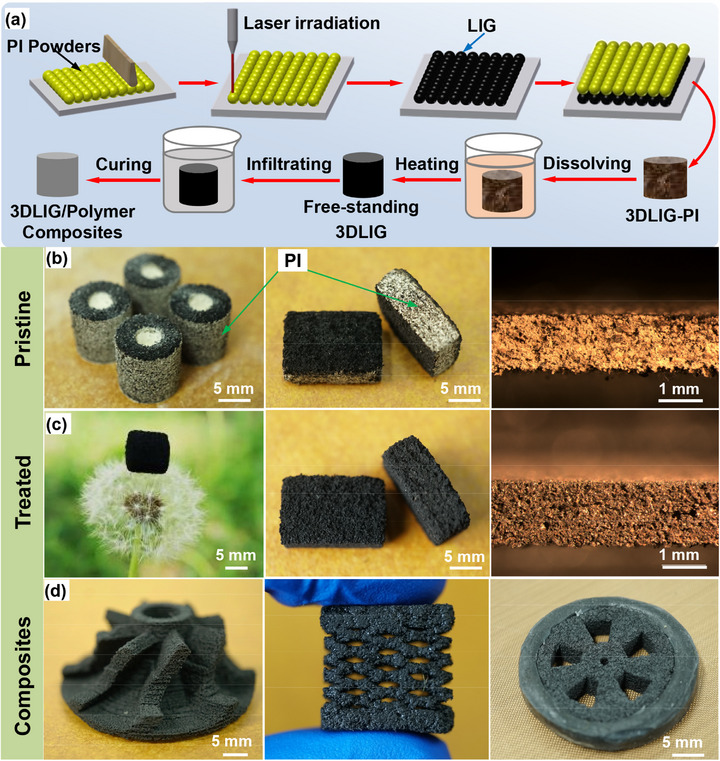 Figure 7
 Figure 8
Peer Reviews
No public reviews on file for this paper yet. If you reviewed it on a platform where reviews are public (OpenReview, ICLR, NeurIPS, ICML), you can paste yours below so the community can read it here.
Videos
No videos yet. Explain this paper in a talk, walkthrough, or lecture? Add one.
Taxonomy
TopicsGraphene research and applications · Graphene and Nanomaterials Applications · Supercapacitor Materials and Fabrication