SURF: A Self‐Supervised Deep Learning Method for Reference‐Free Deconvolution in Spatial Transcriptomics
Shuyu Liang, Zixia Zhou, Peng Huang, Junhu Fu, Jing Jiao, Yunxia Huang, Shichong Zhou, Guanlin Wang, Yuanyuan Wang, Yi Guo

TL;DR
SURF is a new deep learning tool that improves analysis of spatial transcriptomics data without needing cell-level references.
Contribution
SURF introduces a self-supervised deep learning method for reference-free deconvolution in spatial transcriptomics.
Findings
SURF outperforms existing reference-free methods and matches or exceeds reference-based approaches when references are unavailable.
SURF accurately identifies epithelial-to-mesenchymal transition states in tumor regions of human colorectal liver metastasis datasets.
The method is robust across different resolutions, species, spatial patterns, and tissue states.
Abstract
Spatial transcriptomics has revolutionized tissue biology by enabling spatially resolved gene expression profiling. Nonetheless, current spot‐level spatial transcriptomic technologies consolidate signals from multiple cells, complicating cellular‐level analysis. Moreover, matched single‐cell references required by reference‐based deconvolution methods are frequently unavailable. To overcome these limitations, we present SURF, a reference‐free deconvolution tool that integrates high‐dimensional gene data analysis with self‐supervised deep learning to effectively model nonlinear gene interactions and leverage spot relationships. Benchmarking on both synthetic and real datasets shows that SURF consistently outperforms existing reference‐free methods and exceeds reference‐based approaches when appropriate references are absent. Applications across datasets with varying resolutions, species,…
Genes, proteins, chemicals, diseases, species, mutations and cell lines named across the full text — each resolved to its canonical identifier and authoritative record.
Click any figure to enlarge with its caption.
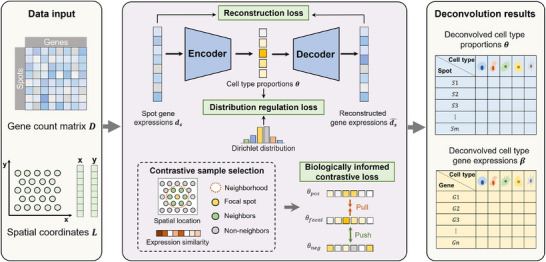 Figure 1
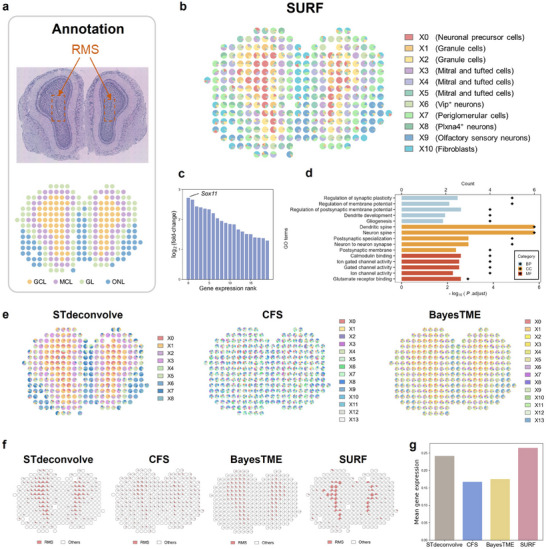 Figure 2
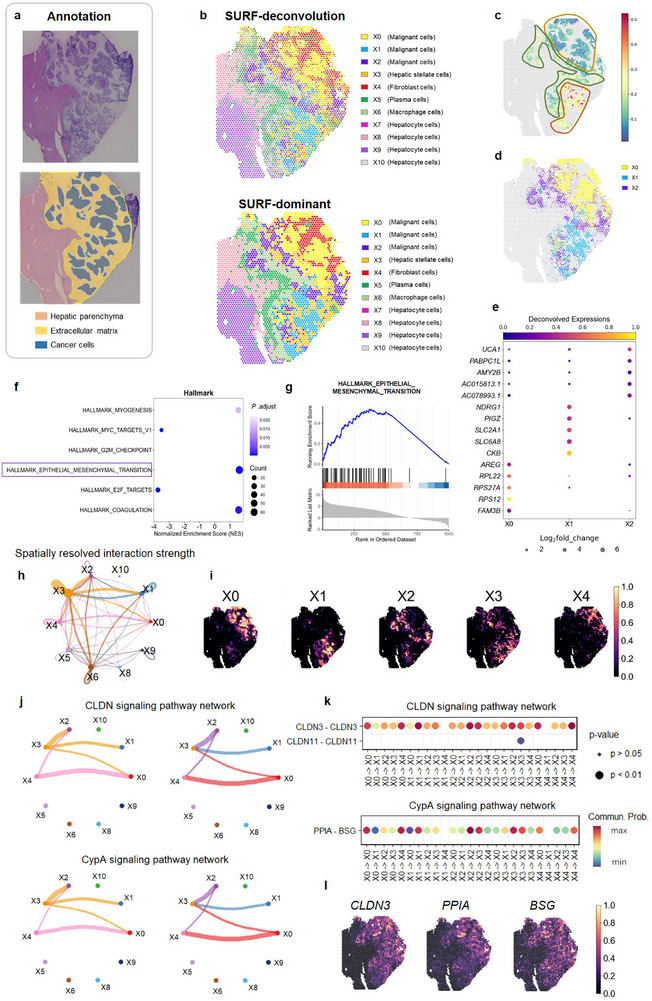 Figure 3
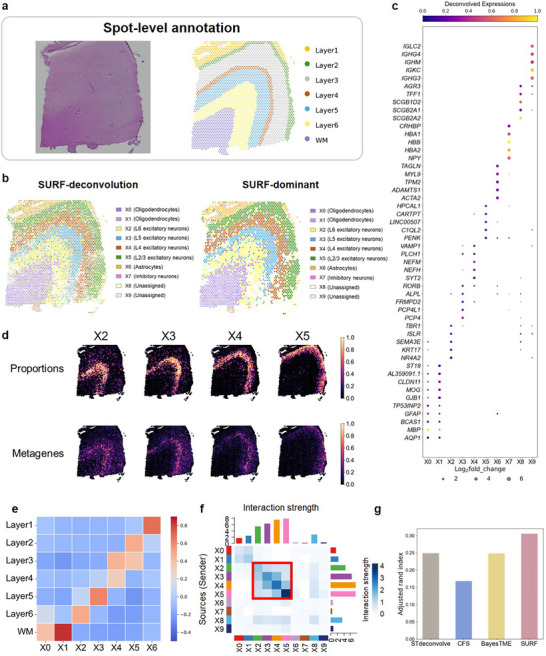 Figure 4
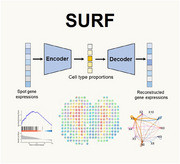 Figure 5
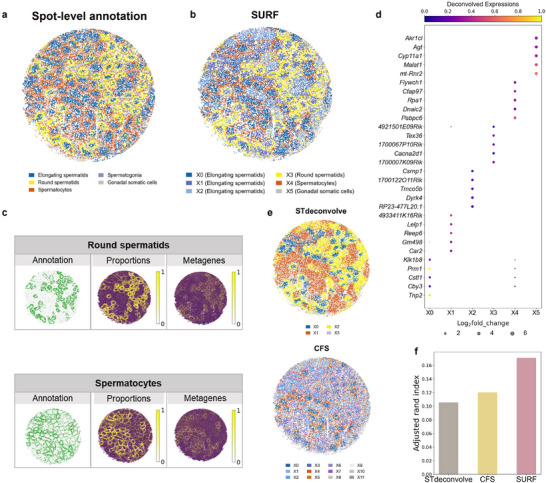 Figure 6
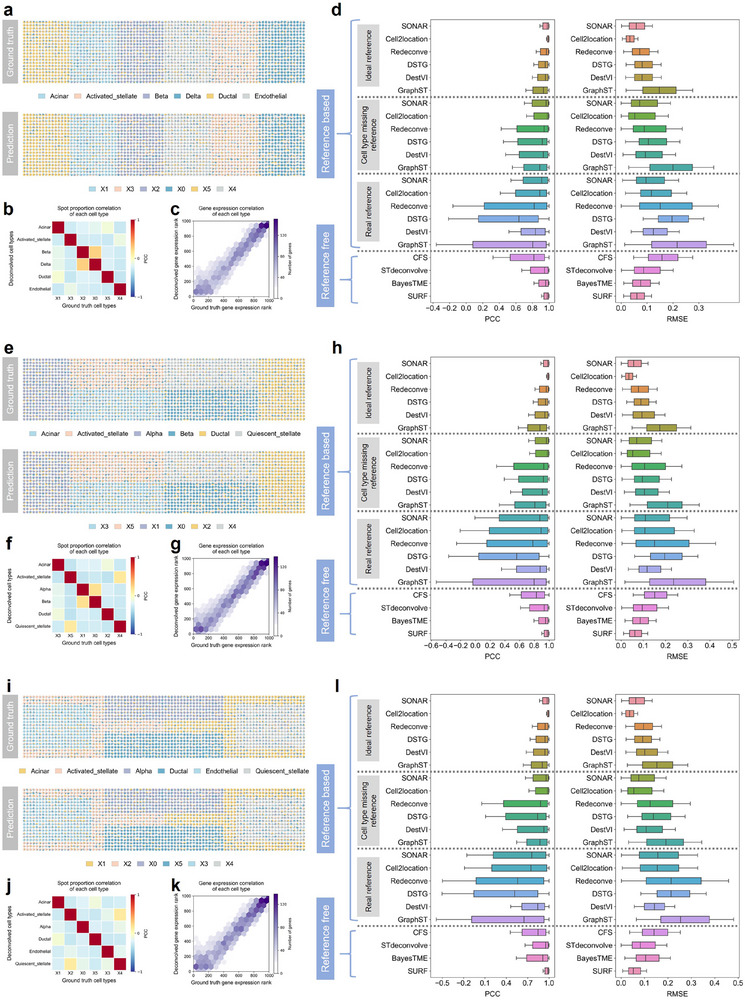 Figure 7
Peer Reviews
No public reviews on file for this paper yet. If you reviewed it on a platform where reviews are public (OpenReview, ICLR, NeurIPS, ICML), you can paste yours below so the community can read it here.
Videos
No videos yet. Explain this paper in a talk, walkthrough, or lecture? Add one.
Taxonomy
TopicsSingle-cell and spatial transcriptomics · Cancer-related molecular mechanisms research · Gene expression and cancer classification