Hilbert-Huang Transform Embedded Self-Attention Neural Network for EEG-based major depressive disorder vs. healthy controls classification
Junxian Chen, Kaikun Tian, Yu Ye, Jiaming Liu

TL;DR
This paper introduces a new neural network model that uses EEG signals to accurately distinguish between people with major depressive disorder and healthy individuals.
Contribution
The novel integration of Hilbert-Huang Transform into a self-attention neural network improves time-frequency analysis for depression detection.
Findings
The proposed model achieved 98.78% accuracy in classifying MDD patients and healthy controls.
The model outperformed traditional methods with high sensitivity (99.23%) and specificity (98.27%).
The method enhances nonlinear processing and captures critical temporal-spectral patterns in EEG data.
Abstract
This paper proposes a novel approach for distinguishing Major Depressive Disorder (MDD) patients from healthy controls (HC), namely depression screening, using EEG signals, where the Hilbert-Huang Transform (HHT) is integrated into a Self-Attention neural network (HHT-SANN). The incorporation of the HHT enhances the model’s time-frequency analysis capabilities and allows for more effective nonlinear processing of the EEG data. By embedding the HHT within the self-attention module, the model captures intricate temporal and spectral patterns that are critical for accurate depression classification. We evaluated our method on a clinical EEG dataset comprising 34 MDD patients and 30 healthy controls from the Hospital of Universiti Sains Malaysia. Experimental results indicate that the proposed method achieves an accuracy of 98.78%, sensitivity of 99.23%, and specificity of 98.27%,…
Genes, proteins, chemicals, diseases, species, mutations and cell lines named across the full text — each resolved to its canonical identifier and authoritative record.
Click any figure to enlarge with its caption.
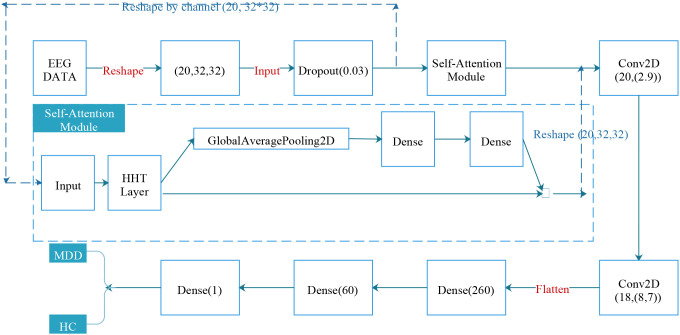 Figure 1
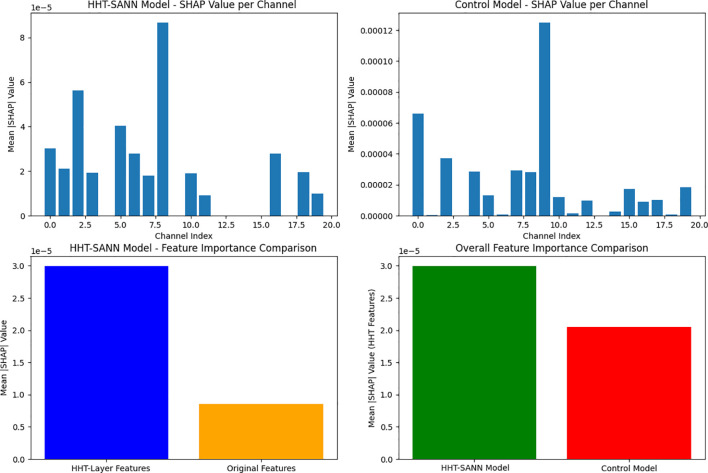 Figure 2
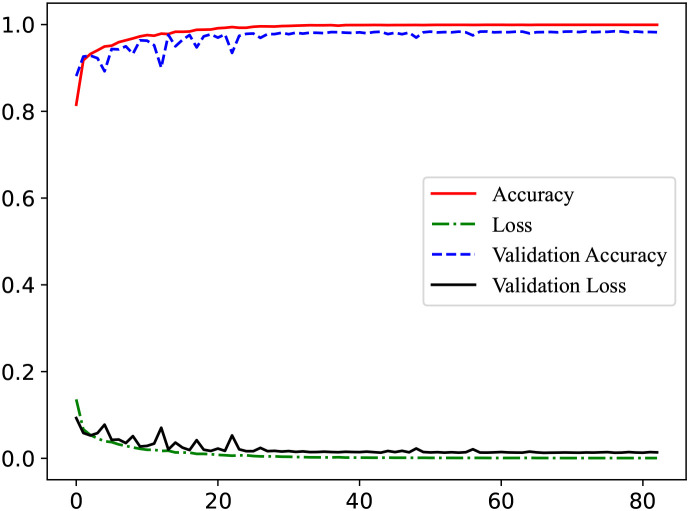 Figure 3
Peer Reviews
No public reviews on file for this paper yet. If you reviewed it on a platform where reviews are public (OpenReview, ICLR, NeurIPS, ICML), you can paste yours below so the community can read it here.
Videos
No videos yet. Explain this paper in a talk, walkthrough, or lecture? Add one.
Taxonomy
TopicsEEG and Brain-Computer Interfaces · Emotion and Mood Recognition · Digital Mental Health Interventions