Molecular Mechanisms of Gas–Ice Interfacial Transport: Size- and Charge-Dependent Fractionation during Bubble Close-off
Yoo Soo Yi, Yeongcheol Han

TL;DR
This study explores how gases move through ice, revealing that both size and charge affect how gases are trapped or escape during bubble close-off in glaciers.
Contribution
The paper introduces a molecular-level understanding of gas-ice interactions using DFT calculations, highlighting the role of charge distribution and chemical hardness.
Findings
Noble gases follow a size-dependent trend in permeation, while molecular gases show deviations due to anisotropic charge distribution.
He and Ne are rapidly depleted from closed-off bubbles due to smaller size and weaker adsorption.
Chemical hardness explains fractionation patterns, showing that interfacial interactions, not just size, govern transport.
Abstract
Gas–ice interfacial transport phenomena are essential across diverse cryogenic environments, ranging from gas fractionation in polar glaciers to the preservation of cosmogenic noble gases on icy celestial bodies. Bubble close-off in polar glaciers is a compelling example of the complex gas–ice interactions that challenge the interpretation of paleoclimate records preserved in ice cores. While previous studies have provided valuable insights, the molecular mechanisms governing fractionation, especially those involving both geometric and electronic characteristics, remain incompletely understood. Here, using density functional theory (DFT) calculations, we determine effective permeation energy barriers (E P) for noble gases (He, Ne, Ar, Kr, and Xe) and molecular gases (N2, O2, and CO2) through a model ice layer. Our results reveal that noble gases largely follow a size-dependent trend,…
Genes, proteins, chemicals, diseases, species, mutations and cell lines named across the full text — each resolved to its canonical identifier and authoritative record.
Click any figure to enlarge with its caption.
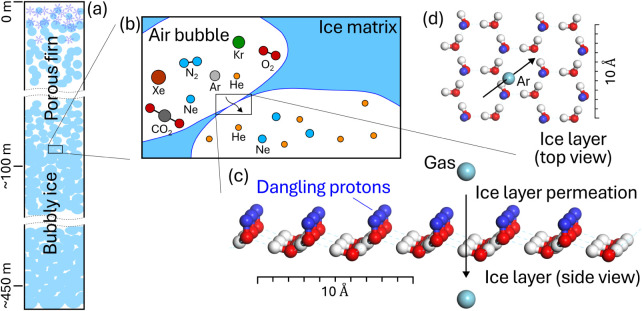 Figure 1
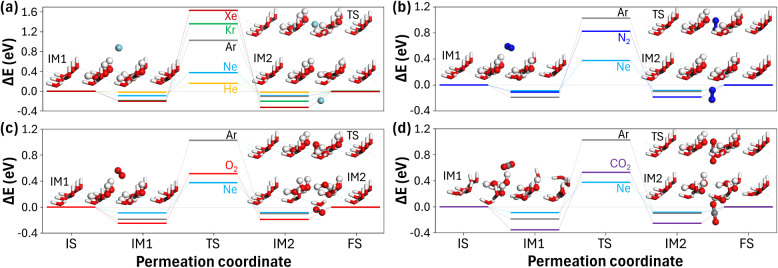 Figure 2
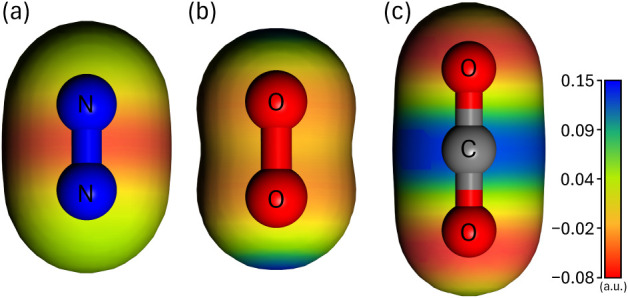 Figure 3
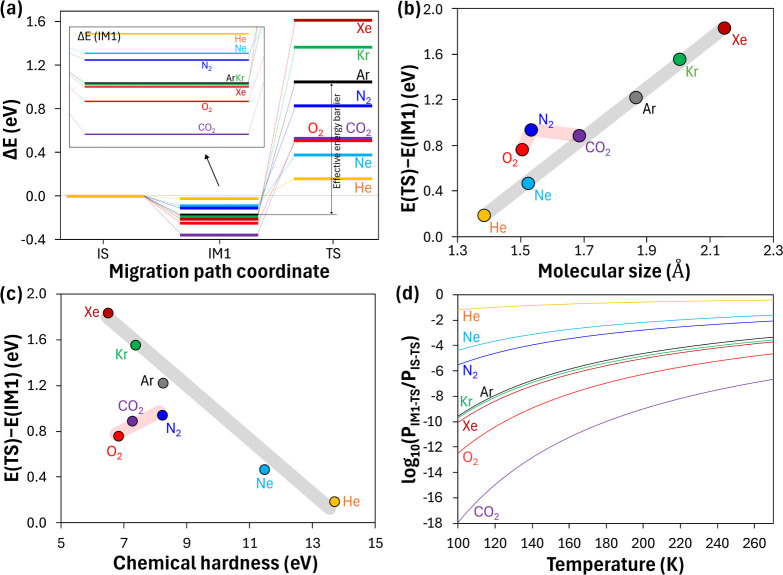 Figure 4
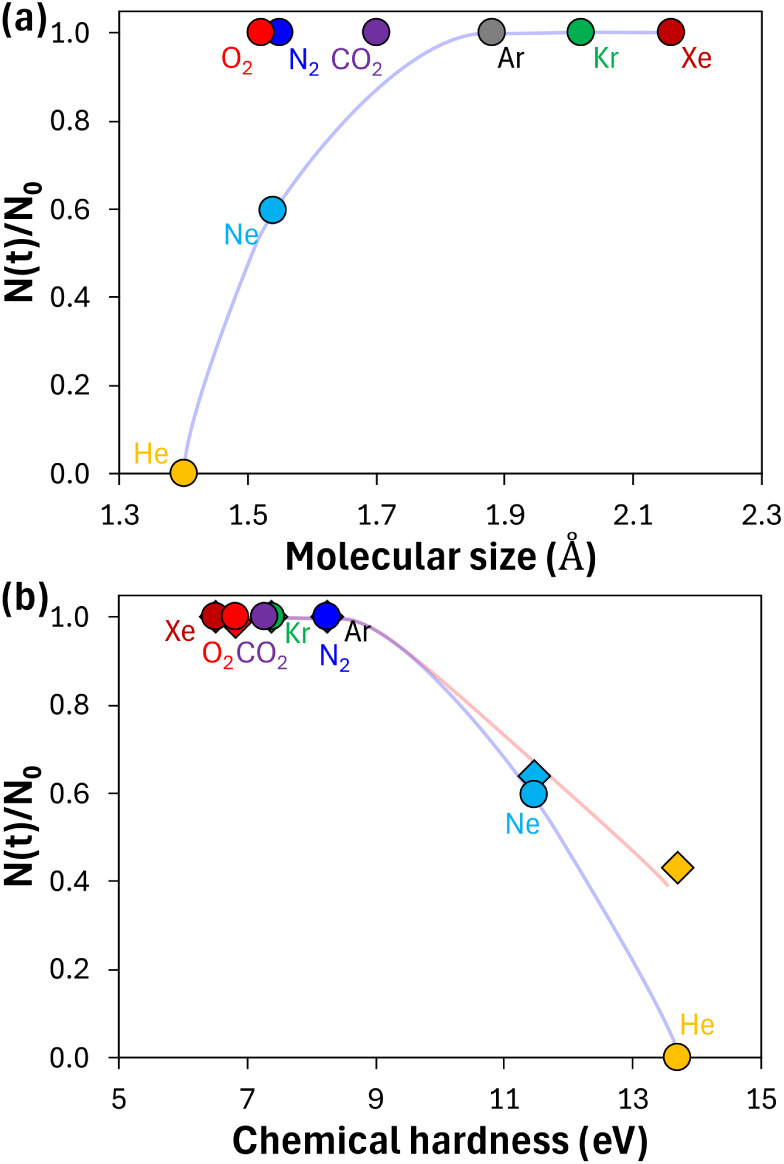 Figure 5
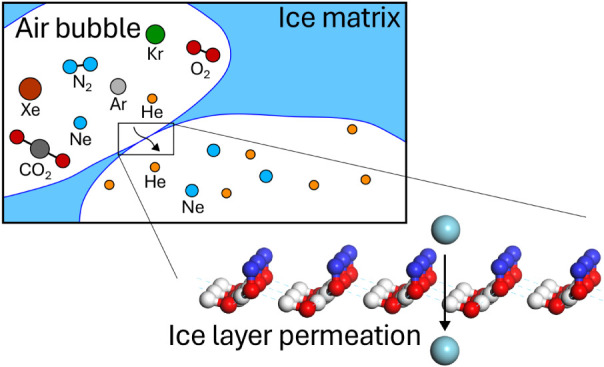 Figure 6
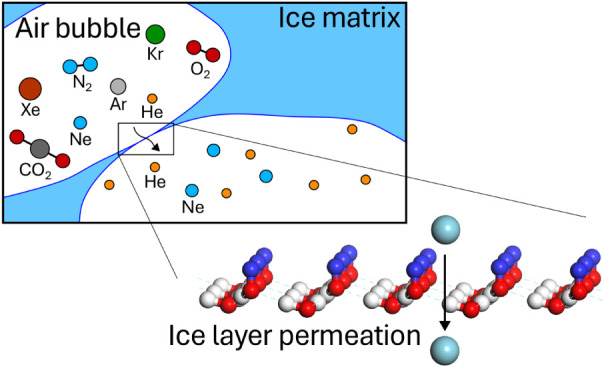 Figure 7
Peer Reviews
No public reviews on file for this paper yet. If you reviewed it on a platform where reviews are public (OpenReview, ICLR, NeurIPS, ICML), you can paste yours below so the community can read it here.
Videos
No videos yet. Explain this paper in a talk, walkthrough, or lecture? Add one.
Taxonomy
TopicsPolar Research and Ecology · Cryospheric studies and observations · Climate change and permafrost