Interleukin-6 levels and their haplotypes are associated with serological autoantibodies status and clinical activity in rheumatoid arthritis
Ma. Natividad Flores-Castro, Ramcés Falfán-Valencia, Olivia Briceño, Ilse Adriana Gutiérrez-Pérez, Oscar Zaragoza-García, Gloria Pérez-Rubio, Cristina Morales-Martínez, Iris Paola Guzmán-Guzmán

TL;DR
This study shows that specific genetic variations in the IL-6 gene are linked to autoantibody status and disease severity in Mexican patients with rheumatoid arthritis.
Contribution
The study identifies a novel association between the GGG IL-6 haplotype and double-positive autoantibody status in rheumatoid arthritis patients.
Findings
The GGG haplotype of IL-6 is associated with double-positive autoantibody status in rheumatoid arthritis patients.
High IL-6 levels correlate with severe clinical features like morning stiffness and elevated inflammatory markers.
Polymorphisms and haplotypes were not linked to IL-6 serum levels but influenced disease severity markers.
Abstract
Interleukin-6 (IL-6) plays an important role in the pathogenesis, progression, and severity of rheumatoid arthritis (RA). High levels of IL-6 are involved in the maintenance of inflammation in the synovium and the development of new blood vessels in the inflamed synovium, contributing to pannus formation. In the present study, we aimed to investigate the relationship of IL-6 polymorphisms/ haplotypes with RA in Mexican patients and on circulating levels of IL-6 and the clinical features of the disease. A total of 225 patients with RA and 362 healthy controls were recruited. Patients’ clinical features were collected, and inflammatory and serological parameters [anti-cyclic citrullinated peptides (anti-CCPs) and rheumatoid factor (RF)] were assessed. All subjects were genotyped for IL-6 polymorphisms (rs1800797, rs1800796, and rs1818879) using real-time polymerase chain reaction (PCR)…
Genes, proteins, chemicals, diseases, species, mutations and cell lines named across the full text — each resolved to its canonical identifier and authoritative record.
Click any figure to enlarge with its caption.
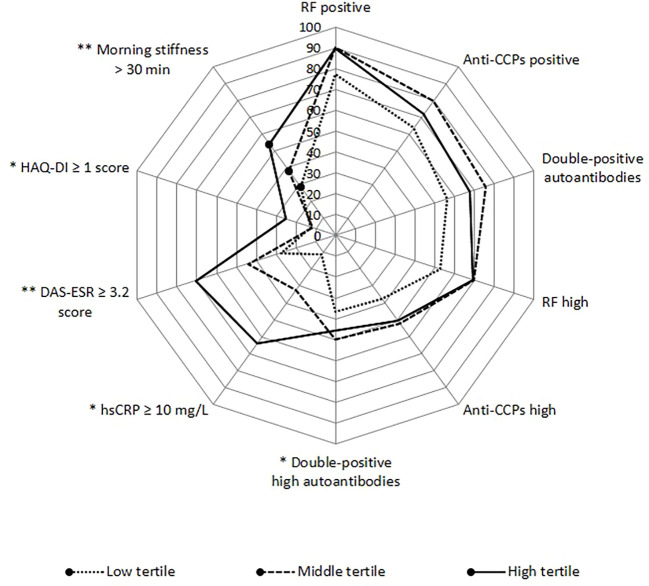 Figure 1
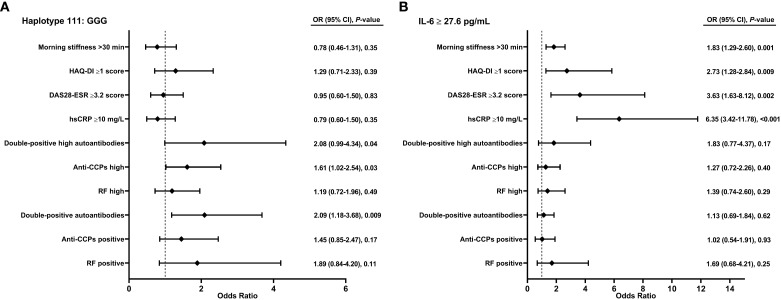 Figure 2
Peer Reviews
No public reviews on file for this paper yet. If you reviewed it on a platform where reviews are public (OpenReview, ICLR, NeurIPS, ICML), you can paste yours below so the community can read it here.
Videos
No videos yet. Explain this paper in a talk, walkthrough, or lecture? Add one.
Taxonomy
TopicsRheumatoid Arthritis Research and Therapies · Systemic Lupus Erythematosus Research · Chemokine receptors and signaling