We-perspective on vision impairment: pathways between common dyadic coping and relationship satisfaction
Stephanie Alves, Katharina Weitkamp, Christina Breitenstein, Guy Bodenmann

TL;DR
This study explores how couples cope with vision impairment together and how this affects their relationship satisfaction.
Contribution
The study identifies we-ness, intimacy, and perceiving vision impairment as a shared challenge as potential mediators of relationship satisfaction.
Findings
Higher common dyadic coping is linked to greater intimacy and we-ness, which in turn increases relationship satisfaction.
Spouses' engagement in common coping leads to a perception of we-disease, which decreases their own relationship satisfaction.
Abstract
Common DC, how couples cope together with stress, may protect couples from relationship dissatisfaction in the context of vision impairment. However, the mechanisms through which common DC relate to couple satisfaction are underexplored. This study aimed to examine whether we-ness, intimacy, and perceiving vision impairment as a we-disease mediate the relationship between common dyadic coping (DC) and relationship satisfaction in the context of vision impairment. Ninety-nine individuals with visual impairment (IVI) and their spouses completed self-report questionnaires assessing DC, relationship satisfaction, intimacy, we-ness, and we-disease. An Actor-Partner Interdependence Mediation Model was performed. Results showed that (1) higher levels of common DC were associated with higher intimacy and we-ness which, consequently, were associated with higher relationship satisfaction in…
Genes, proteins, chemicals, diseases, species, mutations and cell lines named across the full text — each resolved to its canonical identifier and authoritative record.
Click any figure to enlarge with its caption.
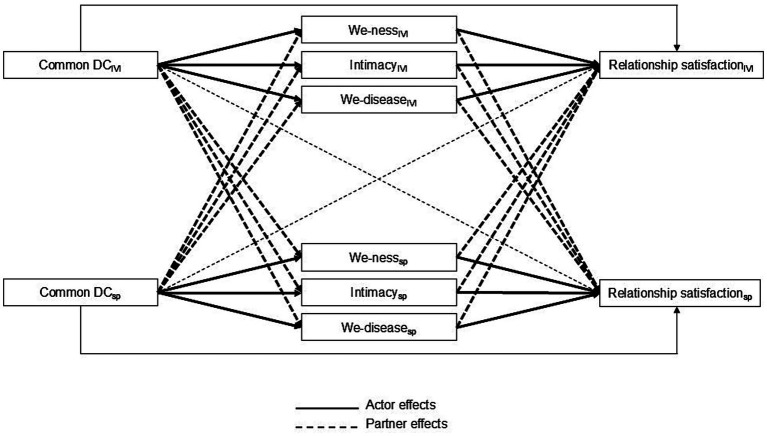 Figure 1
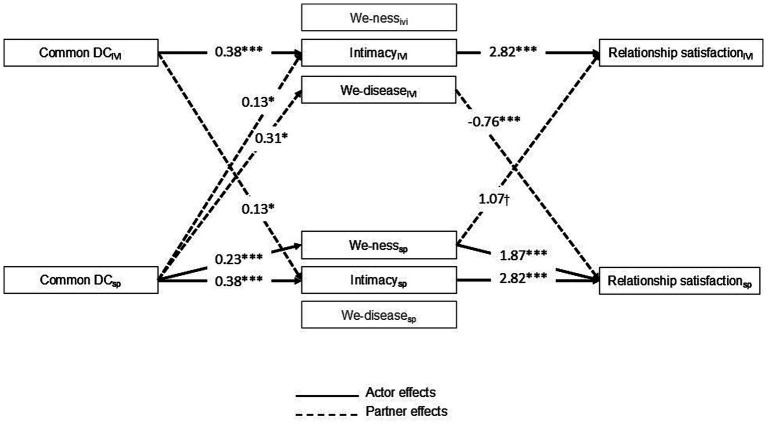 Figure 2
Peer Reviews
No public reviews on file for this paper yet. If you reviewed it on a platform where reviews are public (OpenReview, ICLR, NeurIPS, ICML), you can paste yours below so the community can read it here.
Videos
No videos yet. Explain this paper in a talk, walkthrough, or lecture? Add one.
Taxonomy
TopicsAttachment and Relationship Dynamics · Ophthalmology and Visual Impairment Studies · Intimate Partner and Family Violence